 Matribhumi Samachar English


New Delhi. Friday, 12 June 2026
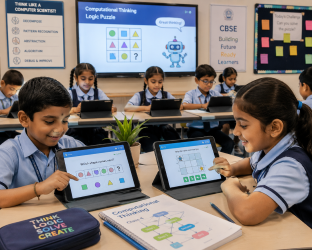
The landscape of Indian schooling is experiencing one of its most transformative updates yet. Beginning in the current 2026–27 academic session, the Central Board of Secondary Education (CBSE) has formally rolled out an integrated Computational Thinking (CT) and Artificial Intelligence (AI) curriculum for students from Classes 3 to 8.
Aligned strictly with the directives of the National Education Policy (NEP) 2020, this far-sighted initiative aims to fundamentally shift how children interact with technology. Instead of remaining passive digital consumers, young learners are being nurtured to become the creative tech leaders of tomorrow.
Step-by-Step Breakdown: What Students Are Learning
The new framework ensures that children are introduced to complex concepts progressively, keeping cognitive load and age-appropriateness in mind.
| Grade Bracket | Focus Areas | Key Pedagogical Approach |
|
Classes 3 to 5 (Primary Level) |
Computational Thinking Foundation | Stress-free learning via gamified puzzles, pattern recognition, and building basic logic paths—completely free from formal exam pressure. |
|
Classes 6 to 8 (Middle School Level) |
AI Foundations & Literacy | Basic coding structures, data handling, and analyzing real-world applications of smart tech across sectors like healthcare and agriculture. |
Real-World Analysis: Why This Early Exposure Matters
By introducing logic architectures before high school, education policymakers are building the precise mental frameworks required for modern enterprise. According to an industry overview on The Ultimate 2026 Guide to AI Career Opportunities in India, India’s domestic tech infrastructure is rapidly shifting toward highly localized data hubs and agentic workflows.
While students won’t be building production-level software in the 5th grade, understanding how data trains an algorithm helps demystify the background mechanics of automation. This early exposure directly feeds the problem-solving logic and algorithmic thinking needed for downstream fields like Data Science, MLOps, and Machine Learning.
The Crucial Missing Link: Ethics & Responsible AI
A standout feature of the CBSE framework is that it explicitly decouples technology from just pure syntax. A significant portion of the middle-school curriculum targets the human side of software engineering, including:
-
Algorithmic Bias: Understanding how a data model can absorb human prejudices.
-
Data Privacy: Teaching young minds the value of user consent and digital footprints.
-
Responsible Digital Citizenship: Curbing misinformation and treating computing spaces safely.
The Implementation Reality
While the initiative looks brilliant on paper, real-world execution requires addressing structural friction points. The true test relies entirely on Teacher Empowerment. Recognizing that many existing computer science educators may not have standard AI backgrounds, CBSE has launched extensive regional workshops and capacity-building boot camps.
Equipping teachers with standardized activity guides and plug-and-play classroom resources is a necessary protective measure to make sure the program succeeds evenly, preventing a digital divide between tier-1 urban schools and rural institutions.
Ultimately, this curriculum change moves the Indian classroom away from traditional “by-heart” memorization and plants the seeds for computational creativity—ensuring the next generation can navigate and dominate a technology-driven global economy.