

Mumbai. Saturday, 13 June 2026
Taking a public company private in India has historically been viewed as an arduous uphill battle. Promoters often faced complex procedural structures, long drawn-out timelines, and highly volatile pricing mechanisms that caused many well-intentioned delisting plans to fall flat.
However, following landmark amendments introduced under the SEBI (Delisting of Equity Shares) Regulations and the ongoing continuous reviews highlighted by the market regulator, India is actively rewriting its capital market exit strategies. The overarching goal is clear: to establish an equitable balance between giving corporate promoters a smooth exit route and ensuring robust protection for minority public shareholders.
The Big Shift: Introduction of the Fixed-Price Delisting Option
For decades, the standard Reverse Book Building (RBB) process stood as the mandatory gatekeeper for corporate exits. In an RBB mechanism, public shareholders submit dynamic bids indicating the price at which they are willing to part with their shares. While ideal in theory for true market price discovery, it frequently allowed speculative bidding syndicates to drive discovered prices to exorbitant, unviable premiums—sometimes more than double the floor price—forcing promoters to abandon the transaction entirely.
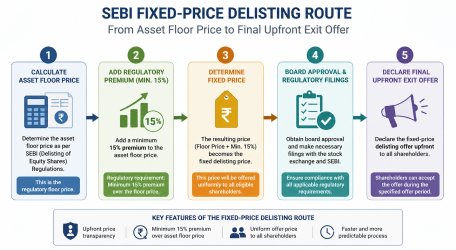
To solve this operational bottleneck, SEBI formally integrated a game-changing alternative: the Fixed-Price Delisting Route.
[Floor Price Calculation] ➔ [Add Minimum 15% Premium] ➔ [Declare Upfront Fixed Price]
Under this new fixed-price pathway, promoters whose shares are frequently traded can announce a deterministic price upfront right at the initial public announcement stage. This fixed price must sit at a minimum 15% premium over the regulatory floor price.
Why This Matters:
For Promoters: It provides precise fund-quantification clarity ahead of time, entirely eliminating midnight surprises or speculative bidding ambushes.
For Investors: It eliminates pricing ambiguity, allowing public investors to make a straightforward binary choice: to tender or not to tender their shares at the declared premium.
Tightening the Safeguards: “Adjusted Book Value” & Refined Thresholds
Making corporate exits easier does not mean minor investors lose out. In fact, SEBI has implemented stricter valuation checks and counter-offer rules to level the playing field.
1. The Adjusted Book Value Floor Price
To prevent opportunistic promoters from taking advantage of artificially suppressed historical stock averages, SEBI expanded the floor price criteria. The floor price must now include an Adjusted Book Value parameter calculated by an independent registered valuer. This metric directly evaluates the actual consolidated fair market value of the company’s physical, financial, and underlying subsidiary assets, ensuring the fundamental worth of the enterprise is fully respected.
2. A More Practical Counter-Offer Trigger
If a company still opts for the traditional Reverse Book Building route and the discovered price lands higher than expected, promoters can make a counter-offer. Previously, this was only allowed if the promoter managed to secure a massive 90% post-offer shareholding threshold. To prevent near-successful exits from breaking down completely, SEBI lowered this trigger requirement to 75% (provided at least 50% of the public shares were successfully tendered).
3. Streamlined Track for Investment Holding Companies (IHCs)
Recognizing that Investment Holding Companies possess distinct holding values, SEBI created a dedicated template allowing them to delist directly through a National Company Law Tribunal (NCLT) approved scheme of arrangement. Rather than handling massive cash payouts, the IHC can simply distribute the underlying shares of its listed subsidiaries pro-rata directly to its public shareholders.
Dual Mechanism Comparison: RBB vs. Fixed Price Route
| Feature Metric | Reverse Book Building (RBB) | Fixed-Price Offer |
| Price Determination | Dynamically driven via public shareholder bids. | Predetermined and announced upfront by the acquirer. |
| Minimum Mandated Price | Must equal or exceed the calculated Floor Price. | Must be at least a 15% premium over the Floor Price. |
| Success Condition | Cumulative promoter shareholding must touch 90% at the discovered price. | Cumulative promoter shareholding must touch 90% at the fixed price. |
| Counter-Offer Option | Available if post-offer holdings touch 75%. | Not available under the fixed-price track. |
| Stock Eligibility | Open to all listed corporations. | Restricted exclusively to frequently traded shares. |
Striking a Healthy Balance for India’s Capital Markets
These changes are a core component of India’s broader economic push to modernize market infrastructure—ranking alongside transitions to faster trade settlements and simplified NRI onboarding procedures.
By providing public companies with distinct choices tailored to their specific market conditions, the regulator is establishing a balanced financial ecosystem. Businesses can freely enter public markets to raise capital during growth phases, yet retain the flexibility to transition smoothly back to private ownership when long-term restructuring demands operational freedom away from constant public market scrutiny.
Helpful External Resources
To follow regional updates, financial press coverage, or policy announcements relating to regulatory changes in India, you can check structural publications on current affairs via Matribhumi Samachar English.
