

Mumbai. Saturday, 13 June 2026
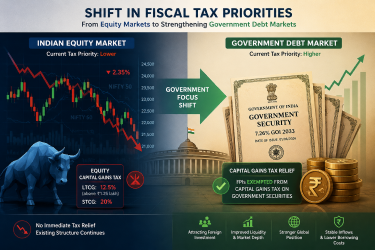
Economic policy signals emanating from New Delhi indicate a deliberate, strategic shift in how the Indian government plans to restructure its capital gains tax framework. For investors anticipating broad-based tax cuts across the board, the latest developments offer a clear reality check: future tax reforms are heavily skewed toward strengthening the country’s debt and bond markets rather than offering immediate fiscal relief to equity investors.
As policymakers aggressively position India to capture long-term foreign institutional capital and deepen domestic financial markets, this targeted approach reveals the government’s underlying macroeconomic priorities.
🏛️ The Great Shift: Why the Bond Market is the Priority
In recent months, India has taken decisive steps to elevate the attractiveness of its sovereign debt. The most notable move has been exempting Foreign Portfolio Investors (FPIs) from capital gains tax on investments in government securities (G-Secs).
This is not a random administrative tweak; it is a calculated tool intended to serve several critical economic functions:
Global Index Integration: Deepening India’s footprint in global bond indices by removing tax friction for international funds.
Lowering Borrowing Costs: As foreign demand for Indian sovereign bonds rises, bond yields naturally ease, directly reducing the government’s cost of borrowing for massive infrastructure developments.
Sovereign Stability: Cultivating a diverse, long-term institutional investor base aids in maintaining stable capital inflows, which buffers the Indian Rupee against global currency volatility.
Economic policymakers have increasingly stressed that tax interventions in the debt market yield far higher macroeconomic dividends—via structural liquidity and infrastructure funding—than tinkering with an already booming stock market.
📉 Equities: The Case for Policy Stability
While market speculation frequently peaks ahead of budget announcements regarding potential cuts to Long-Term Capital Gains (LTCG) or Short-Term Capital Gains (STCG) taxes on stocks, official rhetoric remains conservative.
Policymakers have clarified that modifying equity capital gains taxation is not currently a priority. From the government’s vantage point, the Indian equity market possesses sufficient standalone momentum and maturity. Instead of tax relief, the state is offering equity investors predictability and structural stability. Keeping the existing equity tax framework intact ensures that long-term market participants can plan their asset allocations without the fear of sudden regulatory turbulence.
📊 Side-by-Side: Impact Across Asset Classes
The strategic focus creates a divergent landscape for market participants. The table below outlines how these policy signals filter down to different investor profiles.
| Investor Segment | Near-Term Outlook | Core Takeaway |
| Bond & Debt Investors | 🚀 Highly Favorable | FPI exemptions will drive trading volumes, boost market liquidity, and likely trigger a gradual softening of yields. |
| Equity Investors | ⚖️ Neutral & Stable | Immediate relief on capital gains tax is unlikely. However, a static tax regime ensures long-term policy predictability. |
🔮 What Lies Ahead: Road Map for Future Reforms
Though immediate standalone relief for equities is off the table, the government hasn’t ruled out structural modernization. When broader capital gains tax reforms do materialize, they are expected to focus on systemic cleanups rather than populist market-boosting measures. Market participants should look out for:
Simplification of Rules: Streamlining the complex web of holding periods and tax rates that currently differ vastly across equity, debt, and real estate.
Rationalizing Gaps: Re-evaluating the tax treatment disparity between debt instruments and equity investments to create a more balanced financial ecosystem.
Incentivizing Patient Capital: Potential adjustments to exemption thresholds specifically targeting long-term, committed investors who support core economic growth.
As India balances revenue generation with capital market evolution, all eyes will remain on upcoming Union Budgets and financial policy reviews for the exact timelines of these structural shifts.
Note on Source Links: For localized updates, breaking financial news, and regional economic analysis on Indian market policies, explore the latest English dispatches on Matribhumi Samachar.
