 Matribhumi Samachar English


Mumbai. Sunday. 14 June 2026
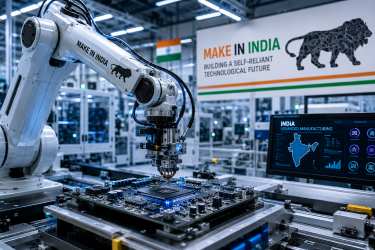
The “Make in India” initiative is undergoing a massive evolutionary upgrade. What started as an ambitious policy blueprint to boost baseline factory production volumes has rapidly matured into a high-octane shift toward innovation-driven, deep-tech advanced manufacturing.
By blending industrial automation, artificial intelligence (AI), industrial robotics, Internet of Things (IoT), and digital twins, India is establishing itself as an indispensable anchor in global high-tech supply chains. Let’s dive into how this transformation is unfolding across the country’s most critical strategic sectors.
🏗️ The Semiconductor Leap: Moving from Blueprints to Active Production
For decades, an uncorrected narrative dominated the global tech space: India possesses the world’s most robust microchip engineering workforce, yet it owns zero proprietary intellectual property (IP).
The rollout of the India Semiconductor Mission (ISM) 2.0 and the Ministry of Electronics and Information Technology’s (MeitY) Design-Linked Incentive (DLI) scheme have fundamentally rewritten that story. The domestic semiconductor landscape has officially shifted from policy proposals directly onto the active factory floor.
Fact Check
The Misconception: Many believe that India’s new semiconductor milestones mean the country is already fully printing advanced commercial chips end-to-end locally.
The Reality: India is executing a precise, multi-tiered hardware roadmap. While major multi-billion dollar mega-fabs (like the Tata Electronics-PSMC facility in Dholera, Gujarat) target future capacities of 50,000 wafer starts per month, current operations are actively scaling through Phase 3 (ATMP & OSAT processing).
Commercial packaging and testing facilities operated by early market movers like Micron Technology in Sanand, Gujarat, and Kaynes Semicon have completed construction and entered active commercial production. Furthermore, regional diversification is booming, with heavy capital flowing into Tata’s ₹27,000 crore OSAT unit in Jagiroad, Morigaon (Assam), designed to process up to 48 million chips per day, alongside new deep-tech developments in Odisha and Uttar Pradesh.
Indigenous Chip Design Breakthrough
On the upstream design front, localized startups are successfully breaking the mold. Kerala-based fabless semiconductor startup Netrasemi recently completed the post-silicon bring-up validation for its flagship AI system-on-chip (SoC), the A2000.
Engineered on a highly efficient 12-nanometer (12nm) process node, this processor is purpose-built for Edge AI applications, allowing drones, smart cameras, and medical equipment to process complex datasets natively without relying on heavy cloud latency. To discover more about how this specific deep-tech milestone reshapes India’s hardware pipeline, read the complete coverage on From Blueprints to Silicon: How Netrasemi’s 12nm A2000 Chip Rewrites India’s Semiconductor Future.
✈️ Aerospace & Defense: Driving Strategic Autonomy
India’s defense corridors are experiencing unprecedented private-sector participation. The strategic vision has firmly pivoted away from transactional military hardware imports and toward absolute co-development and localized design authority.
The expanding aerospace supply chain is currently highlighted by the localization of complex structural military assets. Anchor projects—such as the Tata-Airbus C-295 tactical transport aircraft assembly lines—serve as a manufacturing blueprint, fast-tracking the country’s defense base to hit a target of 70% localization. Simultaneously, heavy industrial focus has moved toward deploying automated quality control for drone swarms, advanced counter-drone electronics, and quantum communication lines.
🤖 Smart Factories and the Industry 4.0 Ecosystem
Across the automotive, pharmaceutical, and engineering landscapes, manufacturers are rapidly transforming traditional assembly lines into fully realized smart factories.
[Real-Time IoT Sensors] ──> [AI Quality Control] ──> [Digital Twin Simulation]
By layering AI-powered automated inspection systems and digital twins over real physical hardware, factories can mirror production flows in real-time. This allows operations to:
-
Predict machine maintenance needs before a mechanical failure happens.
-
Stabilize wafer and component manufacturing margins against slight power grid or voltage fluctuations.
-
Accelerate physical prototyping speeds by up to 50%.
This structural modernization moves in absolute tandem with India’s exploding data center ecosystem. High-performance, hyperscale compute clusters utilizing specialized liquid-cooling architectures are being deployed locally to process the immense generative AI and industrial automation workloads running inside modern smart complexes. For a deep look into this sweeping hardware integration, check out the full report on Silicon Sovereign: How India’s Semiconductor Push is Flipping the Switch to Active Production.
📈 Economic and Strategic Impact at a Glance
The transition toward advanced manufacturing under Make in India has fundamentally altered the nation’s macroeconomic markers, shifting electronics to India’s 3rd largest export category.
| Key Metric | Past Status (Low-Tech Assembly) | Present Status & Target (Advanced Tech Hub) |
| Electronics Export Standing | Dependent on completely knocked-down (CKD) kits | 3rd largest export category; Smartphone exports hit ₹1 Lakh Cr in a 5-month stretch |
| Intellectual Property | Primarily back-office engineering services | Native IP ownership supported by the Design Linked Incentive (DLI) scheme |
| Geographic Manufacturing Footprint | Concentrated in traditional industrial hubs | Multi-state dispersal across Gujarat, Assam, Odisha, Uttar Pradesh, and Kerala |
With continuous policy injections like the Production Linked Incentive (PLI) schemes, the PM Gati Shakti Infrastructure Program, and the foundational ISM 2.0 framework, India’s industrial blueprint is successfully executing its transition. By securing raw component supply lines, investing heavily in specialty chemical engineering, and fostering indigenous deep-tech talent, the country is well on its way to cementing its position as a self-reliant, high-value global manufacturing powerhouse.