

New Delhi. Wednesday, 17 June 2026
The landscape of generative artificial intelligence is shifting from rapid text generation to hyper-realistic video creation. For years, this frontier has been dominated by highly centralized, expensive foreign platforms. However, India’s artificial intelligence ecosystem has taken a major leap forward with the introduction of Varya, an indigenous generative video AI model.
Developed by Bengaluru-based startup Avataar.ai under the aegis of the government’s landmark IndiaAI Mission, Varya is not just another video generator. It represents a massive step toward establishing true sovereign AI capabilities, built specifically to scale within India’s unique economic, linguistic, and cultural frameworks.
What Is Varya?
Varya is a high-quality, multimodal video generation model designed to seamlessly convert natural language text descriptions, images, and creative prompts into cinematic video clips.
While international tools require immense processing pipelines, Varya is optimized to generate short cinematic clips, instructional animations, social media campaigns, and marketing visuals instantly. It understands colloquial natural language prompts, allowing users to express ideas freely and receive visually coherent video outputs within seconds.
The Technical Breakthrough: Why Varya is a Game-Changer
Building an indigenous generative video AI model requires confronting the massive computational bottlenecks that plague global technologies. High-end video generation typically relies on complex diffusion frameworks that are incredibly slow and hardware-intensive. Varya completely bypasses this issue through two distinct architectural breakthroughs:
1. Model Distillation (4-Step Efficiency)
Standard base models (such as Alibaba’s open-weights model, Wan 2.2) require roughly 50 iterative, computational steps to filter out visual noise and render a single frame of clean video.
Varya utilizes a technical optimization known as model distillation. Avataar.ai compressed these hyper-complex capabilities into a leaner, hyper-efficient “student” model. Instead of 50 steps, Varya achieves the exact same structural consistency in just 4 steps.
Running on an enterprise NVIDIA H200 GPU, a stock model takes up to 1,230 seconds to deliver video text prompts. Varya crushes this, generating a 5-second, 720p HD video clip in 45 seconds flat.
2. Radical Cost Reduction
Because it eliminates nearly 90% of traditional rendering redundancies, Varya lowers the cost of video generation to a microscopic level:
₹0.48 (less than half a paisa) per second of generated video.
Compared to mainstream Western and East Asian alternatives—which typically cost creators anywhere from ₹8 to ₹10 per second—Varya is up to 10x more cost-efficient. This ultra-low price barrier opens up elite production capabilities to regional small businesses, educators, and indie filmmakers who were previously priced out of generative media.
Solving the Cultural and Linguistic Bias Problem
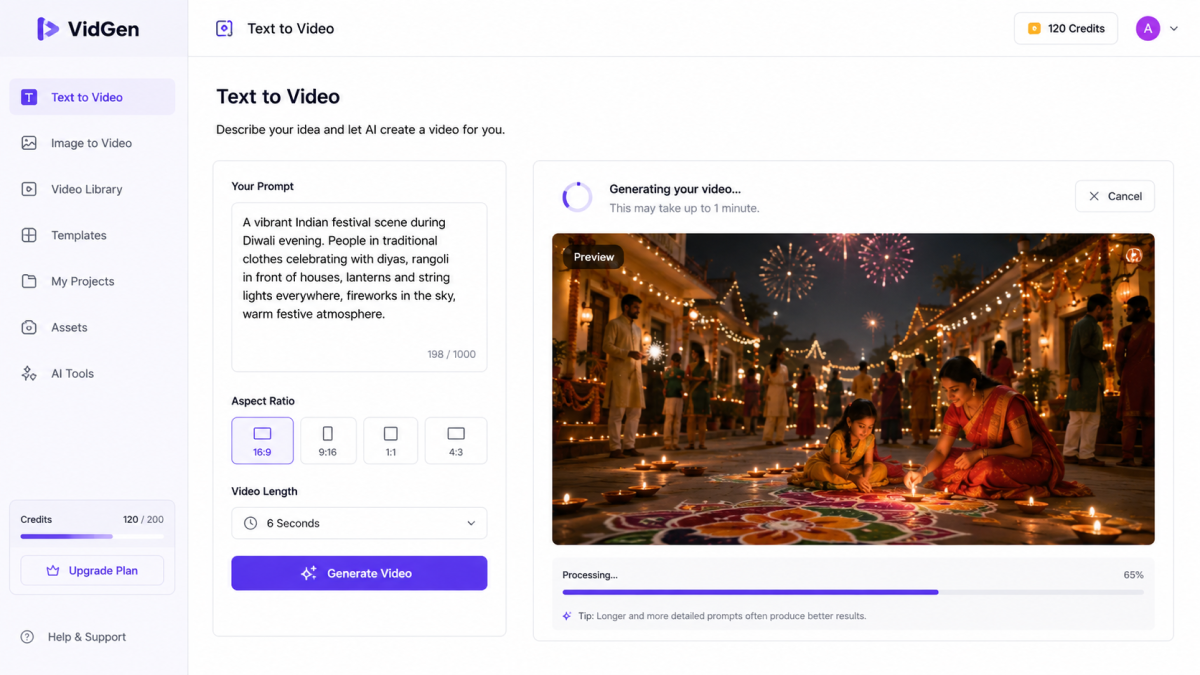
One of the largest hurdles for Indian creators using global AI platforms is systemic cultural hallucination. If a user asks a mainstream Western model to generate an image or video of an “authentic Indian wedding,” a “busy local market,” or traditional dishes like dosa or chole bhature, the model frequently outputs generic, westernized, or highly distorted caricatures.
Varya solves this by native design:
Localized Dataset Training: The model was trained extensively on a curated corpus of over 40,000 Indian cultural datasets.
Nuanced Visual Context: It understands regional festivals, distinct community clothing textures, localized architectural elements, and everyday public realities unique to the subcontinent.
Multilingual Linguistic Context: Built to blend seamlessly with India’s diverse linguistic fabric, Varya is architected to support natural language prompting across multiple Indian languages, including Hindi, Tamil, Bengali, Marathi, Telugu, Kannada, Malayalam, Gujarati, and Punjabi.
Empowering the Ecosystem: Open-Weight Architecture
Unlike closed corporate ecosystems that keep their technology locked behind expensive subscription firewalls, Varya is built to democratize tech infrastructure.
Aligned with the core values of the IndiaAI Mission, Varya is being launched as an open-weight model on the government’s central public repository, AI Kosh. This ensures that any homegrown developer, local startup, or academic researcher can download the core model weights, host it on their own servers, and fine-tune it for custom enterprise applications without paying ongoing technological rent to foreign platforms.
Potential Public and Private Sector Use Cases
| Sector | Practical Application | Impact |
| Media & Publishing | Generating visual explainers, data-driven backdrops, and video assets for breaking news. | Drastically speeds up digital journalism loops. |
| Education | Creating localized animated lessons, physics demonstrations, and historic reconstructions. | Makes immersive, interactive digital classrooms accessible. |
| MSMEs & Marketing | Rapid production of highly targeted social media ads, promotional reels, and brand assets. | Lowers marketing costs to nearly zero. |
| Digital Public Infrastructure | Multilingual government outreach videos, civic awareness announcements, and public utility guides. | Standardizes citizen services communication nationwide. |
Challenges on the Horizon
While the model represents an undeniable leap forward, scaling an indigenous generative video AI model across a subcontinent brings clear operational hurdles:
Misinformation and Deepfakes: As generation speeds increase, creating robust, cryptographic watermarking systems is vital to prevent malicious deepfake propagation.
Compute Constraints: Access to localized public GPU clusters must scale aggressively to support millions of concurrent creator pipelines.
Continuous Moderation: Developing strict guardrails to handle content moderation in alignment with diverse regional legal frameworks.
Frequently Asked Questions (FAQ)
What makes Varya different from global platforms like Sora or Runway?
Varya stands out due to its extreme cost efficiency and deep cultural accuracy. By using 4-step model distillation, it generates videos for a fraction of the cost (₹0.48/sec) and handles nuances in Indian environments, clothing, and languages much better than global alternatives.
Is Varya a public or private AI model?
Varya is built by Avataar.ai under the public framework of India’s National AI Mission. It is hosted as an open-weight model on the government’s AI Kosh repository, making its core architecture accessible to developers nationwide.
Which Indian languages can Varya understand?
The model is designed to process natural language prompts across several major regional languages, including Hindi, Tamil, Telugu, Bengali, Kannada, Marathi, and Malayalam, among others.
Disclaimer: The information provided in this article regarding Varya, its performance metrics, processing speeds, and infrastructure integration is accurate based on current developmental data released by the developers and the IndiaAI Mission frameworks. Actual computing time and costs may vary depending on local server configurations, optimization protocols, and specialized corporate API deployments.
For more regional news, updates on indigenous technologies, and cultural deep dives, explore our complete archival coverage on Matribhumi Samachar English.
