

Mumbai. Thursday, 18 June 2026
India’s startup ecosystem has officially entered a high-octane growth phase. In a bid to match the rapid evolution of advanced engineering and digital infrastructure, the Department for Promotion of Industry and Internal Trade (DPIIT) has introduced a sweeping set of revisions to the Startup India framework.
These revised rules are fundamentally designed to eliminate scaling bottlenecks, support intensive research and development (R&D), and solidify India’s stance as a dominant global hub for deep-tech, artificial intelligence, and strategic manufacturing. By expanding eligibility thresholds and recognizing the unique lifecycles of deep-tech ventures, the government is extending a vital safety net to thousands of domestic entrepreneurs.
1. The Core Policy Shifts: Turnover Thresholds Doubled
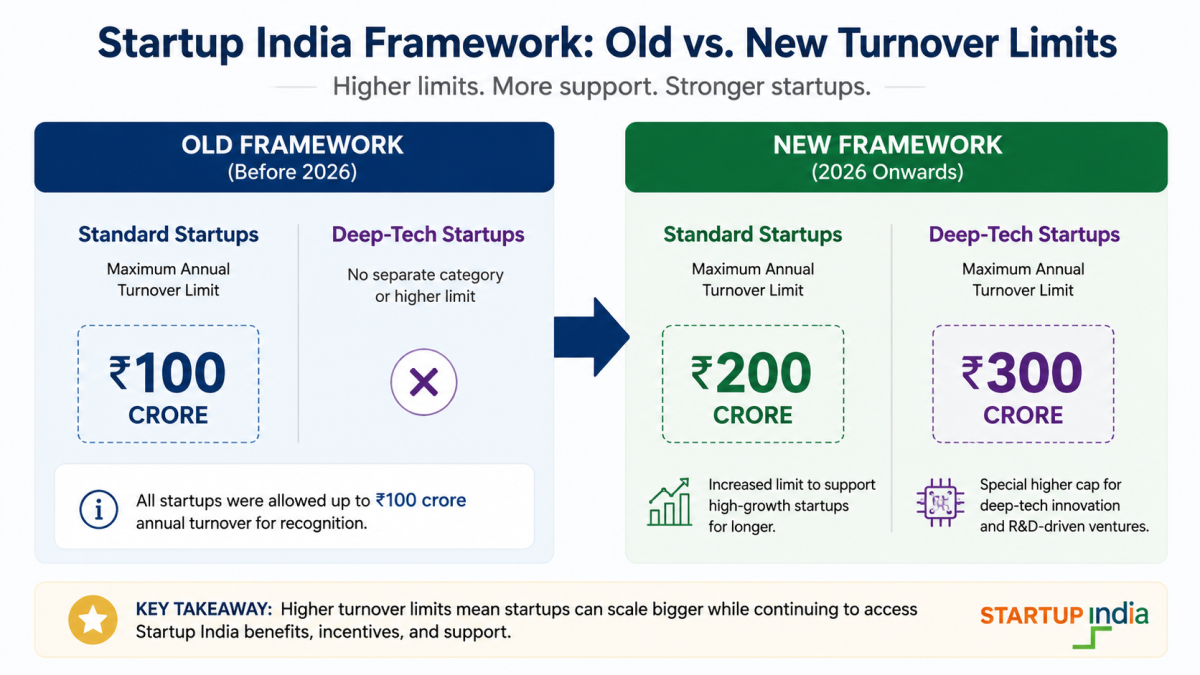
For years, fast-growing startups faced a structural hurdle: crossing the ₹100 crore annual turnover mark meant instantly losing access to critical government procurement programs, tax incentives, and compliance relaxations. The updated framework directly addresses this “scale penalty.”
Standard Turnover Limit Raised to ₹200 Crore: The baseline annual turnover threshold for general startup recognition has been raised from ₹100 crore to ₹200 crore. This gives consumer internet, fintech, and digital service companies double the room to scale operations without prematurely losing their startup status.
Extended 10-Year Runway: Standard startups will continue to enjoy a 10-year recognition window from their date of incorporation, ensuring long-term policy predictability.
2. A Historic First: Dedicated Focus on Deep-Tech Startups
In a major structural shift, the updated framework introduces a distinct, highly protected classification: the Deep-Tech Startup Category.
Deep-tech ventures—operating in sectors like quantum computing, aerospace, advanced materials, and robotics—do not fit the traditional software-as-a-service (SaaS) lifecycle. They require immense capital upfront, face intense post-silicon validation phases, and endure prolonged testing cycles before reaching commercialization.
To support these intensive R&D pipelines, the DPIIT has built a specialized regulatory pathway:
Higher Turnover Cap of ₹300 Crore
Recognizing that physical hardware and specialized equipment require significant capital generation, Deep-Tech startups can now reach an annual turnover of ₹300 crore while fully retaining their Startup India benefits.
Double the Recognition Lifespan (Up to 20 Years)
Instead of the standard 10 years, recognized Deep-Tech startups will enjoy an extended eligibility window of up to 20 years from incorporation. This extension acknowledges that bringing a semiconductor chip design or space launch vehicle from prototype to market can take over a decade of continuous lab-to-market translation.
Deep-Tech Synergies: This policy alignment moves in absolute tandem with major national hardware initiatives. To see how these extended timelines match active on-the-ground infrastructure, read about the specialized testing pipelines in Silicon Sovereignty: How IISc’s New Testing Lab Plugs the Critical Gap in India Semiconductor Mission 2.0.
3. Demarginalizing Innovation: The Inclusion of Cooperatives
In an effort to spread entrepreneurship opportunities outside traditional tier-1 technology hubs, the framework now formally includes multi-state and state-level cooperative societies.
By letting cooperative models qualify for official startup recognition, the policy provides a massive boost to community-driven enterprises, food processing units, and agritech innovations across rural India. This ensures that the next generation of supply-chain breakthroughs can originate from smaller towns and agricultural collectives rather than just corporate tech parks.
4. Summary of Benefits for DPIIT-Recognized Startups
Startups successfully verified under the revised framework continue to unlock a robust pipeline of operational and financial incentives:
Tax Incentives: Access to eligible corporate tax holiday provisions during the foundational growth years.
Government Procurement Advantages: Relaxed prior turnover and experience criteria, allowing early-stage companies to bid for high-value public sector tenders.
Intellectual Property Support: Subsidized legal fees and fast-tracked patent examinations to build defensible IP moats.
Self-Compliance & Compliance Relaxation: Simplified self-certification windows for environmental and labor regulations to reduce bureaucratic friction.
Capital & Network Access: Direct inclusion in state-led funding networks, venture capital programs, and global cross-border tech corridors.
5. Driving India’s Sovereign Innovation Index
The timing of these policy injections is highly deliberate. As global supply lines shift, India is moving away from being a mere tech back-office toward becoming a primary hardware and computing powerhouse.
The updated Startup India rules provide the financial and legal flexibility needed to support other foundational state-backed architectures. For instance, the expansion of deep-tech runways directly fuels entrepreneurs leveraging the massive compute capabilities provided under the national IndiaAI Mission and sovereign cloud infrastructures.
For a deep dive into how startups are capitalizing on these newly democratic public utilities, explore [The Sovereign AI Revolution: How India is Building Its Independent Digital Backbone](https://matribhumisamachar.com/en/2026/06/15/the-sovereign-ai-revolution-how-india-is-building- its-independent-digital-backbone/).
Furthermore, space-tech and satellite engineering platforms—which require substantial early-stage validation—are poised to benefit immensely from the 20-year deep-tech safety net. Discover how these regulatory shifts interact with private orbital networks in How IN-SPACe and Private Innovators are Propelling the India Space Tech Ecosystem to New Heights.
Frequently Asked Questions (FAQ)
1. What is the new turnover limit for standard startups under the Startup India framework?
The annual turnover threshold for standard startups has been increased to ₹200 crore. Previously, companies that crossed ₹100 crore were disqualified from receiving Startup India benefits.
2. How long can a Deep-Tech startup retain its official recognition?
Under the revised DPIIT guidelines, Deep-Tech startups are eligible for recognition for up to 20 years from their date of incorporation, doubling the standard 10-year limit.
3. Why did the government introduce a separate policy for deep-tech companies?
Deep-tech ventures (such as those in quantum computing, advanced materials, and semiconductors) involve deep scientific research, high capital requirements, and long commercialization timelines. The 20-year window and higher ₹300 crore turnover limit prevent these companies from prematurely losing critical scaling incentives.
4. Can cooperative societies apply for benefits under the updated framework?
Yes. The updated policy officially includes multi-state and state-level cooperative societies, allowing rural, community-driven, and agricultural enterprises to leverage startup benefits.
Alt Image Text for Content Creators:
Image 1:
Image 2: Clean infographical chart showing the 10-year standard startup lifecycle vs. the 20-year deep-tech R&D startup runway.
Disclaimer: This article is prepared strictly for informational and educational purposes based on recent policy announcements and framework documentation released by the Department for Promotion of Industry and Internal Trade (DPIIT). For precise corporate compliance guidelines, application criteria, and specific legal provisions, entrepreneurs are advised to consult official portals and authorized legal counsel.
