 Matribhumi Samachar English


Mumbai. Saturday, 27 June 2026
The landscape of financial technology in India is shifting fundamentally. The Reserve Bank of India (RBI) has issued a sweeping public consultation draft titled “Guidance on Regulatory Principles for Model Risk Management, 2026.” Open for stakeholder feedback until July 24, 2026, this newly proposed framework turns artificial intelligence (AI) and machine learning (ML) governance from an IT back-room function into a core, board-level financial risk asset.
As Indian banks and Non-Banking Financial Companies (NBFCs) increasingly delegate critical pipelines—such as credit scoring, underwriting, and real-time fraud detection—to automated software, the central bank’s message is firm: financial institutions carry absolute liability for algorithmic failures, and third-party solutions offer zero regulatory immunity.
The Genesis of the 2026 MRMF Framework
The 2026 draft guidance does not exist in a vacuum. It directly builds upon the foundational principles laid down in two major predecessor documents: the RBI’s August 2024 draft on credit model risk management and the landmark August 2025 report by the Committee on Framework for Responsible and Ethical Enablement of Artificial Intelligence (FREE-AI).
While older guidelines focused heavily on isolated credit scoring applications, this 2026 framework expands the regulatory net to encompass every single model deployed across business or administrative operations. From hyper-complex generative AI engines to standard analytics algorithms and even spreadsheet tools that materially dictate interest rates or customer pricing—if it leverages data to influence a financial outcome, it must be governed.
4 Strategic Changes Looming Over Indian Financial Institutions
For a regular update on Indian finance and banking news, checking a dedicated regional media source like Matribhumi Samachar provides useful local context. If these draft guidelines become final policy post-July, banks must systematically overhaul their core operational architectures across four domains:
1. Board-Approved MRMF and the Three Lines of Defence
Every regulated entity will be required to institute a Board-Approved Model Risk Management Framework (MRMF). The Risk Management Committee of the Board (RMCB) takes on explicit ownership of the organization’s overall model risk appetite. Operationally, this requires establishing the standard Three Lines of Defence (3LoD) architecture:
-
First Line (Model Owners): The business units designing, deploying, and utilizing the tool daily.
-
Second Line (Independent Model Risk Management & Validation): A completely isolated internal unit tasking with ruthlessly stress-testing and validating the first line’s models.
-
Third Line (Internal Audit): Independent assurance over the integrity of the total framework.
2. Mandatory Risk-Tiered Inventory
No model can sit “off-the-books.” Banks must compile and maintain a rigorous, continuous inventory of all active, inactive, and decommissioned models. Decommissioned models must be legally archived for a minimum of 10 years. Crucially, models will be classified into strict risk tiers (High, Medium, Low) based on systemic materiality and analytical complexity. High-risk variants will demand mandatory RMCB review before single-instance field deployment.
3. The Technical “Kill Switch” & Automation Bias Combat
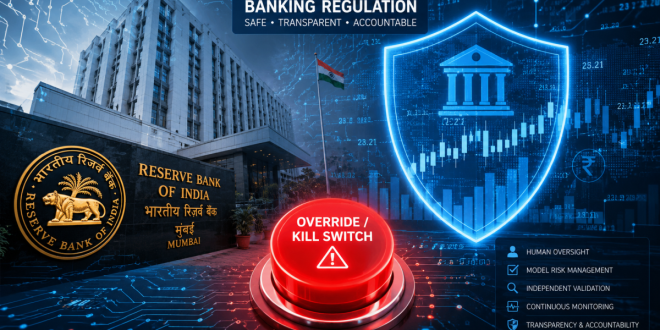
To mitigate frontier software anomalies, banks must engineer explicit technical overrides or emergency “kill switch” capabilities. Should a model begin displaying data drift, acute performance degradation, or algorithmic hallucinations (generating false outputs as objective facts), compliance teams must possess the architecture to immediately suspend or deactivate the system. Furthermore, institutions must actively train personnel to counter “automation bias”—the psychological tendency of human operators to blindly trust algorithmic recommendations.
4. Rewriting Vendor Contracts and Technical Transparency
A massive percentage of Indian banks rely on global fintech vendor suites. Under the draft norms, the RBI makes it explicitly clear that outside certifications or vendor assurances do not substitute for internal validation. Moving forward, banks must independently validate third-party codebases, meaning legal teams will likely have to re-paper vendor contracts to demand deep architectural documentation and absolute audit rights for both internal teams and RBI supervisors.
Customer-Facing Safeguards: Protecting the Everyday Consumer
The draft guidelines are heavily protective of the retail consumer. For any financial institution utilizing customer-facing AI—including generative chat interfaces—the following protocols are mandated:
| Mandatory Protocol | Implementation Requirement |
| Explicit AI Disclosure | Customers must be explicitly informed when they are interacting with an AI system rather than a human. |
| Human Escape Hatch | At any point during an automated interaction, the system must provide an immediate, frictionless option to exit the AI loop and connect with a human agent. |
| Grievance Redressal | Internal customer complaint mechanisms must be explicitly updated to triage, trace, and investigate errors born from automated models. |
Which Institutions are Covered?
The RBI’s draft guidelines cover 11 distinct categories of Regulated Entities (REs) operating within the domestic financial ecosystem:
-
Commercial Banks
-
Small Finance Banks (SFBs)
-
Payments Banks
-
Regional Rural Banks (RRBs)
-
Urban and Rural Co-operative Banks
-
Non-Banking Financial Companies (NBFCs)
-
Asset Reconstruction Companies (ARCs)
-
Credit Information Companies (CICs)
-
All-India Financial Institutions (Exim Bank, NABARD, SIDBI, NHB, NaBFID)
Frequently Asked Questions (FAQs)
What is the primary focus of the RBI’s 2026 draft AI guidelines?
The guidelines introduce a unified Model Risk Management Framework (MRMF) to ensure banks, NBFCs, and financial entities take full board-level accountability for the risks, biases, and operational issues tied to AI, machine learning, and automated decision models.
Can a bank blame a fintech vendor if a purchased AI model fails?
No. The RBI draft guidelines clearly state that regulated entities carry ultimate liability for model outcomes. Third-party certifications or assurances are not a valid regulatory defense; the bank must perform its own independent validation.
What is an AI “Kill Switch” in banking?
It is a mandatory technical override control that allows a financial institution to instantly suspend or deactivate an automated AI/ML model if it outputs harmful, biased, or highly inaccurate data during production.
When is the deadline for submitting feedback on this draft framework?
Stakeholders, including tech providers, banks, and public citizens, can submit their formal feedback on the draft via the RBI’s “Connect 2 Regulate” portal up until July 24, 2026.
Disclaimer
This article is based entirely on the draft ‘Guidance on Regulatory Principles for Model Risk Management, 2026’ released by the Reserve Bank of India on June 24, 2026, for public consultation. It does not constitute final legal, financial, or regulatory compliance advice. Financial institutions and tech developers should refer directly to official circulars issued via the Reserve Bank of India’s authorized channels before restructuring compliance pipelines.