

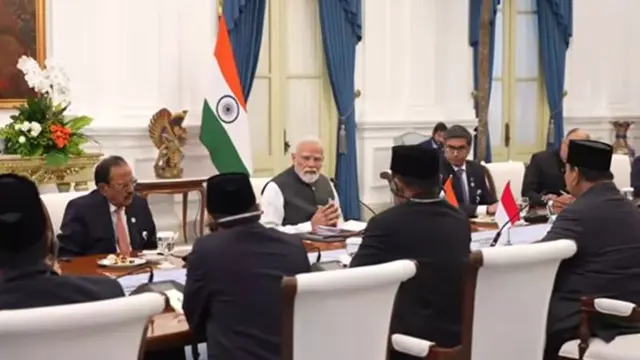
New Delhi. Tuesday, 7 July 2026
The geopolitical landscape of the Indo-Pacific region is witnessing a powerful realignment. In a significant diplomatic milestone, Indian Prime Minister Narendra Modi and Indonesian President Prabowo Subianto held high-level bilateral talks aimed at expanding the India-Indonesia Strategic Partnership.
As two of the largest maritime nations situated along vital international shipping corridors, the growing synergy between New Delhi and Jakarta acts as a cornerstone for maintaining regional stability, securing critical supply chains, and driving clean energy transitions.
1. A Shared Vision for the Indo-Pacific and Act East Policy
The bilateral discussions underscore India’s unwavering commitment to its Act East Policy and its overarching vision for a free, open, inclusive, and rules-based Indo-Pacific. By prioritizing Indonesia as a central pillar of this engagement, India seeks to deepen its footprint in Southeast Asia while addressing evolving maritime challenges.
2. Defence Cooperation & Indigenous Manufacturing
Defence industrial collaboration emerged as a primary outcome of the talks. Moving beyond standard military exercises, both nations are transitioning into co-development and strategic technology sharing.
Defence Manufacturing: Joint initiatives to build robust, localized defence equipment supply chains.
Technology Sharing: Deepening strategic trust via joint research and development (R&D).
Military Training & Surveillance: Expanding joint maritime surveillance to deter non-traditional security threats.
3. Securing Vital Shipping Routes: Maritime Safety First
With global trade heavily reliant on sea lanes passing through the Malacca Strait and the wider Indian Ocean, maritime safety remains a critical objective. The leaders solidified agreements on:
Maritime Domain Awareness (MDA): Sharing real-time tracking data to secure international waters.
Anti-Piracy Initiatives: Coordinating naval assets for smoother search-and-rescue and crime prevention operations.
Capacity Building: Enhancing the tactical coordination between the Indian Navy and Indonesian naval forces.
4. Critical Minerals and the Clean Energy Transition
A major highlight of the evolving partnership is the collaboration on critical minerals. As India accelerates its shift toward electric vehicles (EVs), semiconductor manufacturing, and renewable technologies, securing a stable supply of battery-grade raw materials is essential.
Indonesia, holding some of the world’s largest nickel reserves, serves as a natural partner. The bilateral discussions opened up immediate pathways for mutual investment, setting the stage for joint mineral processing plants and resilient global tech supply chains.
5. Digitization and the Broader Economic Horizon
Beyond heavy industry and security, the economic partnership is diversifying into the digital era. Both leaders agreed to leverage India’s massive experience in Digital Public Infrastructure (DPI) and FinTech to help catalyze Indonesia’s digital economy.
| Sector | Collaboration Focus Areas |
| Digital Economy | Fintech integration, Artificial Intelligence (AI), and Internet of Things (IoT) |
| Healthcare & Pharma | Sharing public health systems, pharmaceutical supply chains, and traditional medicine |
| Food Security | Exchanging frameworks modeled after large-scale public distribution networks |
Frequently Asked Questions (FAQs)
What is the main objective of the India-Indonesia Strategic Partnership?
The main goal is to deepen bilateral ties in defence manufacturing, enhance maritime domain awareness across crucial shipping lanes, and build resilient supply chains for critical minerals like nickel to support clean energy.
Why is Indonesia critical for India’s clean energy goals?
Indonesia possesses immense reserves of critical minerals, particularly nickel, which is a vital component for manufacturing electric vehicle (EV) batteries, semiconductors, and advanced green tech systems.
How does this meeting tie into India’s foreign policy?
The engagement directly advances India’s Act East Policy, which focuses on building stronger economic, strategic, and cultural ties with Southeast Asian nations to maintain a balanced, stable Indo-Pacific region.
Disclaimer: This article is prepared for informational purposes based on official diplomatic readouts, state press statements, and bilateral updates. Readers seeking specific investment data or direct policy actions are advised to consult the respective official ministerial portals.
For more regional updates and detailed coverage on international affairs, stay tuned to the latest columns on Matribhumi Samachar.
