 Matribhumi Samachar English


Mumbai. Tuesday, 7 July 2026
India’s semiconductor journey has entered a defining phase. What was once viewed primarily as an electronics manufacturing initiative has now evolved into a national strategic priority that will influence the country’s future in artificial intelligence (AI), defence, telecommunications, electric vehicles, and advanced manufacturing.
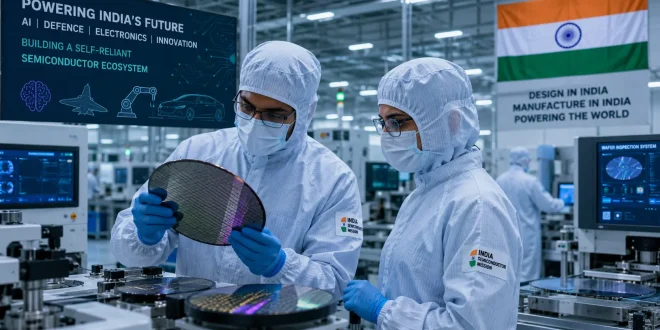
With governments across the world racing to secure chip supply chains, India is positioning itself as an emerging semiconductor hub through policy reforms, large-scale investments, international partnerships, and domestic manufacturing incentives. Recent developments, including the expansion of the India Semiconductor Mission (ISM) 2.0, new semiconductor assembly and packaging facilities, and broader incentives for the entire chip ecosystem, demonstrate India’s ambition to become a trusted global semiconductor partner.
Why Semiconductors Have Become Strategic Assets
Semiconductors are tiny electronic chips that control and process information inside almost every digital device.
Today they power:
- Artificial Intelligence systems
- Smartphones
- Data centres
- Electric vehicles
- Fighter aircraft
- Missiles
- Satellites
- Medical equipment
- Industrial robots
- Telecom infrastructure
- Consumer electronics
Without semiconductors, modern economies cannot function.
Unlike oil, which powered the industrial age, semiconductor chips are increasingly becoming the strategic resource driving the digital economy.
India’s AI Future Depends on Advanced Chips
Artificial Intelligence has dramatically increased global demand for high-performance computing chips.
Every AI application—from generative AI chatbots to autonomous vehicles and healthcare diagnostics—requires advanced processors capable of performing trillions of calculations every second.
India’s AI ambitions are expanding rapidly through investments in AI infrastructure, sovereign AI models, multilingual AI platforms and computing capacity. The government has also announced plans to significantly expand GPU availability through the IndiaAI ecosystem to support researchers, startups and enterprises.
As AI adoption accelerates across sectors including healthcare, education, agriculture, finance and governance, domestic semiconductor capabilities will become increasingly important.
Strengthening National Security Through Semiconductor Self-Reliance
Modern defence systems depend heavily on sophisticated semiconductor technologies.
These include:
- Radar systems
- Electronic warfare
- Missile guidance
- Secure military communications
- Drone technology
- Space missions
- Cybersecurity infrastructure
- Surveillance equipment
Countries with stronger semiconductor ecosystems are better positioned to secure critical defence technologies while reducing dependence on external suppliers.
For India, expanding domestic chip manufacturing is also about enhancing technological sovereignty.
Electronics Manufacturing Is Moving Up the Value Chain
India has already emerged as one of the world’s largest smartphone manufacturing destinations.
The country’s electronics manufacturing sector is expanding into:
- Consumer electronics
- Telecom equipment
- Automotive electronics
- Industrial electronics
- Medical devices
- Smart appliances
Recent government initiatives have also accelerated domestic electronics production, strengthening India’s position in global manufacturing.
However, semiconductor imports still account for a significant share of manufacturing costs.
Producing more semiconductor components domestically can increase value addition while making India’s electronics exports more globally competitive.
India’s Semiconductor Ecosystem Is Expanding Beyond Chip Fabs
Experts increasingly emphasize that successful semiconductor ecosystems require much more than fabrication plants.
India’s strategy now covers the complete semiconductor value chain, including:
Semiconductor Design
India already hosts one of the world’s largest semiconductor design talent pools, with global technology companies operating major engineering centres across the country.
Fabrication Facilities
India continues to support new semiconductor fabrication projects under the India Semiconductor Mission to reduce import dependence.
Assembly, Testing and Packaging
Outsourced Semiconductor Assembly and Test (OSAT) and Assembly, Testing, Marking and Packaging (ATMP) facilities are rapidly expanding, helping build domestic manufacturing capabilities.
Research and Innovation
The next phase of India’s semiconductor strategy focuses on indigenous intellectual property (IP), semiconductor equipment, advanced materials, workforce development and industry-led research.
Semiconductors Are Critical for India’s EV Revolution
Electric vehicles contain significantly more semiconductor content than conventional vehicles.
Semiconductors enable:
- Battery management
- Power conversion
- Motor control
- Driver assistance systems
- Vehicle connectivity
- Charging infrastructure
- Safety systems
As EV adoption accelerates, demand for automotive-grade chips is expected to increase substantially.
Supporting India’s Digital Infrastructure
India’s rapidly growing digital economy depends upon reliable semiconductor supplies.
Key growth sectors include:
- 5G and future telecom networks
- Cloud computing
- AI data centres
- Smart cities
- Internet of Things (IoT)
- Digital payments
- Industrial automation
Every new digital service ultimately depends on advanced semiconductor technology.
Reducing Supply Chain Risks
The global semiconductor shortage during recent years exposed vulnerabilities across industries.
Production disruptions affected:
- Automobiles
- Smartphones
- Medical devices
- Consumer electronics
- Industrial machinery
India’s long-term semiconductor strategy seeks to improve resilience by diversifying supply chains while encouraging domestic manufacturing.
India Semiconductor Mission 2.0 Signals the Next Phase
India’s semiconductor strategy is now entering a broader phase.
Recent policy developments indicate that Semiconductor Mission 2.0 will expand incentives beyond fabrication plants to support:
- Chip design
- Semiconductor equipment
- Materials
- Assembly and packaging
- Research and development
- Talent development
- Domestic supply chains
This broader ecosystem approach reflects global best practices adopted by leading semiconductor economies.
Employment and Economic Growth
A mature semiconductor ecosystem generates opportunities across multiple industries.
Employment is expected in:
- Chip design
- Manufacturing
- Robotics
- AI engineering
- Automation
- Equipment maintenance
- Chemical engineering
- Materials science
- Research and development
- Quality assurance
The industry also creates indirect employment through logistics, construction, software, education and supply chain services.
Challenges India Still Needs to Address
Despite strong momentum, several challenges remain.
These include:
- High capital investment requirements
- Access to advanced manufacturing technology
- Reliable power and water infrastructure
- Skilled workforce availability
- Global competition
- Long project timelines
- Supply chain localization
Industry experts believe execution, infrastructure readiness and workforce development will determine the long-term success of India’s semiconductor ambitions.
The Road Ahead
Semiconductors are becoming far more than electronic components—they are now strategic assets that influence economic growth, technological leadership and national security.
With AI adoption accelerating worldwide, India’s investments in semiconductor manufacturing, chip design, advanced packaging and research could help transform the country into a major global technology hub over the coming decade.
If current policy momentum continues, semiconductors may become one of the strongest pillars supporting India’s vision of becoming a leading AI-powered manufacturing economy.
Frequently Asked Questions (FAQ)
Why are semiconductors important for India’s economy?
Semiconductors power electronics, AI, telecommunications, defence systems, automobiles and industrial equipment. Domestic production can strengthen manufacturing, exports and technological self-reliance.
How do semiconductors support Artificial Intelligence?
AI models require high-performance processors such as GPUs, AI accelerators and advanced memory chips to process massive datasets efficiently.
What is the India Semiconductor Mission?
The India Semiconductor Mission (ISM) is the Government of India’s flagship initiative to build a comprehensive semiconductor ecosystem by promoting chip manufacturing, design, research, innovation and workforce development.
Which industries will benefit the most?
Artificial Intelligence, defence, electronics manufacturing, electric vehicles, healthcare, aerospace, telecommunications, cloud computing and industrial automation.
Why is semiconductor manufacturing considered strategic?
Domestic chip manufacturing reduces dependence on imports, strengthens supply chains, improves national security and supports high-value manufacturing.
Disclaimer
This article is intended for informational and educational purposes only. It is based on publicly available government announcements, industry developments and general technology trends available as of July 2026. Semiconductor policies, investments and project timelines may evolve over time. Readers should consult official government notifications and industry publications for the latest updates.
Suggested Internal Links
- https://matribhumisamachar.com/en/indias-semiconductor-push-accelerates-how-new-chip-investments-are-reshaping-manufacturing/
- https://matribhumisamachar.com/en/made-in-india-chips-to-power-indias-ai-future/
- https://matribhumisamachar.com/en/indias-deep-tech-revolution-the-technologies-powering-the-next-phase-of-economic-growth/
- https://matribhumisamachar.com/en/why-critical-minerals-are-becoming-central-to-indias-indo-pacific-economic-strategy/
- https://matribhumisamachar.com/en/iim-bangalore-to-establish-indonesia-campus-as-india-expands-higher-education-partnerships-in-asean/