

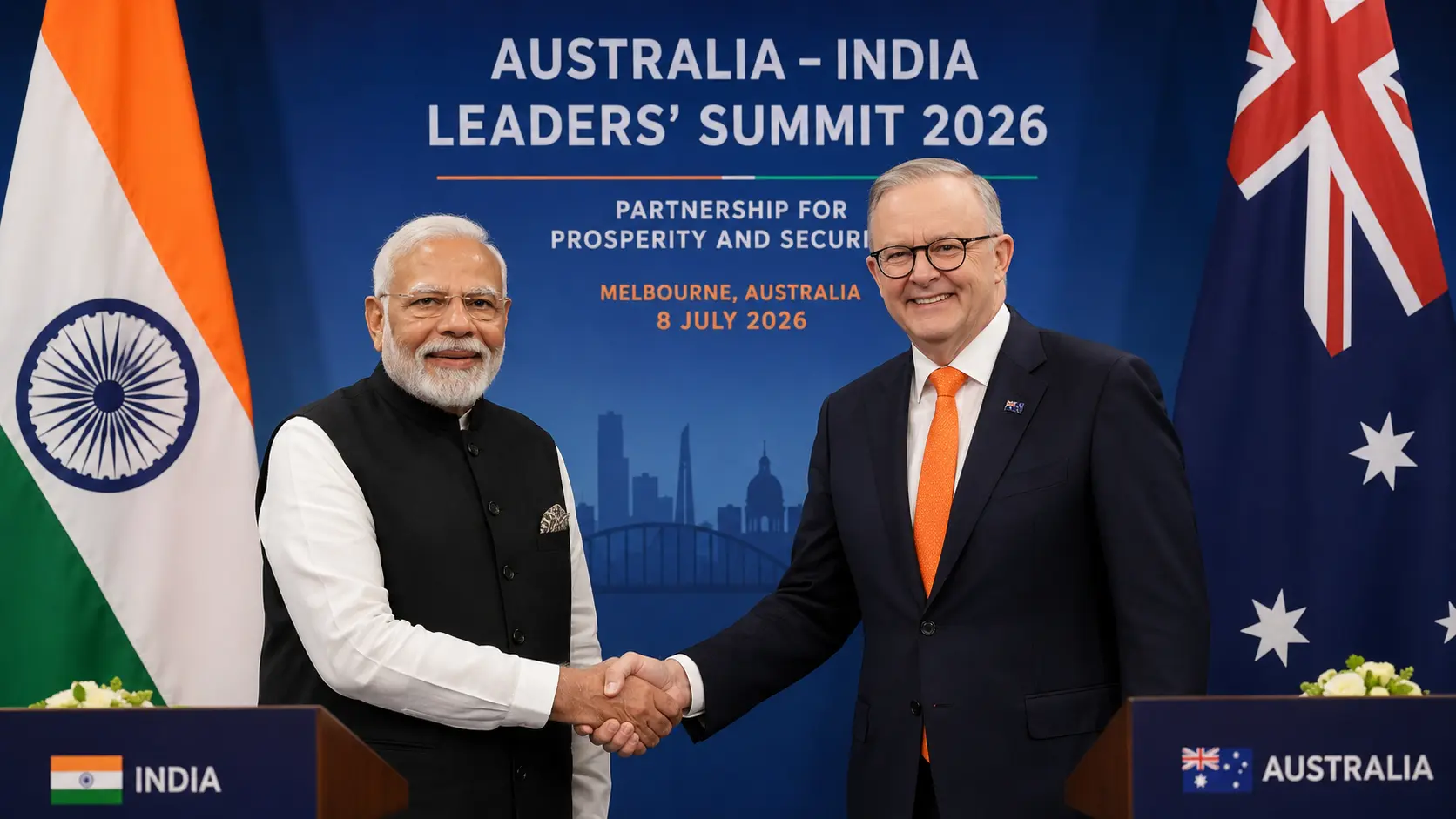
Melbourne | Updated on : Thursday, 9 July 2026
The strategic and economic alliance between India and Australia has reached a landmark milestone following the conclusion of the highly anticipated Australia–India Annual Summit 2026 in Melbourne. Led by Indian Prime Minister Narendra Modi and Australian Prime Minister Anthony Albanese, the bilateral meeting laid down a comprehensive blueprint aimed at securing resilient supply chains, accelerating economic integration, and unlocking collaborative growth in high-tech fields.
With foundational advancements spanning critical mineral pipelines to advanced semiconductor ecosystems, the outcome of this summit fundamentally shifts how both nations co-navigate an evolving Indo-Pacific theater.
For a broader look at international relations and regional coverage, visit the official Matribhumi Samachar English Section.
1. Transforming the Trade Landscape: From ECTA to CECA
A primary centerpiece of the Melbourne discussions was the fortification of bilateral commerce. Building upon the operational success of the Economic Cooperation and Trade Agreement (ECTA), both leaders formally accelerated technical negotiations for a full-scale Comprehensive Economic Cooperation Agreement (CECA).
The deliberate dismantling of market friction is poised to provide:
Streamlined Market Access: Direct benefits for manufacturing exporters scaling into both consumer pools.
Tariff Rationalization: Targeted lowering of structural trade barriers on prioritized industrial goods.
Modernized Customs Infrastructure: Digitized data integration to achieve vastly accelerated customs clearance.
SME Integration: Targeted pathways making cross-border partnerships affordable for small and medium-sized enterprises.
2. Powering the Future: Critical Minerals and Clean Energy Cooperation
As India advances its clean energy transition and scales domestic manufacturing through its signature Make in India initiative, supply security remains paramount. Australia—holding vast global reserves of critical raw materials including lithium, cobalt, nickel, and rare earth elements—is uniquely positioned to serve as a bedrock partner.
The expanded 2026 framework establishes institutional mechanisms for joint exploration, domestic processing, and multi-year long-term supply agreements. This direct minerals pipeline actively underpins the expanding production demands of India’s electric vehicles (EV), battery storage systems, and semiconductor fabrication units. Concurrently, technical working groups are deepening collaboration across a spectrum of renewable platforms:
Green Hydrogen fuel infrastructure
Next-generation solar photovoltaic technologies
High-yield wind power distribution
Large-scale utility battery storage frameworks
3. The New Frontiers: AI, Semiconductors, and Cybersecurity
Beyond legacy trade commodities, technology cooperation has rapidly evolved into a frontline strategic pillar. The 2026 summit established formalized networks joining universities, research institutes, and private industries to drive innovation across deep-tech industries.
Frontline Tech Alliances:
├── Artificial Intelligence (Shared ethics & framework optimization)
├── Semiconductor Supply Chains (Resilient fab-to-assembly pipelines)
├── Quantum Computing & Cryptography (Joint laboratory research teams)
└── Enterprise Cybersecurity (Real-time threat landscape data mapping)
These structural networks ensure that Indian technology ventures gain direct access to sophisticated markets while building robust safety architectures to protect shared digital infrastructure from evolving global risks.
To stay updated on technology regulations and corporate investments, check out the Matribhumi Samachar Business News Hub.
4. Academic Mobility and Workforce Integration
Education remains a historic bridge between both populations. With India serving as one of the largest demographics for international students within Australia, the 2026 bilateral framework introduces critical updates for institutional parity.
Key deliverables underway include:
Qualifications Recognition: Streamlined frameworks for the mutual recognition of professional and academic qualifications.
Joint Research Funding: Dedicated grant structures for co-developed science and technology programs.
Skill Alignment: Industry-modeled vocational training targeting emerging engineering and digital sectors.
Visual Summary: Strategic Pillars
Alt Image Text Recommendation: Labeled chart detailing the five strategic pillars of the 2026 Australia India Summit: Trade, Clean Energy, Technology, Education, and Regional Defense.
| Sector | Immediate Initiative | Targeted Macro Benefit |
| Trade | Finalizing full CECA parameters | Greater global supply chain resilience |
| Minerals | Joint Lithium & Cobalt extraction | Fueling domestic EV and tech production |
| Defense | Indo-Pacific maritime coordinate tracking | Enhanced regional stability & strategic trust |
Frequently Asked Questions (FAQs)
What is the main outcome of the Australia–India Annual Summit 2026?
The summit successfully expanded bilateral commitments across trade (CECA acceleration), clean energy integration, critical mineral supply mapping, high-tech defense protocols, and mutual academic qualifications recognition.
How do Australian critical minerals impact Indian industries?
Australia possesses massive reserves of lithium, cobalt, and rare earths. Securing long-term supply agreements enables India to scale its domestic manufacturing of semiconductors, electric vehicles, and renewable power arrays with reduced import dependence.
What career fields will see the most growth from this summit?
Professionals specializing in Artificial Intelligence, semiconductor fabrication, clean energy engineering, cybersecurity architecture, and advanced logistics stand to see heightened cross-border employment demand.
Disclaimer
The information contained in this article is compiled based on the official policy declarations and bilateral outlines released at the Australia–India Annual Summit 2026. Long-term impacts, trade execution timelines, and commercial benefits are subject to final government agency implementations and changing macroeconomic factors.
