

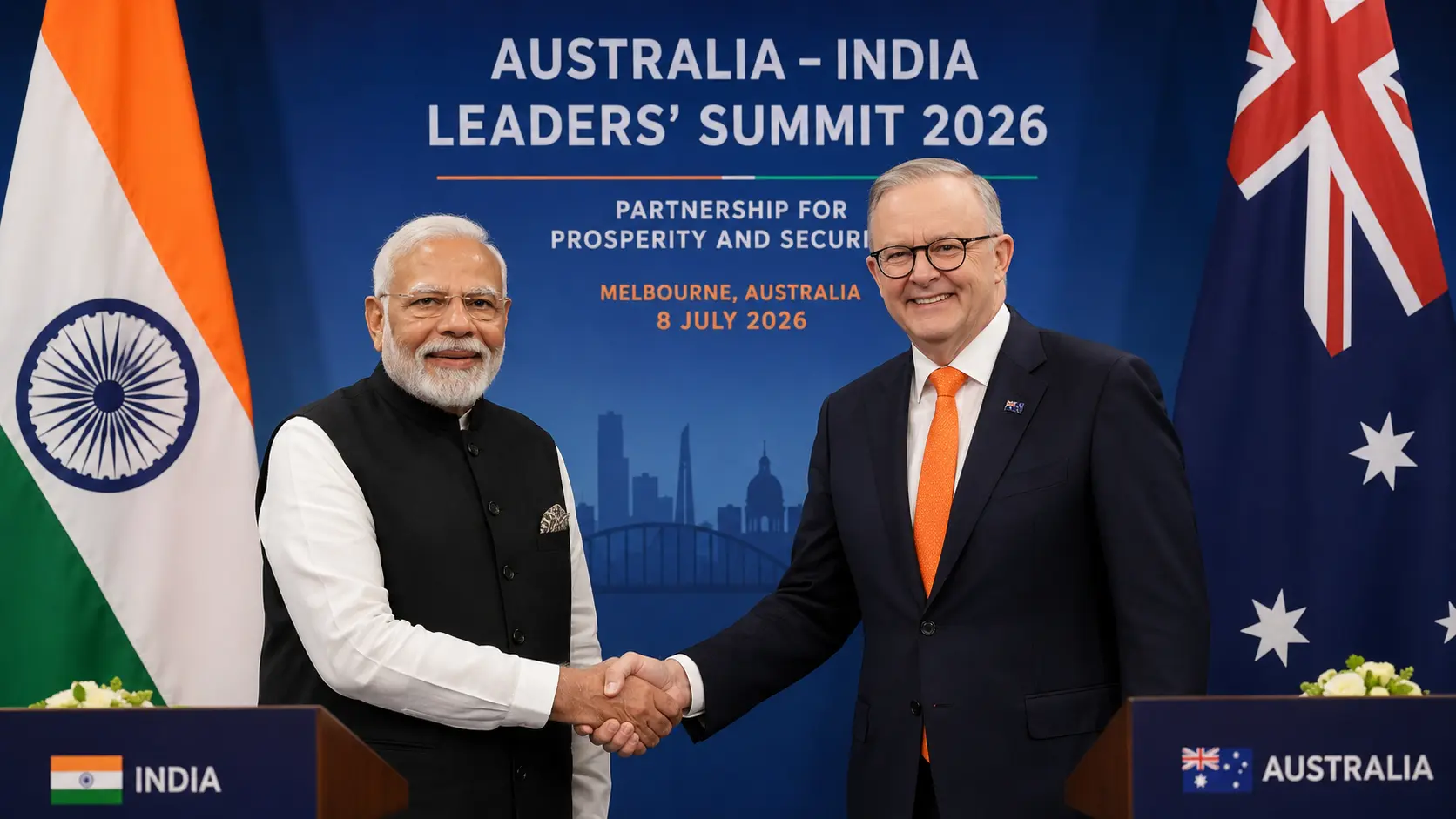
New Delhi. Wednesday, 8 July 2026
The geopolitical and economic landscape of the Indo-Pacific is undergoing a profound structural transformation. In a pivotal moment for regional alignment, Indian Prime Minister Narendra Modi and Australian Prime Minister Anthony Albanese are meeting for the high-stakes Australia–India Leaders’ Summit 2026. This high-level dialogue marks an ambitious acceleration of the Comprehensive Strategic Partnership upgraded in 2020.
As global supply chains shift toward trust and resilience, this summit moves beyond diplomatic formalities to establish hard-cut economic and security architectures. The tour highlights New Delhi’s compounding momentum under its Act East Policy and solidifies Canberra’s position as a premier, reliable resource partner.
The Strategic Blueprint: Critical Minerals Take Center Stage
At the absolute core of the 2026 bilateral discussions is the issue of resource security. Australia possesses an unparalleled global advantage in the extraction of raw earth elements, while India is scaling its domestic manufacturing capabilities at an unprecedented rate.
Bridging the Supply-Demand Gap
Australia stands as a global titan in the production of vital resources, including:
Lithium & Cobalt: Essential for electric vehicle (EV) battery manufacturing.
Rare Earth Elements: Critical for semiconductor fabrication and specialized electronics.
Nickel & Graphite: Highly sought after for renewable energy systems and advanced storage technologies.
Through the Australia–India Critical Minerals Investment Partnership, the 2026 summit actively encourages Indian public and private entities to invest directly in Australian mining projects and downstream processing infrastructures. This collaborative framework drastically reduces deep-tier dependence on single-source, highly concentrated global supply chains, laying down a reliable foundation for India’s emerging high-tech ecosystems.
Elevating Trade: Accelerating ECTA toward CECA
Economic integration between the two powerhouses has scaled sequentially over the last few years. The implementation of the Economic Cooperation and Trade Agreement (ECTA) has already catalyzed bilateral merchandise trade and reduced immediate tariff friction.
The primary objective during the 2026 summit is to maintain momentum on the highly anticipated Comprehensive Economic Cooperation Agreement (CECA). While ECTA provided early market access and immediate tariff relief across primary sectors, CECA aims to lock in long-term structural frameworks for:
Services Exports: Streamlining pathways for IT, engineering, and financial professional exchanges.
Advanced Manufacturing: Joint ventures processing raw commodities before export.
Cross-Border Capital Flows: Promoting direct institutional investments in large-scale infrastructure projects.
Frontier Technology, Semiconductors, and Defense Integration
Rather than operating merely as a buyer-seller relationship, the partnership has pivoted toward co-development in highly sensitive technological fields.
Advanced Tech Ecosystems
The nations are building aligned research frameworks linking universities, deep-tech startups, and state-backed laboratories. Key strategic verticals include:
Semiconductors: Aligning India’s booming chip design ecosystem with Australia’s advanced material research.
Artificial Intelligence (AI) & Quantum Computing: Collaborative development in secure AI infrastructure and next-generation processing capabilities.
Space & Cybersecurity: Hardening critical communications networks and expanding joint satellite data utilization.
Indo-Pacific Security and The Quad
The strategic environment in the Indo-Pacific remains dynamic and complex. As vital anchors of the Quad (alongside the United States and Japan), India and Australia are deepening their defense integration to preserve freedom of navigation and secure vital maritime trade routes. The summit expands concrete cooperation in maritime domain awareness, complex joint naval drills, cross-nation military logistics, and defense industry co-production.
Clean Energy, Skills, and Educational Mobility
The energy transition serves as another massive pillar of long-term cooperation. With Australia’s abundant natural wealth and India’s surging clean energy requirements, the summit outlines collaborative pipelines for green hydrogen production, domestic battery manufacturing, and civil nuclear cooperation.
Simultaneously, the foundational bedrock of this partnership relies on robust people-to-people ties. Leaders are executing renewed frameworks for the mutual recognition of professional qualifications, streamlined student mobility, and institutional partnerships between elite universities. This integration guarantees that both industrial bases are supported by a highly skilled, cross-compatible workforce.
Frequently Asked Questions (FAQ)
What makes the Australia–India Leaders’ Summit 2026 different from previous meetings?
The 2026 summit transitions the bilateral relationship from a traditional transactional trade format into a deeply integrated strategic alliance. It actively focuses on joint-investment frameworks in critical minerals, co-developing advanced technologies like semiconductors, and building hard maritime security safeguards across the Indo-Pacific.
How does the Critical Minerals Partnership protect supply chains?
By channeling Indian capital directly into Australian mining and downstream processing facilities, it builds an isolated, highly reliable supply loop. This prevents disruptions from geopolitical tensions or single-country monopolies on raw minerals like lithium, cobalt, and rare earth elements.
What is the current status of ECTA and CECA?
The India–Australia Economic Cooperation and Trade Agreement (ECTA) is fully active and has already reduced tariffs on a wide array of goods. The 2026 summit serves to expedite negotiations for the broader Comprehensive Economic Cooperation Agreement (CECA), which will encompass services, deep investments, and structural trade frameworks.
Relevant Links for Further Strategic Reading
To track India’s broader diplomatic expansions and parallel regional partnerships occurring this year, explore these deep-dive analyses:
For a look at India’s broader diplomatic strategies in the region during this active month, read about the PM Modi Indo-Pacific Tour 2026: Deepening Strategic Ties with Indonesia, Australia, and New Zealand.
To see how India is expanding its high-tech industrial manufacturing capabilities locally, explore the details on how India Extends ₹7,280-Crore Rare Earth Permanent Magnet (REPM) Scheme Application Deadline to July 29, 2026.
To understand how India is transforming its military capabilities in parallel with strategic international alignment, see The Rise of Indigenous Defence Drones: How India Is Engineering Its New Era of Military Self-Reliance.
Disclaimer
This comprehensive analysis is compiled for educational and general informational purposes based on current ministerial agendas, industrial bilateral outlines, and strategic foreign policy briefs available as of July 2026. Given the ongoing nature of international trade treaties, bilateral negotiations, and geopolitical policy changes, final institutional frameworks and ratified clauses should be verified through the official publications of the Ministry of External Affairs (MEA), Government of India, and the Department of Foreign Affairs and Trade (DFAT), Australian Government.
