

Mumbai. Tuesday, 14 July 2026
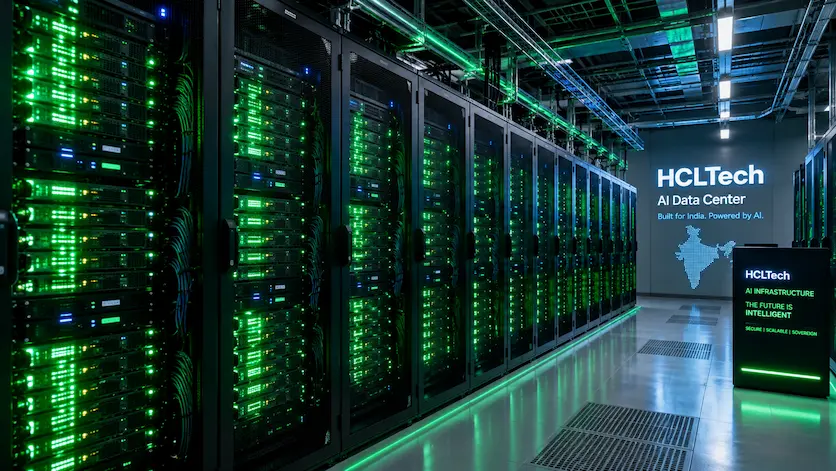
In a definitive structural shift that underlines India’s fast-maturing artificial intelligence ecosystem, IT major HCLTech has announced a monumental investment plan of ₹3,500 crore dedicated entirely to developing AI-focused data centres across the country.
This move directly addresses the surging domestic demand for sovereign AI infrastructure, giving enterprises and highly regulated government organizations the capability to execute complex AI workloads on computing hardware localized strictly within national boundaries. The strategy marks a clear transformation for HCLTech, expanding its footprint well beyond its legacy IT services business to establish its role as a comprehensive, full-stack AI solutions provider.
Scaling Up Beyond Traditional IT Services
The core blueprint of HCLTech’s investment focuses on building next-generation, AI-ready data centres. The initial computing capacity is engineered for aggressive scalability, designed to expand up to approximately 50 megawatts (MW) over time. Unlike standard data facilities, these centers are purpose-built to sustain the immense power and thermal requirements of:
High-Performance Computing (HPC) tasks
GPU-intensive Large Language Model (LLM) training and inference operations
Private cloud enterprise architectures
Locally deployed enterprise-scale Generative AI applications
By engineering an integrated domestic ecosystem—uniting physical infrastructure, secure cloud platforms, localized AI software, managed operations, and technical consulting—HCLTech provides local entities a viable path to escape absolute reliance on international cloud hyperscalers.
The Strategic Imperative of India’s Sovereign AI
The rollout of this infrastructure aligns directly with India’s macro vision of data sovereignty. The concept of “Sovereign AI” demands that critical citizen data, computational hardware, and trained algorithmic models reside firmly under national jurisdiction. As legal structures like the Digital Personal Data Protection (DPDP) framework actively govern data compliance, domestic hosting has pivoted from an operational preference to a strict regulatory mandate.
Several sensitive sectors across the Indian economy are accelerating their transition toward local compute models:
Government & Public Infrastructure: Securing localized public data arrays.
Banking & Financial Services: Driving rapid institutional automation under the watchful eye of domestic regulators.
Defence & Aerospace: Processing sensitive edge data and powering autonomous mission systems locally.
Healthcare & Pharmaceuticals: Ensuring patient data confidentiality during large-scale medical AI research.
Harmonizing with India’s Macro Technology Blueprint
This capital deployment functions as a critical private-sector brick in the larger wall of the Atmanirbhar Bharat (Self-Reliant India) digital architecture. It directly complements public policy efforts geared toward semiconductor packaging, indigenous deep-tech pipelines, and localized digital public infrastructure (DPI) platforms.
As foundational algorithms increasingly reshape vital components of the public sphere—ranging from the automation of high-throughput tax environments to secure sovereign logistics—the demand for highly localized, hyper-resilient GPU clusters is projected to grow exponentially over the next decade. HCLTech’s infrastructural anchoring positions it to capture this massive public and enterprise market share, shielding critical operations from global geopolitical friction or supply vulnerabilities.
Frequently Asked Questions (FAQ)
What exactly is “Sovereign AI” and why does India need it?
Sovereign AI means keeping artificial intelligence systems—including the data used, the physical data servers, and the software models—within the borders and legal jurisdiction of a specific nation. India requires it to safeguard national security, protect citizen data privacy, and maintain absolute technological independence from foreign entities or external geopolitical pressures.
How does a 50 MW capacity benefit enterprise AI training?
Modern generative AI and Large Language Models require vast arrays of high-end graphics processing units (GPUs) that consume enormous amounts of electricity and generate intense heat. A 50-megawatt (MW) capacity data center provides the specialized high-density power distribution and cooling architecture necessary to keep these advanced chips running continuously without failures.
Which industries will benefit most from HCLTech’s AI data centres?
The primary beneficiaries are highly regulated industries that handle sensitive information, such as Banking and Financial Services (BFSI), Government Administration, Healthcare, Telecommunications, Defense, and Energy utilities.
Relevant Links for Further Reading
To contextualize how these large-scale digital data architectures are influencing wider sectors across India, explore these deep-dive resources:
Discover how advanced internal computational automation is transforming domestic financial institutions: Beyond Chatbots: How Artificial Intelligence is Rewriting the Rules of Indian Banking.
Understand the strategic convergence of domestic software, edge computing, and independent local hardware frameworks: The Rise of Indigenous Defence Drones: How India Is Engineering Its New Era of Military Self-Reliance.
Disclaimer: The information contained in this article is compiled for educational and informational purposes based on current industry announcements as of July 2026. Readers seeking to make corporate technology decisions or infrastructure investments should perform independent due diligence or consult directly with certified technology advisors.
