 Matribhumi Samachar English


New Delhi. Friday, 17 July 2026
India is orchestrating a monumental paradigm shift in its industrial architecture. Building upon the foundational success of its initial Production Linked Incentive (PLI) schemes, the government is rolling out a massive ₹1.9 lakh crore investment strategy designed to transform the country from a major electronics assembly destination into a comprehensive, global electronics production and innovation superpower.
While the previous phase turned India into one of the world’s fastest-growing mobile phone producers, a significant percentage of high-value internal components—such as semiconductors, display panels, and precision sensors—have traditionally remained dependent on international silicon foundries. This ambitious new strategy actively bridges that gap by systematically localizing the entire electronics value chain.
The Strategic Pillars of the ₹1.9 Lakh Crore Roadmap
The updated framework shifts the focus from simple final-stage assembly to deep-tier domestic value addition across four core operational vertices:
1. Component Manufacturing Deepening
To halt the flow of expensive imports, India is deploying capital to localize the production of underlying hardware sub-assemblies. The target verticals include:
-
Multi-layered Printed Circuit Boards (PCBs)
-
Advanced display and camera modules
-
High-capacity batteries and connectors
-
Precision sensors and passive electronics
2. Expanding the Semiconductor Ecosystem
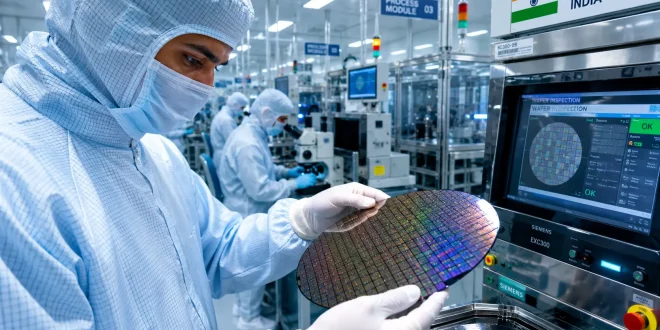
Moving beyond design, India’s Semicon 2.0 framework is establishing brick-and-mortar infrastructure to safeguard critical high-tech supply chains. This includes massive capital subsidies for:
-
Semiconductor Fabrication Plants (Fabs): Cultivating localized silicon wafer production.
-
ATMP/OSAT Facilities: High-tech testing and chip packaging sites, anchored by major milestones like the recently operational Sanand OSAT facility.
-
Upstream Materials: Financing sub-sectors like specialized chemicals, electronic design automation (EDA) tools, and specialized hardware machinery.
3. Diversified Electronics Manufacturing Services (EMS)
Contract manufacturing is moving far past smartphones. The strategy explicitly expands India’s factory capacity into high-margin segments including automotive electronics, industrial robotics, telecom infrastructure (including indigenous 6G tech), and aerospace and defense electronics.
4. R&D and Design-Led Innovation
Shifting from a pure “factory floor” to an intellectual property hub, the government is incentivizing industry-academia collaborations, building advanced prototype testing laboratories, and supporting deep-tech and electronics startups with non-dilutive grants.
Socio-Economic Multipliers: Jobs, Exports, and Infrastructure
This systemic scaling unlocks three vital economic drivers:
-
Export-Led Growth: The blueprint establishes a concrete path to transition India into an aggressive global exporter of laptops, tablets, servers, and semiconductor devices, diversifying revenue away from purely domestic consumption.
-
Mass Employment Generation: Millions of direct and indirect jobs are projected to emerge across precision assembly, logistics, cleanroom engineering, and chip design.
-
Global Supply Chain Harmony: This framework aligns tightly with other mega-infrastructure goals. Higher factory outputs feed directly into India’s surging June 2026 GST collections of ₹1.95 lakh crore. Furthermore, deep-tier raw material schemes, like the ₹7,280-crore Rare Earth Permanent Magnet (REPM) initiative, provide the vital magnetics and raw processing infrastructure required for high-end electronics and robotics.
Overcoming the Industrial Roadblocks
Despite unprecedented momentum, achieving absolute global competitiveness requires navigating critical domestic headwinds:
-
Logistical Costs: High freight and distribution overheads compared to established East Asian hubs.
-
Infrastructure Baselines: The strict requirement for uninterrupted, ultra-pure water and highly stable electricity grids needed for semiconductor fabrication.
-
Skilled Talent Deficit: The immediate, pressing demand to upskill hundreds of thousands of technicians, chemical engineers, and advanced semiconductor professionals.
By capitalizing on global geopolitical diversification trends (such as the “China Plus One” manufacturing pivot) and signing strategic technology corridors with partners like the US, Japan, and Australia, India is systematically mitigating these vulnerabilities.
If executed with swift single-window clearances and persistent policy clarity, this ₹1.9 lakh crore strategy will successfully cement India’s position as an irreplaceable, sovereign anchor of the global technology ecosystem.
Frequently Asked Questions (FAQ)
What is the primary objective of India’s new ₹1.9 lakh crore electronics manufacturing strategy?
The strategy aims to deepen India’s electronics ecosystem by transitioning from simple device assembly to high-value component manufacturing, advanced chip packaging, and semiconductor fabrication, drastically reducing reliance on component imports.
How does this strategy connect with the India Semiconductor Mission (ISM)?
The strategy expands upon the ISM (and Semicon 2.0) by funding infrastructure for semiconductor fabrication plants, ATMP/OSAT packaging facilities, chip design startups, and downstream ecosystems like precision electronics.
What are the main challenges facing India’s electronics manufacturing expansion?
Key challenges include higher domestic logistics costs, building out specialized semiconductor-grade utility infrastructure (like hyper-pure water and uninterrupted power grids), and addressing the urgent need for a highly skilled microchip engineering workforce.
Disclaimer
This article is intended solely for informational, educational, and analytical purposes. The details regarding the proposed ₹1.9 lakh crore electronics manufacturing investment strategy, policy components, and industrial frameworks are based on available ministerial notifications, economic reports, and industry publications as of July 2026. Readers are advised to consult official government portals for real-time legislative and policy updates.