

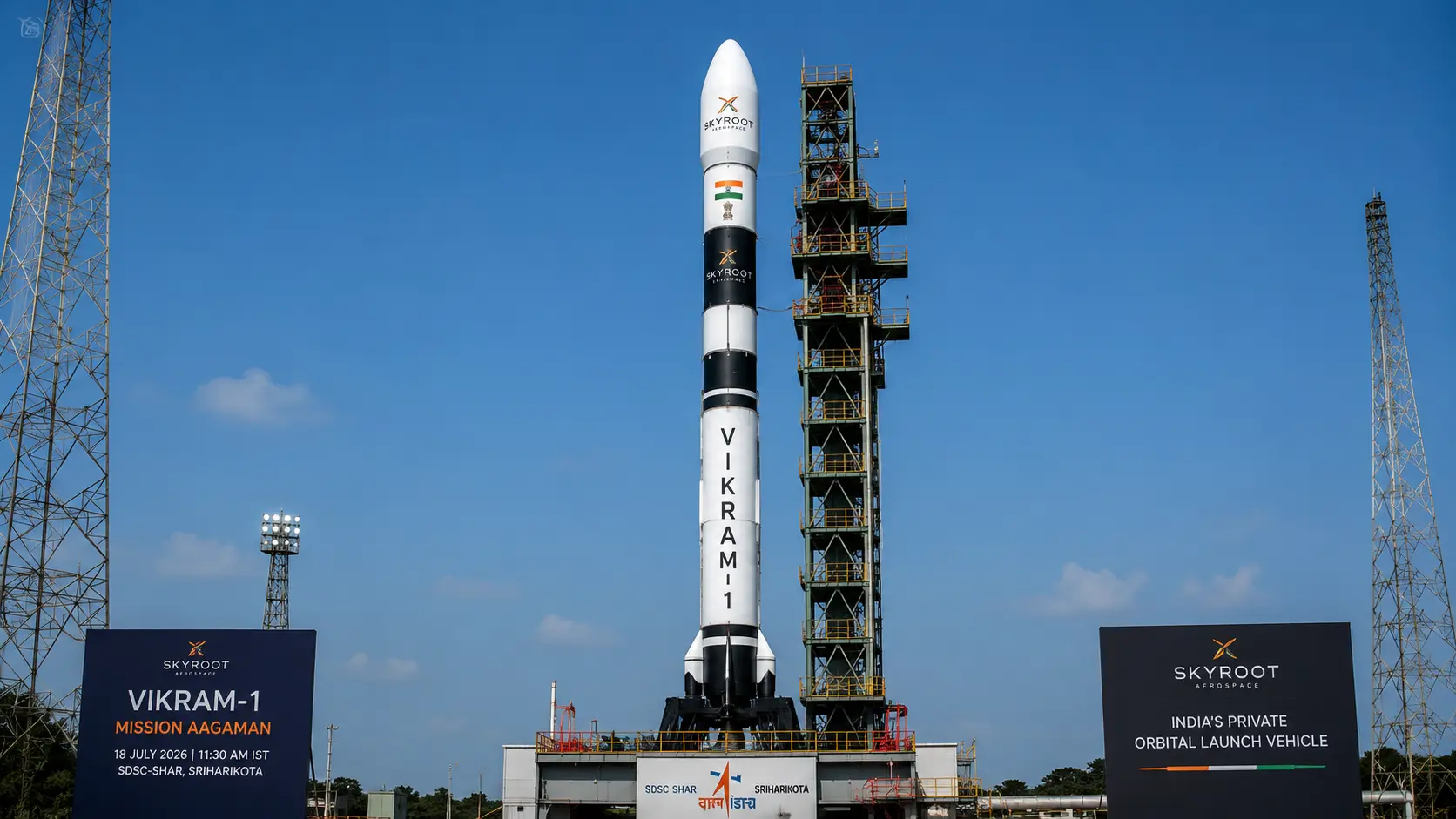
Sriharikota. Friday, 17 July 2026
India is on the verge of scripting a monumental new chapter in its space exploration history. Skyroot Aerospace, a pioneering space-tech startup, is in the final stages of countdown preparations for the launch of Vikram-1, the country’s first privately developed orbital-class launch vehicle.
Dubbed Mission Aagaman (meaning “Arrival”), this landmark flight is scheduled to lift off from the Satish Dhawan Space Centre (SDSC-SHAR) in Sriharikota. It represents a massive leap forward for India’s rapidly expanding private space sector, proving that commercial startups can independently engineer, integrate, and operate advanced orbital launch vehicles alongside the Indian Space Research Organisation (ISRO).
A Paradigm Shift in India’s Space Ecosystem
For decades, India’s space program was entirely state-driven. However, sweeping regulatory reforms initiated by the government opened up the defense and aerospace sectors to private players. Skyroot Aerospace capitalized on this shift, previously making waves with its suborbital flight in late 2022.
Now, with Vikram-1, the company is transitioning from suborbital demonstrations to full-scale orbital capabilities. A successful deployment will place Skyroot into an elite global club of private corporations capable of launching satellites into orbit.
Technical Blueprint: The Vikram-1 Rocket Fleet
Vikram-1 is a highly optimized, multi-stage small satellite launch vehicle designed for rapid deployment and cost-effectiveness.
| Feature / Specification | Details |
| Structure | Advanced carbon composite body for maximum weight reduction |
| Stages | Three solid-propellant lower stages + One liquid upper stage |
| Upper Stage | Restartable liquid-propellant engine for precision orbital injection |
| Manufacturing | Leverages indigenous, 3D-printed propulsion components |
| Payload Capacity | Up to 350 kilograms to Low Earth Orbit (LEO) |
The integration of 3D-printed components and a carbon-fiber architecture allows Skyroot to manufacture these rockets at a fraction of traditional costs, maintaining structural integrity while boosting performance efficiency.
Mission Aagaman: What Will the Flight Test?
As a primary technology demonstration mission, Mission Aagaman focuses on validating end-to-end flight systems before entering regular commercial service. The mission parameters will evaluate:
Real-time structural integrity during supersonic ascent.
The deployment and timing mechanics of the multi-stage separation systems.
Guidance, navigation, and closed-loop control software accuracy.
The restart capability of the liquid upper stage to achieve exact orbital coordinates.
Boosting the Global Small-Satellite Market
The demand for small satellite constellations—used globally for real-time Earth observation, telecommunications, localized climate monitoring, and scientific research—is at an all-time high. Vikram-1 addresses this exact market niche. By offering reliable, on-demand launch windows, India is positioning itself as a highly competitive global hub for international commercial payloads.
Frequently Asked Questions (FAQ)
Q: What makes Vikram-1 different from previous Indian rockets?
A: Unlike ISRO’s legacy PSLV or GSLV fleets, Vikram-1 is completely designed, funded, and integrated by a private enterprise (Skyroot Aerospace) rather than a government agency.
Q: What is the payload capacity of the Vikram-1 rocket?
A: It can carry payloads weighing up to 350 kg into Low Earth Orbit (LEO).
Q: Why is the upper stage engine restartable?
A: A restartable liquid engine allows the rocket to cut off and reignite its propulsion in space, enabling it to drop multiple satellites into completely different precise orbits during a single mission.
Related Coverage
For a deeper dive into how this milestone fits into the broader timeline of India’s aerospace evolution, read the comprehensive analysis on India’s Private Space Race Hits Orbit.
Disclaimer: Space missions are subject to complex technical criteria, precise atmospheric conditions, and real-time safety clearances. Launch schedules may be adjusted or shifted by mission control to ensure safety and optimal flight telemetry.
