

New Delhi. Monday, 20 July 2026
Defence engine technology is the foundation of modern military capability, enabling fighter aircraft, tanks, warships, submarines, missiles, drones, and military vehicles to operate with greater speed, endurance, and reliability. As geopolitical competition intensifies, countries are investing heavily in indigenous engine development to reduce dependence on foreign suppliers and strengthen national security.
Why Defence Engines Matter for Strategic Autonomy
Military platforms are only as capable as the engines that power them. Advanced defence engines provide:
Higher Thrust & Power Output: Essential for high-speed combat maneuvers and heavy-load transports.
Improved Fuel Efficiency: Extends operational range and reduces logistics footprints in combat zones.
Greater Operational Range: Crucial for power projection in long-range missions.
Better Survivability: Enhanced thermal and acoustic insulation ensures durability in harsh environments.
Reduced Maintenance: Advanced diagnostics decrease downtime and lifecycle costs.
Enhanced Stealth: Lower infrared (IR) signatures shield aircraft and naval ships from targeted detection.
Because engine IP—particularly in the combustor and high-pressure turbine “hot sections”—is rarely transferred between nations, engine technology remains one of the most strategically sensitive domains in global defence manufacturing.
Major Categories of Defence Engines
                            ┌─────────────────────────────────────────┐
                            │    Defence Engine Categories            │
                            └────────────────────┬────────────────────┘
                                                 │
        ┌───────────────────┬────────────────────┼────────────────────┬───────────────────┐
        ▼                   ▼                    ▼                    ▼                   ▼
┌───────────────┐   ┌───────────────┐    ┌───────────────┐    ┌───────────────┐   ┌───────────────┐
│   Aircraft    │   │ Land Vehicles │    │     Naval     │    │   Missiles    │   │     UAVs      │
│ Turbofans &   │   │ High-HP Diesel│    │ Gas Turbines &│    │ Scramjets &   │   │ Electric &    │
│  Turboshafts  │   │ & Gas Turbines│    │ Nuclear Power │    │ Solid Rockets │   │ Piston Systems│
└───────────────┘   └───────────────┘    └───────────────┘    └───────────────┘   └───────────────┘
1. Aircraft Engines
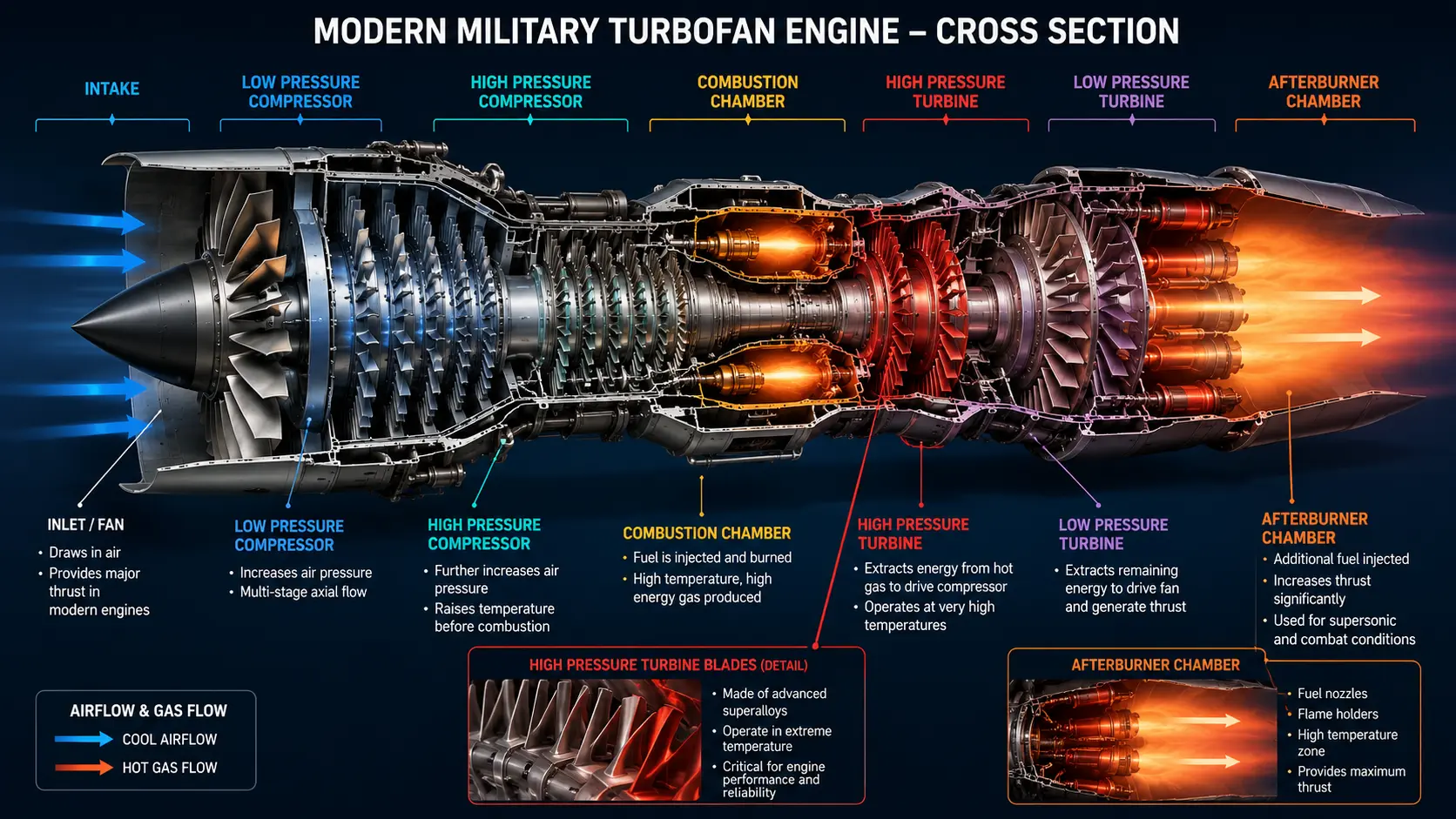
Military aviation relies on high-performance gas turbine engines capable of operating under high g-forces and thermal strain.
Types: Turbojet, Turbofan, Turboprop, and Turboshaft engines.
Applications: Fighter jets, tactical airlifters, attack helicopters, and airborne early warning platforms.
Key Requirement: Modern fifth- and sixth-generation fighters require engines capable of supercruise (supersonic flight without afterburners), 3D thrust vectoring, and minimal radar/heat signatures.
2. Tank and Armoured Vehicle Engines
Main Battle Tanks (MBTs) demand high-horsepower diesel or gas turbine powerpacks capable of delivering instant torque across unpredictable terrain.
Characteristics: High output (1,000–1,500+ HP), high torque at low RPMs, compact spatial footprint, and quick battlefield replacement.
Future Shift: Next-generation combat vehicles are moving toward hybrid-electric propulsion systems for silent watch capabilities.
3. Naval Propulsion Systems
Modern naval engineering balances high-speed interception with ultra-quiet acoustic signatures to evade sub-surface tracking.
Technologies: Marine diesel engines, naval gas turbines, Combined Diesel and Gas (CODAG), Combined Diesel-Electric, and Nuclear Reactors.
Focus: Lowering acoustic noise profiles, optimizing cruise fuel economy, and maintaining high power margins for directed-energy weapons.
4. Missile Propulsion
Missiles utilize specific engine designs depending on flight profile and target range.
Technologies: Solid rocket motors (instant acceleration), liquid-fuel engines, ramjets, and scramjets for hypersonic weapons cruising above Mach 5.
5. UAV and Drone Engines
Unmanned Systems use tailored powerplants ranging from lightweight internal combustion engines to hybrid setups.
Technologies: Small piston engines, rotary (Wankel) engines, miniature gas turbines, electric motors, and hybrid-electric powertrains.
Focus: Long-endurance UAVs prioritize ultra-low brake specific fuel consumption (BSFC), while tactical loitering drones focus on quiet electric propulsion.
Emerging Technologies Shaping Next-Gen Propulsion
Adaptive Cycle Engines (ACE)
Adaptive or “Three-Stream” engines dynamically alter airflow during flight. By introducing a third stream of air, the engine switches seamlessly between maximum thrust for air-to-air combat and high-bypass fuel efficiency for long-range cruising.
Digital Twins & FADEC Integration
Modern engines rely on Full Authority Digital Engine Control (FADEC) paired with AI-driven Digital Twins. Real-time sensor monitoring allows maintenance crews to fix minor structural anomalies before mechanical failure occurs.
Next-Generation Metallurgy & Materials
To withstand combustor temperatures exceeding 2,000°C, modern engine manufacturers employ:
Single-Crystal Superalloys: Eliminates grain boundaries to withstand extreme centrifugal forces.
Ceramic Matrix Composites (CMCs): Provides high heat tolerance at a fraction of the weight of traditional metals.
Thermal Barrier Coatings (TBCs): Insulates core turbine components from extreme thermal wear.
India’s Indigenous Defence Engine Ecosystem
Through initiatives like Atmanirbhar Bharat, India is accelerating efforts to design, test, and manufacture military propulsion systems locally:
Aviation: Focus on reviving the Kaveri 2.0 turbofan program and initiating joint development projects with global OEMs (e.g., Safran, Rolls-Royce) for a 110–120 kN engine to power the Advanced Medium Combat Aircraft (AMCA) Mk2.
Unmanned Systems: Deployment of Dry Kaveri variants and specialized small internal combustion engines for tactical and high-altitude UAV fleets.
Land & Naval: Development of high-power domestic tank engines (DATRAN project) and marine gas turbine testing facilities.
Related Reading on Matribhumi Samachar:
Learn how indigenous drone manufacturing and UAV engine programs are building domestic capability: The Rise of Indigenous Defence Drones: How India Is Engineering Its New Era of Military Self-Reliance
Frequently Asked Questions (FAQ)
Q1: What is supercruise in military aviation engines?
A: Supercruise is the ability of a fighter aircraft to sustain supersonic flight without using afterburners, significantly saving fuel and extending operational range.
Q2: Why is developing a domestic jet engine so difficult?
A: Jet engine development requires mastering single-crystal metallurgy, advanced ceramic coatings, precision machining, and complex thermodynamic controls—technologies guarded closely by a small handful of nations.
Q3: How do Ceramic Matrix Composites (CMCs) improve engine efficiency?
A: CMCs are lighter than traditional superalloys and can withstand much higher operating temperatures without requiring heavy cooling air, thereby increasing thermal efficiency and thrust.
Q4: What is an Adaptive Cycle Engine?
A: It is a next-generation engine that uses a third stream of air to dynamically adjust its bypass ratio, switching between high-thrust fighter modes and high-efficiency passenger-like modes depending on tactical needs.
Disclaimer
This article is intended for educational and informational purposes only. The information provided regarding defence engine technology, military research programs, and industrial trends is curated from open-source reporting and military analysis. Readers should consult official press releases from respective Ministries of Defence or verified defence contractors for official procurement and technical updates.
