

Mumbai. Tuesday, 21 July 2026
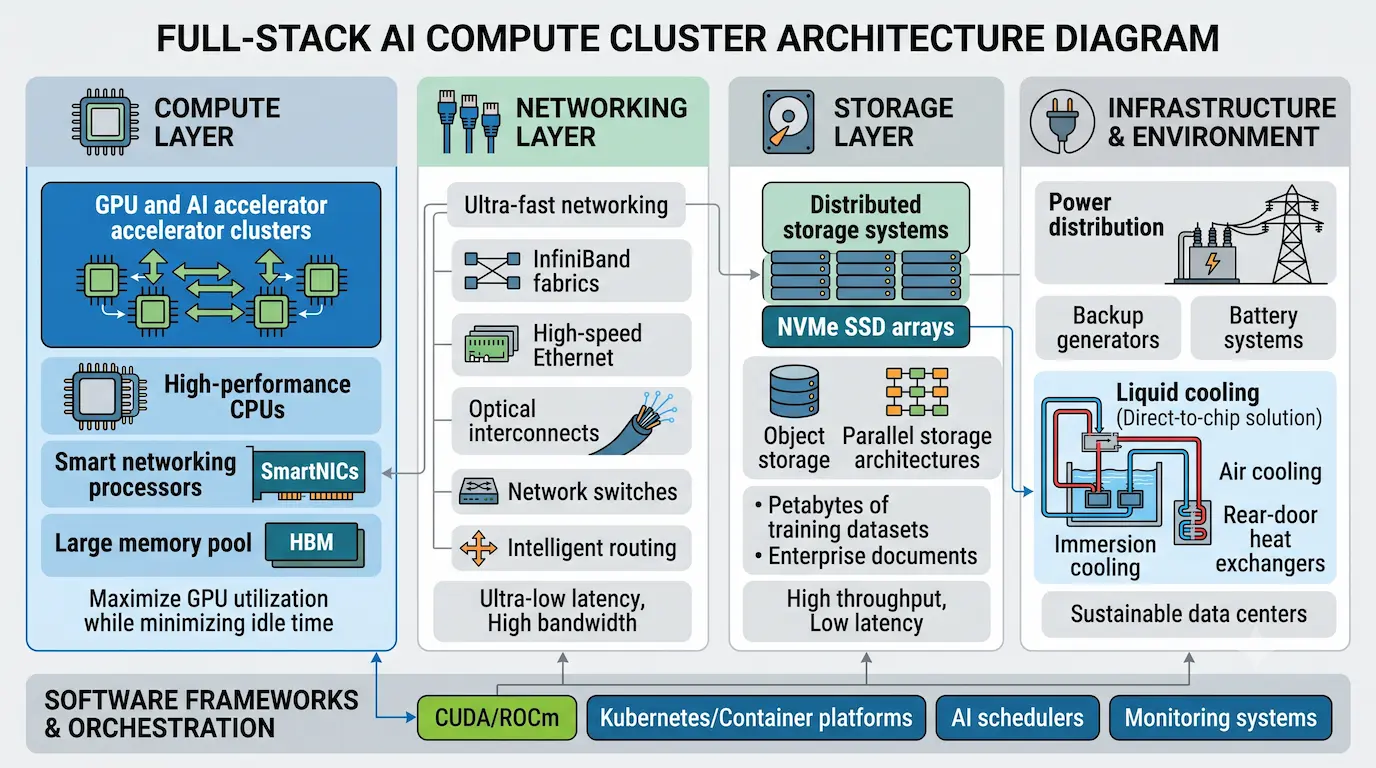
Artificial Intelligence has transformed from a software buzzword into the primary strategic engine shaping global economic dominance. While public commentary frequently fixates on high-profile Graphics Processing Units (GPUs) and massive hyper-scaler facilities, these represent only the visible layer of a far deeper physical and digital architecture.
To realize its ambition of becoming a global tech powerhouse, India’s AI strategy rests on an integrated AI compute ecosystem—a synchronized system spanning silicon design, optical networking, distributed storage arrays, energy grids, liquid cooling, orchestration software, and specialized engineering talent.
1. The Compute Layer: Optimization Beyond the Processor
Modern deep learning workloads are distributed across thousands of compute nodes. While GPUs handle massive parallel matrix calculations, their throughput depends entirely on balanced co-processing hardware.
┌─────────────────────────────────────────────────────────┐
│                     COMPUTE NODE                        │
│  ┌─────────────────┐             ┌───────────────────┐  │
│  │   AI Accelerators│<──High-Speed│ High-Core-Count  │  │
│  │   (GPUs/GPGPUs) │   Bus Inter.│ CPUs / SmartNICs  │  │
│  └────────┬────────┘             └─────────┬─────────┘  │
└───────────┼────────────────────────────────┼────────────┘
            │                                │
            ▼                                ▼
 ┌─────────────────────┐          ┌──────────────────────┐
 │  High-Bandwidth     │          │ Lossless Optical     │
 │  Memory (HBM) Pool  │          │ Networking Fabric    │
 └─────────────────────┘          └──────────────────────┘
Without ultra-fast memory access and high-core-count CPUs feeding data to accelerator cores, expensive silicon sits idle—creating costly compute bottlenecks.
2. High-Speed Interconnects and Storage Throughput
Training foundation models requires thousands of GPUs to synchronize parameters across an infrastructure cluster after every step.
Networking Architecture: Traditional enterprise Ethernet introduces packet loss and latency that slow down distributed training. Systems rely heavily on InfiniBand fabrics, SmartNICs, optical interconnects, and losslessly tuned high-speed Ethernet.
Storage Ingestion: AI datasets—spanning petabytes of unstructured video, text, and sensor data—require high-throughput NVMe SSD arrays, parallel file systems, and distributed object stores to feed pipelines without data starvation.
3. Thermal Management and Clean Power Requirements
As silicon design scales to higher Thermal Design Power (TDP) thresholds, traditional air cooling reaches physical limits.
               COOLING EVOLUTION IN DATA CENTERS

    Air Cooling       Rear-Door Heat        Direct-to-Chip       Immersion
     (Legacy)        Exchangers (Hybrid)    Liquid (Modern)      (Next-Gen)
   [───────────]  ──>  [───────────]  ──>    [───────────]  ──>  [───────────]
   Low Density         Medium Density        High TDP Density     Ultra Density
Cooling Innovation: AI facilities are shifting directly to direct-to-chip liquid cooling and immersion systems to safely dissipate heat.
Energy Capacity: Electricity availability has become a primary bottleneck for high-density computing. India’s clean energy expansion—with over 50% of installed capacity derived from non-fossil sources—offers a distinct advantage for sustainable data center scaling.
4. India’s Sovereign AI Infrastructure Landscape
To democratize access to advanced compute, the ₹10,372 Crore IndiaAI Mission has restructured how compute is provisioned.
  ┌───────────────────────────────────────────────────────────┐
  │                 INDIA AI MISSION ARCHITECTURE             │
  └─────────────────────────────┬─────────────────────────────┘
                                │
        ┌───────────────────────┼───────────────────────┐
        ▼                       ▼                       ▼
  ┌───────────┐           ┌───────────┐           ┌───────────┐
  │  Compute  │           │   Target  │           │   Silcon  │
  │  Portal   │           │ Startups  │           │  Strategy │
  └─────┬─────┘           └─────┬─────┘           └─────┬─────┘
        │                       │                       │
        ▼                       ▼                       ▼
┌──────────────┐        ┌──────────────┐        ┌──────────────┐
│  38,000+ GPUs│        │ MSMEs, Research│      │  Semicon 2.0 │
│ Onboarded    │        │ & Academia   │        │ & RISC-V     │
└──────────────┘        └──────────────┘        └──────────────┘
Through the IndiaAI Compute Portal, the government onboards GPU clusters via cloud providers, offering compute to startups, researchers, and academia at heavily subsidized rates.
Massive Compute Expansion: Onboarded capacity has crossed 38,000 GPUs, with an additional 20,000 GPUs being added under expanding procurement frameworks.
Semiconductor Autonomy (ISM 2.0): The Semicon India Programme and Design Linked Incentive (DLI) scheme support domestic chip design, packaging, and open-source RISC-V architectures to lower long-term import reliance.
Edge Deployment: Driven by industrial automation, smart cities, and 5G networks, AI capabilities are decentralizing from central clouds directly to real-time edge devices.
Explore Related Deep Dives
For further analysis on semiconductor supply chains, sovereign compute architectures, and advanced packaging developments, explore coverage from Matribhumi Samachar:
The Sovereign AI Revolution: Building Independent Digital Backbones
India’s Silicon Leap: Glass-Core Substrates & Advanced Packaging
Frequently Asked Questions (FAQ)
What components make up a complete AI compute ecosystem?
A full-stack AI ecosystem requires GPUs/accelerators, high-core CPUs, high-speed networking (InfiniBand/Ethernet), high-throughput storage (NVMe/distributed file systems), orchestration software, high-density power grids, and advanced cooling infrastructure.
Why is liquid cooling becoming essential for AI data centers?
Modern high-performance AI chips output heat densities beyond the cooling capabilities of traditional air systems. Direct-to-chip and immersion liquid cooling maintain optimal operating temperatures while reducing overall energy consumption.
How does the IndiaAI Mission lower compute costs for startups?
The IndiaAI Mission subsidizes compute capacity onboarded through empanelled cloud providers. Startups, academics, and researchers can access high-performance GPU clusters via the national portal at heavily reduced hourly rates.
Disclaimer
This article is for informational and educational purposes only. Information regarding government policies, GPU allocations, and semiconductor initiatives is based on publicly available updates and industry developments. Readers should verify official government portals for current policy guidelines and incentive schemes.
