

Mumbai. Tuesday, 21 July 2026
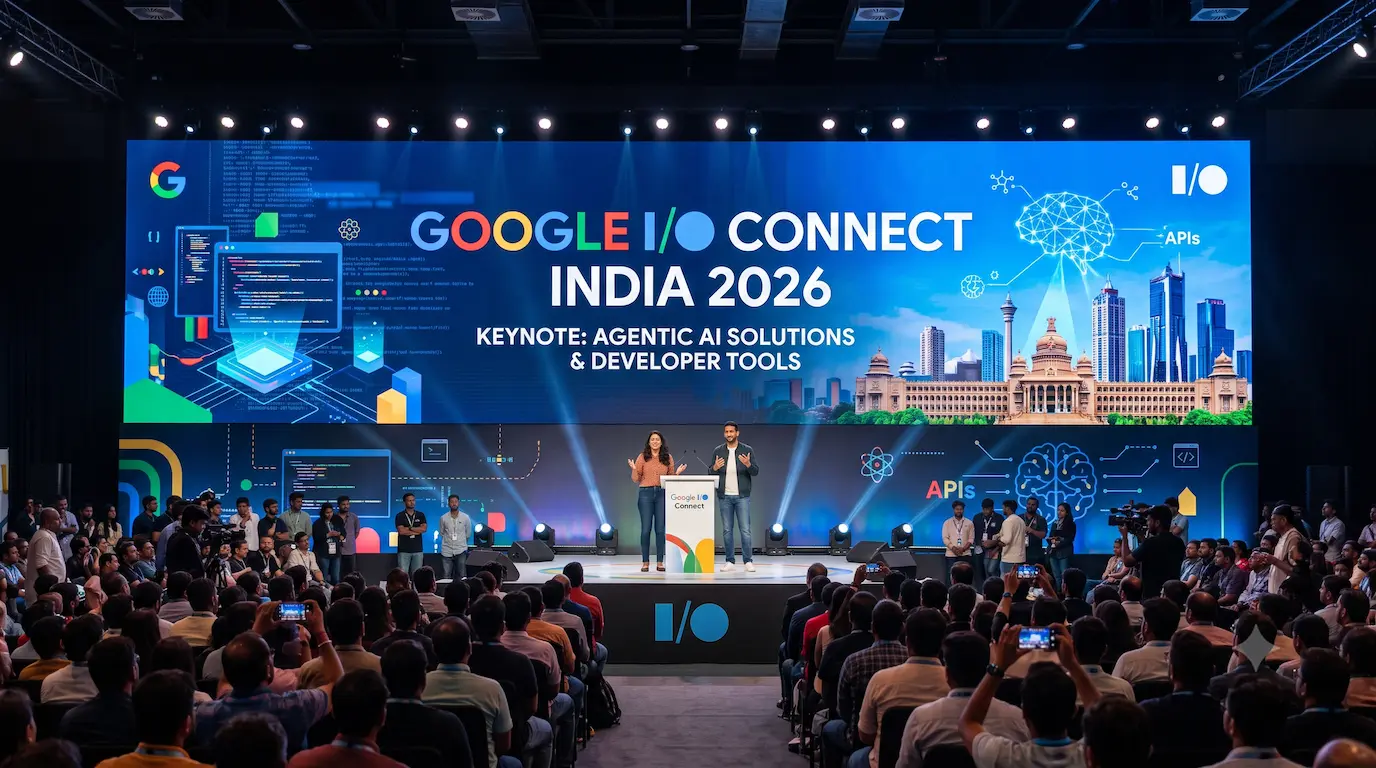
At Google I/O Connect India 2026, held at the Bangalore International Exhibition Centre (BIEC) in Bengaluru, Google officially signaled a massive shift in how artificial intelligence will be built, deployed, and secured across the subcontinent.
Moving past basic conversational chatbots, the central theme of 2026 focused on Agentic AI—autonomous, multi-step AI systems capable of executing complex workflows, making secure decisions, and driving real-world task execution safely.
1. Deepening Developer Skills & Research Workforce
Recognizing that building foundation models requires more than basic prompt engineering, Google DeepMind unveiled high-impact workforce programs designed to turn India into an AI research powerhouse:
AI Research Foundations Curriculum: A free, 56-hour comprehensive course from Google DeepMind created to teach engineers how to construct, fine-tune, and align Large Language Models (LLMs) from scratch. Google is partnering with NASSCOM and IISc Bengaluru to scale this curriculum across Indian academic institutions.
ATL Saathi for Classrooms: Deepening its alliance with the Atal Innovation Mission, Google introduced ATL Saathi, a Gemini-powered web application that acts as a co-pilot for teachers in Atal Tinkering Labs. It provides step-by-step experiment guidance in robotics and electronics, launching in 100 schools initially with a target of 10,000.
2. Enterprise Cloud & Data Sovereignty
To address strict data localization requirements across government, defense, and financial sectors, Google Cloud introduced sovereign cloud options for Indian enterprises:
[Regulated Sector Data] ──► [Google Distributed Cloud (GDC)] ──► [In-Country Processing]
                                (On-Premises in India)              (Fully Air-Gapped)
Gemini on Google Distributed Cloud (GDC): Highly regulated industries (such as banking and public sector agencies) can now deploy frontier Gemini models on-premises within Indian data centers, operating entirely air-gapped from the public internet.
Gemini Enterprise Agent Platform: Gives startups and enterprises access to Gemini 3.5 Flash with strict, in-country machine learning data processing guarantees.
3. Trust, Security, and Agent Guardrails
As AI systems transition into autonomous agents capable of interacting with databases and APIs, Google open-sourced critical security frameworks:
CAPSEM (Capabilities Security for Agents): An open-source runtime environment created by Google’s Privacy and Security team that isolates each AI agent within an isolated virtual machine, ensuring malicious prompts cannot compromise the broader corporate network.
Sec-Gemini V3 & CodeMender: Rolled out specialized cybersecurity AI agents to Indian enterprise testers (like Flipkart) to automate incident investigation and generate security hotfixes directly for open-source repositories.
Agent-Led Payment Protocols (A2A & AP2): Introduced new open protocols for low-value agentic financial transactions (under $100), backed by Device Bound Session Credentials (DBSC) to render stolen session tokens useless.
4. Multilingual Access & Healthcare AI Innovations
Google expanded its localized AI footprint to make digital tools accessible to every corner of India:
25+ Indian Languages on Gemini Live: Native conversational voice and text support expanded to include regional languages and dialects such as Sanskrit, Bhojpuri, and Maithili.
Open Diagnostic Models with AIIMS Delhi: Researchers at AIIMS Delhi are utilizing Google’s open MedGemma models to build diagnostic tools tailored for identifying conditions like leprosy and managing reproductive health via image and text inputs.
Economic Impact: The $60 Billion Digital Engine
Google showcased the massive economic flywheel driven by its open mobile and cloud platforms. Third-party estimates indicate that the Android and Google Play ecosystem contributed ₹5.3 lakh crore (~US$60 billion) to India’s digital economy in 2025 alone—reflecting a 28% year-over-year growth rate.
Frequently Asked Questions (FAQ)
What was the central theme of Google I/O Connect India 2026?
The core focus was Agentic AI—moving beyond standard conversational text generation toward autonomous AI systems capable of executing multi-step tasks, workflows, and transaction protocols securely.
How can Indian developers access free LLM training from Google?
Developers can enroll in Google DeepMind’s free 56-hour AI Research Foundations curriculum via the Google Skills platform, earning Google Cloud Skill Badges upon completion.
What is CAPSEM?
CAPSEM (Capabilities Security for Agents) is an open-source sandbox runtime environment that isolates AI agents inside individual virtual machines, preventing malicious prompt injections from affecting broader infrastructure.
Relevant Links & External Coverage
For additional coverage, regional reporting, and context on Indian technology news, visit the following resource:
For national tech updates and current affairs analysis, visit Matribhumi Samachar English.
Disclaimer: This article is published for informational and educational purposes only. Product specifications, developer availability, and curriculum details mentioned reflect announcements made during Google I/O Connect India 2026. Readers and enterprise buyers should verify technical implementation details directly on official Google Cloud and Google Developer documentation.
