

Mumbai | Wednesday, 22 July 2026
Global crude oil price movements remain one of the most critical external determinants of India’s macroeconomic stability. As the world’s third-largest crude consumer, India imports roughly 88–90% of its total domestic crude requirements. Consequently, any sharp upward momentum in international oil benchmarks—driven by Middle Eastern geopolitical tensions or unexpected supply disruptions—triggers a widespread domino effect across transportation costs, manufacturing overheads, household fuel bills, and national account balance sheets.
Why Crude Oil Pricing Shapes the Indian Economy
Crude oil isn’t merely an energy commodity; it serves as a foundational baseline input across multiple industries. Fluctuations in Brent crude directly impact key essential categories:
Retail Transportation Fuels: Petrol and diesel prices at local pumps.
Aviation & Travel: Jet fuel (ATF) accounting for a major portion of airline operating costs.
Domestic Cooking Energy: LPG cylinder refill prices and city gas distribution networks.
Agriculture Inputs: Synthetic fertilizer production (naphtha and natural gas derivatives).
Industrial Manufacturing: Petrochemical feedstocks, plastics, synthetic rubber, and industrial solvents.
Freight & Supply Chains: Primary trucking logistics moving agricultural produce and FMCG goods nationwide.
When international crude costs surge, production and logistical expenses escalate across all these sectors, creating direct and indirect inflationary waves throughout the domestic economy.
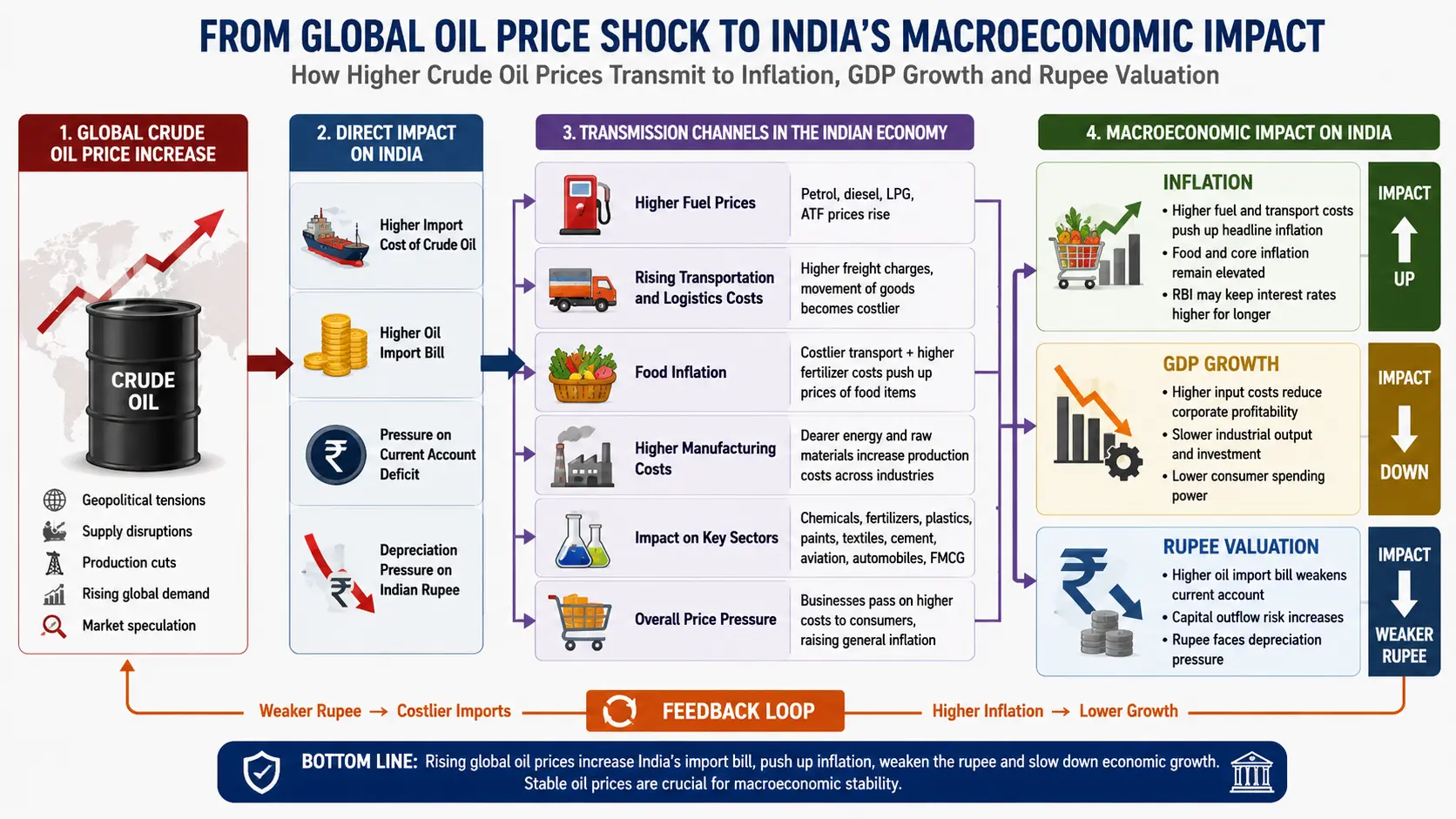
The 5 Channels of Inflationary Impact in India
Global Oil Price Surge
  │
  ├──► 1. Higher Fuel Prices (Direct retail pump price adjustments)
  │
  ├──► 2. Rising Freight Charges (Higher diesel logistics costs)
  │
  ├──► 3. Food Inflation (Increased transport & fertilizer expenses)
  │
  ├──► 4. Manufacturing Input Strain (Petrochemicals, paints, plastics)
  │
  └──► 5. Currency Depreciation (Dollar demand rises ➔ imported inflation)
Direct Fuel Escalation: Higher crude prices place immediate pressure on state-run Oil Marketing Companies (OMCs like IOCL, BPCL, HPCL) to eventually pass on costs to consumers via higher petrol, diesel, and LPG rates.
Rising Transportation Charges: As diesel prices go up, long-haul freight rates increase, inflating the cost of moving industrial raw materials and consumer goods.
Food Inflation Spikes: Transporting fresh produce, vegetables, grains, and dairy from agricultural hubs to urban mandis becomes more expensive, compounding pressure on food prices.
Manufacturing Margin Pressure: Industries reliant on oil derivatives—such as paints, chemicals, plastics, automotive tires, textiles, and FMCG—face squeezed operating margins, forcing them to hike end-product retail prices.
The “Imported Inflation” Double Whammy: India buys oil in US Dollars. Elevated oil prices drive up India’s dollar demand, weakening the Indian Rupee (INR) against the USD. A weaker Rupee makes every subsequent imported commodity even more expensive in local terms.
Summary of Macroeconomic Indicators Under Stress
| Macro Indicator | Expected Economic Trend | Transmission Mechanism |
| Consumer Inflation (CPI) | Upward Pressure | Every $10/barrel jump in Brent crude adds 0.2%–0.3% to headline retail inflation. |
| Current Account Deficit (CAD) | Widens | Every $1/barrel sustained surge adds roughly $1.5–$2.0 Billion to the annual import bill. |
| GDP Growth Rate | Moderate Slowdown | High energy costs curb discretionary consumer spending and corporate capital expenditure. |
| Fiscal Position | Increased Risk | Government faces pressure to lower central excise duties or absorb OMC under-recoveries. |
| Rupee Exchange Rate (INR/USD) | Depreciation Risk | Dollar outlfows increase to pay the energy bill, weighing down currency valuation. |
Sectors Most Exposed to Energy Price Shocks
Energy-intensive industries experience immediate margin contraction when global crude trades elevated over extended periods:
Airlines: Jet fuel accounts for nearly 40% of an airline’s operational expenditures.
Logistics & Transportation: Trucking fleets and courier networks face direct diesel margin cuts.
FMCG & Paints: Packaging costs (plastics) and primary raw material inputs (titanium dioxide, synthetic resins) scale higher.
Fertilizer Manufacturers: Higher feedstock costs necessitate greater government subsidy allocations.
Automobiles & Cement: Logistics costs and freight for heavy raw materials compress sector profitability.
Government and RBI Policy Toolkit
To insulate the domestic ecosystem against severe global energy shocks, Indian policymakers typically activate multi-tiered defense mechanisms:
Strategic Petroleum Reserves (SPRs): Deploying emergency crude reserves from storage facilities in Visakhapatnam, Mangaluru, and Padur to stabilize temporary supply deficits.
Fiscal Duty Calibration: Temporarily slashing central excise duties on petrol and diesel to prevent complete price pass-through to end consumers.
Import Diversification: Purchasing crude from diverse global suppliers offering competitive pricing or discounted terms to reduce overall foreign exchange outflow.
Reserve Bank of India (RBI) Action: Utilizing foreign exchange reserves to curb extreme currency volatility and maintaining tight monetary policy via interest rates to anchor inflation expectations.
Outlook
If global geopolitical friction subsides and energy markets stabilize, domestic inflationary pressures will naturally moderate. However, a prolonged phase of elevated Brent crude prices will remain a primary swing factor for India’s economic momentum, test fiscal margins, and heavily guide future Reserve Bank of India monetary policy decisions.
Frequently Asked Questions (FAQ)
How much crude oil does India import?
India imports between 88% and 90% of its daily crude oil requirements, making it the world’s third-largest oil importer and highly vulnerable to international price spikes.
How does high oil price cause food inflation in India?
Higher oil prices directly increase diesel costs. Since diesel runs the majority of India’s agricultural transport trucks and farm equipment (like tractors and pump sets), logistics costs increase, driving up market prices for fruits, vegetables, grains, and milk.
How does crude oil impact the Indian Rupee?
India buys crude oil using US Dollars. When oil prices increase, Indian importers require more USD to buy the same volume of oil. This surges dollar demand, leading to the depreciation of the Indian Rupee (INR) relative to the US Dollar.
Disclaimer
This article is provided for informational and analytical purposes only, reflecting macroeconomic data and energy market conditions as of July 2026. Prospective investors and readers should review formal government notifications, market updates, and official RBI publications prior to making financial or strategic decisions.
Relevant Articles & Sources
For more coverage on India’s macroeconomic strategies, supply chain developments, and energy transitions, explore these relevant articles from Matribhumi Samachar English:
Read about infrastructure and energy corridor investments: 73rd Meeting of Network Planning Group Under PM GatiShakti Evaluates Key Projects
Explore trade and energy cooperation details: India-Australia CECA: Ushering a New Era in Trade and Green Energy
Learn about strategic industrial schemes for supply chain resilience: India Extends ₹7,280-Crore Rare Earth Permanent Magnet Scheme Application Deadline
