

New Delhi. Wednesday, 22 July 2026
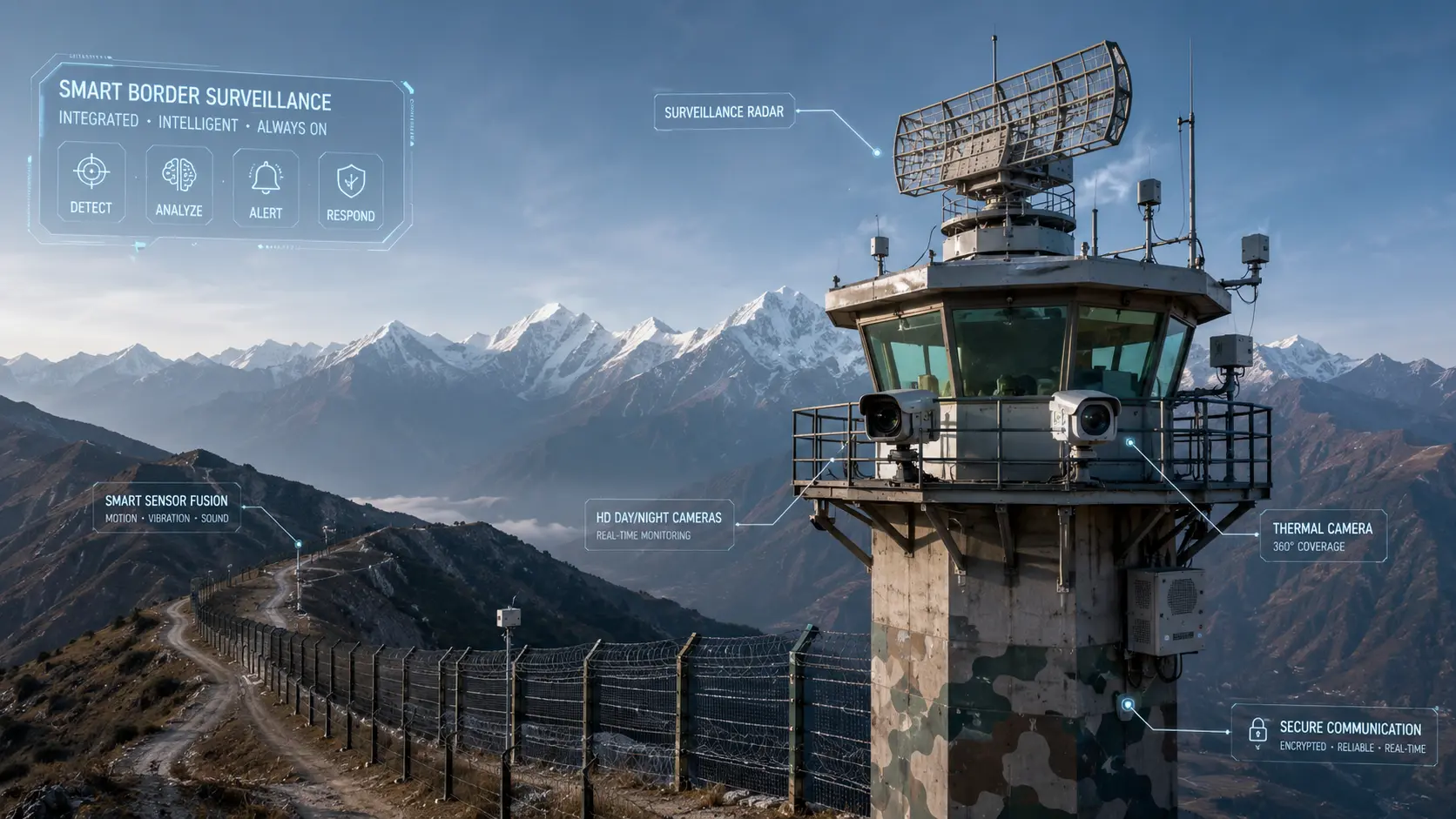
For centuries, nations relied heavily on concrete walls, barbed wire, and physical patrols to safeguard sovereign boundaries. However, remote terrains, extreme weather conditions, and modern infiltration techniques have exposed the physical limitations of traditional border security. Enter Smart Border Grid technology—an integrated digital ecosystem that turns miles of uninhabited perimeter into an intelligent, real-time surveillance network.
Instead of deploying guards across thousands of miles of harsh terrain, a Smart Border Grid creates a continuous digital security web. By fusing artificial intelligence (AI), long-range optics, autonomous aerial systems, and buried sensors, defense forces can detect, identify, and interdict illegal crossings before intruders even reach the physical perimeter.
8 Essential Pillars of a Smart Border Grid
                  +-----------------------------------+
                  |   Command & Control Dashboard     |
                  +-----------------+-----------------+
                                    |
      +-----------------------------+-----------------------------+
      |                             |                             |
+-----+-----+                 +-----+-----+                 +-----+-----+
|  AI/Edge  |                 | Sensor    |                 | Aerial    |
| Analytics |                 | Array     |                 | & Orbit   |
+-----+-----+                 +-----+-----+                 +-----+-----+
      |                             |                             |
      |-- Video Analytics           |-- Ground Sensors            |-- Autonomous UAVs
      |-- Threat Categorization     |-- Radar Systems             |-- Satellites
      |-- Automated Alerts          |-- Thermal/EO Optics         |-- Secure Mesh Nets
AI-Powered Surveillance: Artificial intelligence algorithms analyze live streams from hundreds of nodes simultaneously, filtering out natural false alarms (such as wildlife or blowing vegetation) and flagging suspicious human or vehicular movement patterns.
Electro-Optical & Thermal Imaging: Dual-spectrum long-range cameras maintain visual command during pitch-black nights, thick fog, or heavy monsoon rain.
Buried Ground Sensors: Hidden seismic, acoustic, and subterranean vibration sensors detect footsteps, tunneling, or heavy machinery movement near sensitive zones.
Surveillance Radar Systems: Compact ground-search radar units continuously scan several kilometers of land or riverine routes.
Drone Swarms & UAVs: Unmanned aerial vehicles perform routine automated sweeps, providing command teams with instant aerial vantage points over impenetrable terrains.
Low Earth Orbit (LEO) Satellites: Satellite connectivity guarantees high-speed data transmission across remote deserts, mountain passes, and dense jungles where cellular towers cannot exist.
Encrypted Tactical Networks: High-bandwidth mesh networks link border towers, mobile patrols, and command centers without risking interception or electronic warfare breaches.
Centralized Command & Control (C4ISR): Multi-source sensor data consolidates onto a unified operational dashboard, giving commanders complete situational awareness in real time.
Operational Workflow: From Detection to Interdiction
A Smart Border Grid replaces slow manual verification with an automated operational chain:
Detection: Buried seismic sensors or radar flag anomalous motion along a sector.
Target Lock: Automated pan-tilt-zoom (PTZ) optical and thermal cameras automatically lock onto the coordinates.
AI Evaluation: Edge computer-vision models classify the target (e.g., wild animal vs. human group).
Alert Trigger: The central operational room receives a verified high-priority alert.
Rapid Response: Patrol teams or autonomous interceptor drones launch with exact GPS coordinates for swift resolution.
Global Case Studies in Action
Governments around the world are rapidly adopting smart grid architectures to fortify their frontiers:
India: Through the Comprehensive Integrated Border Management System (CIBMS), India deploys smart fencing, riverine underwater sensors, and integrated command centers along complex sectors.
United States: High-tech autonomous surveillance towers (ASTs) backed by radar and thermal optics monitor wide expanses of desert terrain.
Israel: Multi-layered smart fences combining subterranean sensors, AI tracking, and remote-controlled defense units safeguard perimeter sectors.
European Union: Member states utilize common biometric frameworks, satellite monitoring, and AI-assisted surveillance to manage external Schengen boundaries.
Key Challenges & Technical Barriers
While Smart Border Grids offer unparalleled security, implementation requires overcoming significant hurdles:
High Infrastructure Investment: High initial capital costs for sensors, optic towers, and fiber/satellite backbones.
Cybersecurity Exposure: Susceptibility to signal jamming, spoofing, and cyberattacks targeting central command databases.
Harsh Operating Environments: Extreme desert heat, freezing alpine temperatures, and coastal salt spray cause hardware degradation over time.
Privacy & Legal Frameworks: Regulatory limits regarding biometric data harvesting and civilian surveillance in populated border zones.
Frequently Asked Questions (FAQ)
Q1: What makes a Smart Border Grid different from a traditional border fence?
A: A traditional fence is a passive physical barrier that can be cut, climbed, or tunneled under without immediate detection. A Smart Border Grid is an active digital network that uses sensors, optics, and AI to identify threats continuously and dispatch responders in real time.
Q2: How does the system avoid false alarms from wildlife?
A: Computer vision models trained on deep learning datasets analyze movement velocity, shape, and heat signatures to distinguish animals or wind-blown debris from human activity before generating an alert.
Q3: Can Smart Border Grids function in remote areas without power infrastructure?
A: Yes. Modern field nodes rely on hybrid renewable power setups (solar panels and long-life industrial battery banks) and send data via satellite or long-range encrypted wireless mesh networks.
Recommended Contextual Reading
For additional localized coverage on defense technologies, border logistics, and security policies, explore these resources on Matribhumi Samachar:
National & Regional Security Updates: Matribhumi Samachar Regional News
Defence Tech & Security Analysis: Matribhumi Samachar Main Section
Disclaimer: This article is written for educational and informational purposes only. Information regarding military and border technology implementations is compiled from publicly available defense reports, industry analysis, and open-source intelligence.
