

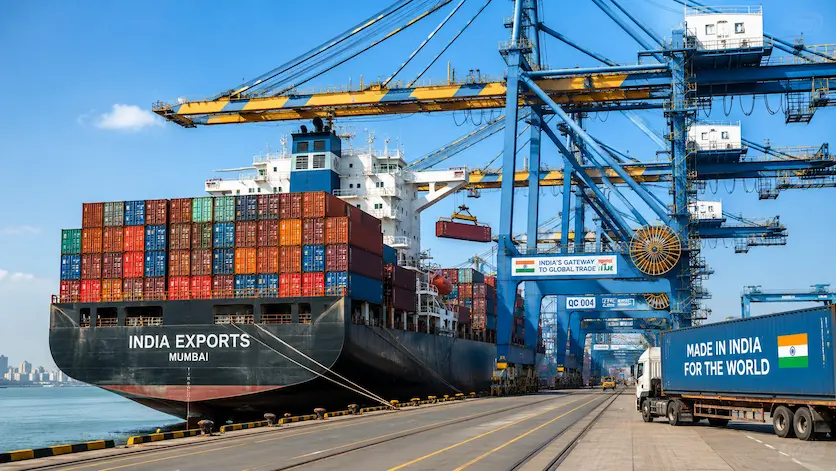
Mumbai. Wednesday, 22 July 2026
India’s position on the global economic stage is undergoing a profound transformation. As the world’s fifth-largest economy, India is no longer just a major consumer market—it is rapidly establishing itself as a global hub for manufacturing, high-tech innovation, and digital services.
At the center of this shift is India’s export competitiveness: the country’s ability to produce and sell goods and services in international markets at attractive prices while maintaining high standards of quality, innovation, and supply chain reliability. With total exports (merchandise and services combined) surging past $860 billion, the ecosystem is strengthening across every major sector.
What Drives India’s Export Surge?
Several key structural drivers have aligned to accelerate India’s trade momentum:
1. Robust Manufacturing Base & PLI Incentives
Through flagship initiatives like Make in India and the Production-Linked Incentive (PLI) schemes, India has shifted from simple assembly to high-value manufacturing.
Electronics Boom: Electronics exports have surged past $38 billion, driven by domestic smartphone manufacturing and component ecosystems.
Core Diversification: Sectors such as pharmaceuticals, automobiles, specialty chemicals, and engineering goods continue to expand their global market share while increasing domestic value addition to lower import dependencies.
2. Competitive Labor & Engineering Talent
India offers a unique demographic advantage: a massive, skilled workforce paired with world-class technical talent. This deep talent pool allows domestic manufacturers and tech firms to maintain competitive cost structures without compromising on precision, quality, or technological innovation.
3. Unrivaled Leadership in Services Exports
While physical goods exports expand, services remain India’s bedrock of global trade:
Information Technology & Software: Leading global digital transformation projects.
Global Capability Centres (GCCs): Over 1,600 GCCs operate across Indian metros, carrying out cutting-edge R&D, artificial intelligence engineering, and strategic corporate operations.
BPO & Professional Consulting: Consistently delivering financial, legal, and engineering solutions to Fortune 500 companies worldwide.
4. Overhauling Logistics Infrastructure
High logistics costs have historically been a friction point for Indian exporters. Today, targeted government investments are bringing domestic logistics costs closer to international standards:
PM Gati Shakti National Master Plan: Integrated spatial planning for multimodal connectivity.
Dedicated Freight Corridors (DFCs): Fast-tracking rail cargo from inland manufacturing centers directly to major ports.
Sagarmala & Port Modernization: Streamlining maritime shipping along India’s extensive coastline.
Initiatives such as the government’s ambitious Districts as Export Hubs scheme are empowering local micro, small, and medium enterprises (MSMEs) across hundreds of districts to tap directly into foreign markets.
5. Forward-Looking Free Trade Agreements (FTAs)
Strategic trade diplomacy is giving Indian exporters preferred market access. Economic partnerships, including landmark pacts like the India-Australia CECA, are slashing tariffs on industrial raw materials, critical minerals, clean tech, and agricultural products while opening new avenues for cross-border digital services.
At a Glance: Key Export Sectors & Advantages
| Sector | Primary Export Drivers | Key Competitive Advantage |
| Electronics | Smartphones, components, consumer devices | Large-scale assembly & growing semiconductor ecosystem |
| Pharmaceuticals | Generic drugs, active ingredients (APIs), vaccines | Known as the “Pharmacy of the World” for affordable quality |
| Engineering Goods | Industrial machinery, auto parts, heavy equipment | Strong manufacturing heritage and technical precision |
| Chemicals | Specialty chemicals, polymers, petrochemicals | Advanced chemical synthesis & green chemistry transition |
| Textiles & Apparel | Cotton yarn, readymade garments, technical textiles | Rich raw material base & skilled artisan heritage |
| Gems & Jewellery | Cut & polished diamonds, gold jewellery | World leader in diamond processing and craft |
| IT & Services | Cloud, AI, software development, GCC R&D | World’s largest concentration of digital engineering talent |
Overcoming Structural Challenges
Despite impressive growth, sustaining long-term competitiveness requires tackling key headwinds:
Input Dependencies: Continued reliance on imported crude oil, specialized semiconductor chips, and select active pharmaceutical ingredients (APIs).
Global Carbon & Sustainability Rules: Navigating international policies like the EU’s Carbon Border Adjustment Mechanism (CBAM), which requires Indian steel, aluminum, and manufacturing sectors to decarbonize rapidly.
Regional Competition: Managing cost pressures from manufacturing hubs such as Vietnam, Bangladesh, and Mexico in price-sensitive sectors.
Emerging Horizons & Future Outlook
India is positioned to capitalize on major global trends, including the “China + 1” strategy, as multinational corporations seek resilient, diversified supply chains. Opportunities in green hydrogen, electric vehicle components, defense production, and semiconductor fabrication position the nation for high-value export expansion over the coming decade.
Supported by modern logistics frameworks, targeted export incentives (like RoDTEP), and active trade diplomacy, India is steadily building a future-ready export powerhouse.
Frequently Asked Questions (FAQ)
Q1: What does “India’s export competitiveness” mean?
It refers to India’s capacity to deliver quality goods and services to international buyers at market-competitive prices, supported by reliable logistics, innovation, and strategic trade partnerships.
Q2: How do PLI schemes boost Indian exports?
Production-Linked Incentive (PLI) schemes offer financial incentives to companies based on incremental domestic sales, encouraging companies to scale up domestic manufacturing capacity, attract foreign direct investment, and produce export-ready goods.
Q3: What role does PM Gati Shakti play in global trade?
PM Gati Shakti is a multi-modal connectivity platform that integrates infrastructure planning across railways, roads, ports, and airways. It significantly reduces transit times and logistics overheads for exporters.
Disclaimer
The information provided in this article is intended solely for educational and informational purposes. Trade statistics, government policy guidelines, and market dynamics are subject to change over time based on official announcements from regulatory bodies and international trade organizations.
