 Matribhumi Samachar English


New Delhi. Thursday, 23 July 2026
India’s journey toward military self-reliance is turning a new leaf. Having built foundational momentum through the Defence Industrial Corridors in Uttar Pradesh and Tamil Nadu, the Ministry of Defence is now rolling out a network of seven specialised defence manufacturing clusters.
Instead of duplicating factory setups across state lines, this strategy creates region-specific centres of excellence. By linking state governments, industrial leaders, agile startups, MSMEs, academia, and R&D labs, India is building an integrated military-industrial ecosystem to support the Aatmanirbhar Bharat vision.
Why Expand Beyond Defence Corridors?
The Uttar Pradesh and Tamil Nadu corridors demonstrated how targeted policy can bring in substantial investments for ammunition, missiles, and armored vehicles. However, modern defense manufacturing requires specialized capabilities dispersed across multiple domains:
-
Advanced Materials & Precision Machining
-
Artificial Intelligence (AI) & Autonomous Systems
-
Cybersecurity & Radar Technologies
-
Military Testing Labs & Aerospace Certification
Distributing these functions nationwide prevents regional supply-chain bottlenecks and enables broader industrial participation.
Breakdown of the 7 Specialised Clusters
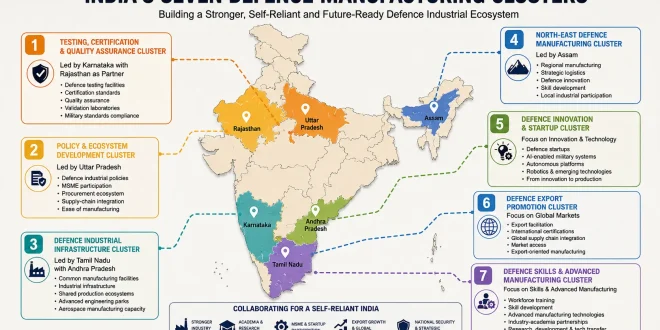
Each cluster focuses on a distinct segment of the defence value chain:
-
Testing, Certification & Quality Assurance Cluster (Led by Karnataka, Partner: Rajasthan)
Focuses on military-grade testing grounds, validation labs, and standardization compliance, supported by research teams from top IITs.
-
Policy & Ecosystem Development Cluster (Proposed Lead: Uttar Pradesh)
Aims to streamline procurement frameworks, boost MSME integration, and simplify manufacturing policies.
-
Defence Industrial Infrastructure Cluster (Jointly Developed by Tamil Nadu & Andhra Pradesh)
Provides shared engineering parks, common manufacturing units, and expanded aerospace infrastructure.
-
North-East Defence Manufacturing Cluster (Led by Assam)
Integrates Northeast India into the defense supply chain by focusing on regional manufacturing, logistics, and innovation.
-
Defence Innovation & Startup Cluster
Accelerates emerging technologies including robotics, AI-enabled systems, autonomous platforms, and military software.
-
Defence Export Promotion Cluster
Facilitates market access, international certification, and global supply-chain integration to boost exports.
-
Defence Skills & Advanced Manufacturing Cluster
Focuses on workforce upskilling, industry-academia research partnerships, and technology transfer.
🔬 Role of IITs, MSMEs, and Startups
A crucial aspect of this model is the formal inclusion of higher education institutions like the IITs to bridge the gap between lab research and factory assembly. Furthermore, rather than relying solely on Defence Public Sector Undertakings (DPSUs), this multi-tier ecosystem opens significant doors for small and medium enterprises specializing in precision components, embedded systems, drone tech, and specialized software.
❓ Frequently Asked Questions (FAQ)
How do these seven clusters differ from the existing Defence Corridors?
While the two Defence Industrial Corridors in UP and Tamil Nadu focus on physical industrial hubs, the seven clusters assign specific functional roles (such as testing, software, policy, or exports) across nationwide regions.
What role do MSMEs play in these new clusters?
MSMEs act as tier-2 and tier-3 suppliers providing precision machining, specialized sensors, drone tech, and embedded software.
How does this strategy boost India’s defence exports?
By standardizing certification, lowering production overheads, and building globally recognized testing standards, Indian defence hardware becomes more competitive in overseas markets.
📑 Related Reading & Further Coverage
-
Explore the broader context of India’s Defence Manufacturing Sector: Engineering a New Era of Strategic Self-Reliance.
-
Read about record production growth in India’s Defence Manufacturing Growth Reshapes Global Military Markets.
Disclaimer: This article is intended for informational and educational purposes only. Information regarding proposed government cluster policies, state leads, and institutional partnerships is subject to change based on official Ministry of Defence updates and notifications.