

New Delhi. Thursday, 23 July 2026
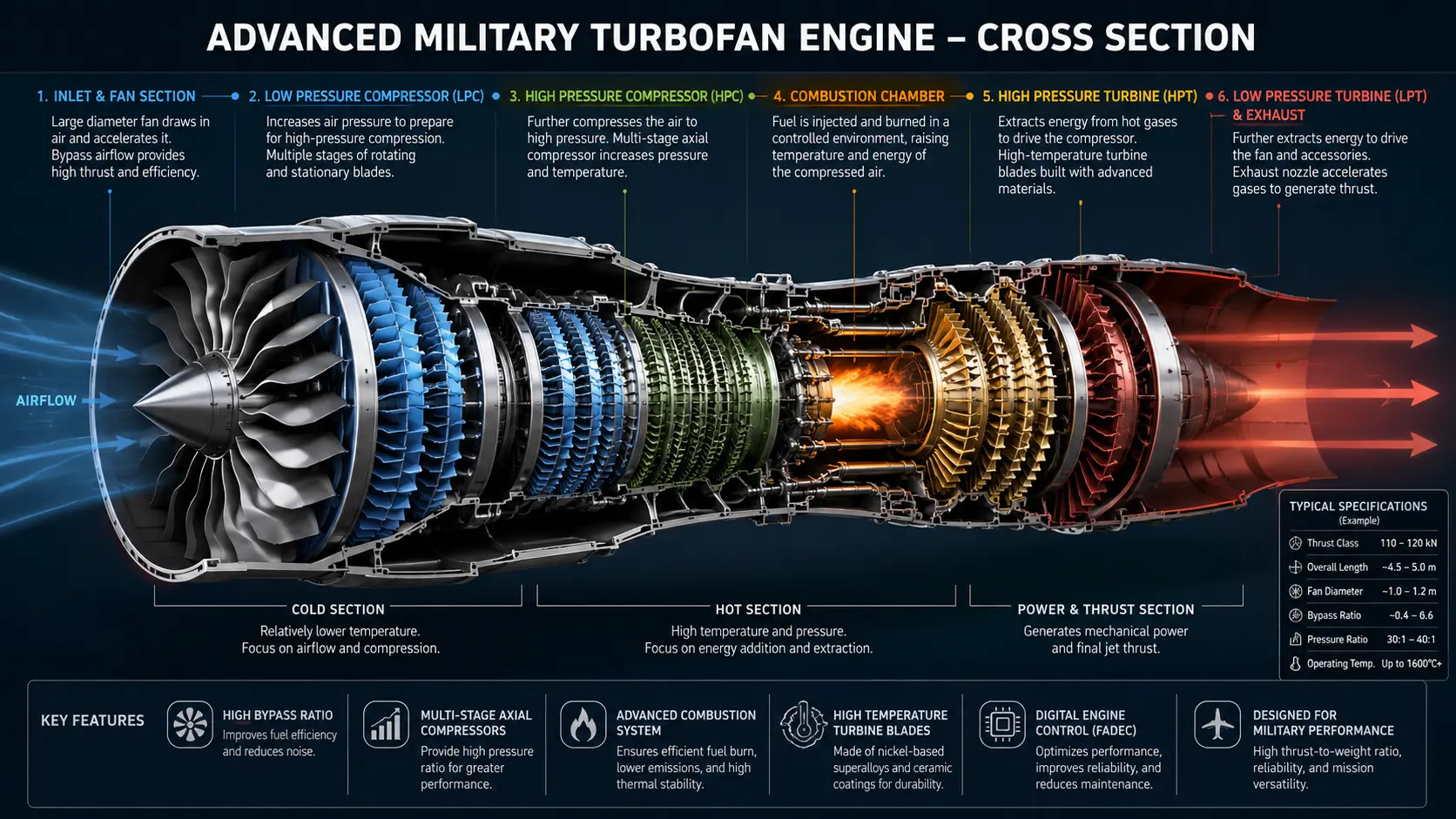
India’s quest for self-reliance in defence technology has entered a decisive phase as the nation accelerates efforts to design, build, and certify a home-grown high-thrust turbofan engine. While India has proven its engineering prowess in ballistic missiles, space exploration, and naval warships, mastering fifth-generation military jet engines remains the final, most complex frontier.
The Indigenous Turbofan Engine Programme is far more than a high-stakes engineering endeavor—it is a vital national security initiative designed to liberate India’s aerospace ecosystem from external supply chain vulnerabilities and foreign export restrictions.
Why Fighter Jet Engines Represent the Pinnacle of Manufacturing
Modern air combat demands propulsion systems that perform flawlessly under extreme thermal and mechanical stresses. A fighter’s engine directly governs critical operational metrics, including:
Supercruise: Sustained supersonic flight without engaging fuel-heavy afterburners.
Combat Radius & Payload: Maxing out ordnance capacity and mission range.
Thermal & Infrared Signature: Keeping the aircraft hidden from enemy heat-seeking sensors.
Extreme Maneuverability: Maintaining airflow stability during high-angle-of-attack evasive maneuvers.
Without a domestic engine core, even an indigenously designed stealth airframe relies on foreign propulsion partners, leaving national strategic posture vulnerable to geopolitical shifts.
The Evolutionary Curve: From Kaveri Lessons to Modern Co-Development
India’s gas turbine journey—led by the Defence Research and Development Organisation’s (DRDO) Gas Turbine Research Establishment (GTRE)—began in earnest with the Kaveri engine project. Although Kaveri missed the power-to-weight targets required for the Light Combat Aircraft (LCA) Tejas, the program generated irreplaceable institutional knowledge in:
High-Temperature Metallurgy: Working with single-crystal alloys and thermal coatings.
Turbomachinery Dynamics: Mastering multi-stage axial compressor behavior.
Aerodynamic Modeling: Utilizing Computational Fluid Dynamics (CFD) for internal airflow optimization.
Rather than starting from total scratch or buying off-the-shelf imports, India’s current strategy couples these past lessons with equal-partner co-development models (such as joint projects with Safran). This approach ensures India co-owns the core Intellectual Property (IP) for the 110–120 kN class engine destined for future platforms.
Target Platforms for India’s Next-Gen Turbofan
| Aircraft Platform | Role / Type | Target Engine Class | Primary Objective |
| AMCA Mk2 | 5th-Gen Stealth Fighter | 110–120 kN (Wet Thrust) | Supercruise, low IR signature, deep-strike autonomy |
| TEDBF | Twin-Engine Deck-Based Fighter | 110–120 kN (Wet Thrust) | High-thrust carrier launch & maritime corrosion resistance |
| Ghatak / UCAV | Stealth Unmanned Combat Air Vehicle | Dry-thrust Derivative | Long-endurance autonomous deep penetration |
Overcoming the Big Four Technological Bottlenecks
Developing an advanced military engine requires breaking through barriers where tolerances are measured in microns and internal temperatures exceed the melting point of conventional metals:
1. Single-Crystal Superalloys & CMCs
Turbine blades must withstand rotational forces equivalent to hanging a mid-sized car from each blade, all while operating in temperatures above 1,500°C. India’s material laboratories are advancing single-crystal casting techniques and Ceramic Matrix Composites (CMCs) to deliver extreme heat resistance without adding parasitic weight.
2. Laser-Drilled Film Cooling & Coatings
High-pressure turbine blades feature intricate internal cooling channels and micro-scale air bleed holes. Combined with Thermal Barrier Coatings (TBCs), these innovations allow engine components to survive infernal combustion chamber conditions.
3. Full Authority Digital Engine Control (FADEC)
Modern engines require real-time digital management to continuously tune fuel-to-air ratios, monitor vibration, prevent compressor stalls, and run auto-diagnostics throughout flight maneuvers.
4. Precision 5-Axis Additive Manufacturing
Manufacturing complex turbine geometries relies on 5-axis CNC machining, additive 3D metal printing, and precision investment casting to reduce part counts and eliminate structural weak points.
Strategic Takeaway: True defence autonomy cannot be achieved by assembling foreign parts. Complete ownership of turbine engine IP is the only way to safeguard sovereign deployment, export weapons systems without third-party vetoes, and drive high-tech manufacturing spillovers into civil aviation, marine propulsion, and heavy power generation.
FAQs
Why could the original Kaveri engine not power the LCA Tejas?
The Kaveri engine faced severe weight optimization challenges, high-temperature material limitations, and thrust-to-weight deficits during high-altitude testing, preventing it from meeting the stringent requirements of the operational LCA Tejas airframe.
What thrust rating is required for India’s AMCA Mk2 fighter?
The Advanced Medium Combat Aircraft (AMCA) Mk2 requires a joint-venture engine capable of producing 110–120 kN of wet thrust (afterburning) to enable supercruise and stealth capabilities.
Will foreign partners own the Intellectual Property (IP) of the new engine?
No. Under the current co-development framework, India (via DRDO/GTRE) aims for shared or full core design IP ownership. This ensures complete freedom for domestic modifications, upgrades, and unhindered global exports.
Disclaimer
This article is prepared for informational and educational purposes based on publicly available aerospace research, defense analysis, and organizational reports. Views and forward-looking statements regarding ongoing defense programs do not constitute official policy statements from the Ministry of Defence or partner organizations.
Related Coverage
Read more on defense engineering breakthroughs at Matribhumi Samachar Defence Manufacturing Sector Analysis.
