

Mumbai. Thursday, 23 July 2026
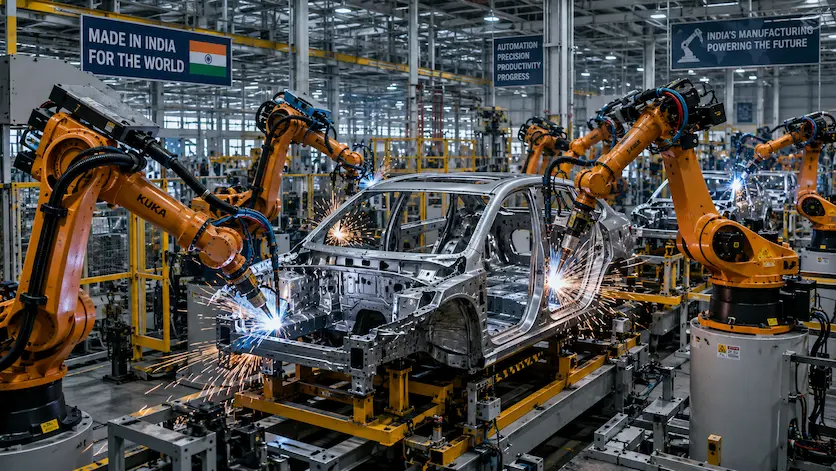
India’s manufacturing sector is undergoing a profound structural shift. What was once viewed as a high-tech luxury—industrial automation—has rapidly evolved into an indispensable competitive tool. Facing rising labor costs, expanding production targets, tighter international quality benchmarks, and shifting global supply chains, Indian manufacturers are deploying industrial robots at an unprecedented speed.
From sprawling automotive plants in Chennai and Pune to modern semiconductor and electronics assembly hubs in Gujarat and Tamil Nadu, industrial robots are stepping in to elevate productivity, ensure pinpoint accuracy, and transform workplace safety.
The Next Manufacturing Revolution
Industrial robots are designed to handle repetitive, hazardous, and high-precision tasks with unwavering accuracy. Unlike traditional manual operations, automated systems run $24/7$ with minimal downtime, enabling companies to increase output while cutting production errors to near zero.
As India aggressively positions itself as a dominant global manufacturing hub, automation is no longer optional—it is the baseline for competing against nations that already operate heavily automated production lines.
5 Key Reasons Indian Manufacturers Are Investing in Robots
┌───────────────────────────────────────────────────────────────────┐
│               Core Drivers of Industrial Robotics                 │
├───────────────────────┬───────────────────────────────────────────┤
│ 1. Peak Productivity  │ Continuous operations maximize output     │
│ 2. Unmatched Quality │ High-precision welding, painting & assembly│
│ 3. Skilled Labor Bridge│ Fills technical skill gaps for complex tasks│
│ 4. Enhanced Safety   │ Removes humans from hazardous tasks       │
│ 5. Long-Term Savings  │ Lower waste, fewer defects, reduced costs │
└───────────────────────┴───────────────────────────────────────────┘
Higher Productivity: Robots maintain a constant production pace without fatigue, allowing factories to scale throughput without sacrificing quality.
Superior Product Quality: From arc welding and paint spraying to micro-chip assembly and automated optical inspection, industrial robots minimize defects and elevate product consistency.
Bridging Skilled Labor Shortages: Many sectors struggle to recruit and retain workers for grueling or highly repetitive jobs. Robots handle these specialized roles, allowing human employees to upskill into high-value positions like system programming, quality auditing, and maintenance.
Significantly Improved Workplace Safety: By taking over operations involving extreme heat, toxic chemicals, heavy machinery, or sharp materials, robots drastically cut down industrial accidents.
Compounding Long-Term Cost Savings: While initial capital expenditure is significant, manufacturers achieve high return on investment (ROI) through waste reduction, lower energy consumption, and reduced quality-loss overheads.
Leading Sectors Driving Adoption in India
While automotive manufacturing historically claimed the largest share of robot installations, other high-growth verticals are catching up rapidly:
Automotive & Auto Components: Precision welding, robotic painting, and chassis assembly.
Electronics & Semiconductor Assembly: Micro-soldering, surface-mount technology (SMT), and PCB testing.
Pharmaceuticals & Medical Devices: Sterile packaging, automated filling, and pill counting.
Warehousing & Logistics: Autonomous Mobile Robots (AMRs) for sorting and material handling.
Metal Fabrication, Food Processing & FMCG: High-speed packaging, palletizing, and cutting.
Strategic Government Initiatives Backing Automation
National initiatives continue to modernize India’s industrial backbone. Landmark policies encouraging advanced automation include:
Make in India & Digital India: Establishing domestic manufacturing infrastructure and digital public tools.
Production Linked Incentive (PLI) Schemes: Tying fiscal incentives to production volume and global quality standards across key sectors like automotive, pharma, and electronics.
National Semiconductor Mission & SPECS: Attracting global chipmakers and OSAT facilities that rely entirely on cleanroom robotics.
Related Context: Explore how these policies fit into India’s trade expansion in our coverage on the India-Australia CECA Agreement and the broader digital shift outlined in Matribhumi Samachar Business News.
Smart Automation: The Role of AI and Cobots
Modern industrial robots are no longer simple machines following rigid scripts. Powered by Artificial Intelligence, computer vision, and real-time sensor analytics, today’s factory systems can:
Detect micro-defects in real time on high-speed conveyers.
Dynamically adapt to variations in raw materials or batch sizes.
Perform predictive maintenance, alerting engineers before component failures occur.
Safely work alongside human operators.
Collaborative Robots (Cobots) are proving particularly revolutionary for Small and Medium Enterprises (SMEs). Unlike traditional industrial robots that require expensive physical safety cages, cobots feature built-in force sensors, allowing them to stop automatically upon contact with a human worker.
Overcoming Key Challenges
Despite rapid growth, full-scale adoption across India faces a few hurdles:
High Initial Capital Outlay: Procuring and integrating robotic arms remains expensive for smaller MSMEs.
Integration with Legacy Systems: Upgrading older factories with modern Internet of Things (IoT) sensors and robotics controllers requires tailored engineering.
Workforce Upskilling: Transitioning factory workers from manual labor to operating and maintaining smart systems requires concerted reskilling programs.
Government financing programs, subsidized technology centers like Uttar Pradesh’s new U-Hubs, and local automation partnerships are helping bridge these operational gaps.
Frequently Asked Questions (FAQ)
Q1: What is driving the sudden demand for industrial robots in India?
Growing quality expectations, rising labor costs, global supply chain diversification (e.g., “China Plus One”), and government schemes like the PLI incentives are compelling Indian manufacturers to adopt robotics.
Q2: How do collaborative robots (cobots) differ from traditional industrial robots?
Traditional industrial robots operate at high speeds inside enclosed safety cages to prevent injuries. Cobots are lightweight, easy to reprogram, and equipped with sensitive safety sensors that allow them to work safely alongside humans without physical barriers.
Q3: Will industrial automation cause job losses in Indian manufacturing?
While automation reduces manual, repetitive jobs, it creates higher-value engineering roles in robot programming, maintenance, system integration, and quality assurance.
Disclaimer
The information presented in this article is intended solely for educational and informational purposes. Market trends, sector forecasts, and policy frameworks discussed are based on prevailing industry reports and official policy documentation. Readers and business entities should perform independent due diligence before making capital investment or operational decisions.
