

Mumbai. Thursday, 23 July 2026
Manufacturing is undergoing its most profound transformation since the assembly line. Artificial intelligence (AI) has shifted from an emerging digital experiment to an essential industrial asset, standing shoulder-to-shoulder with heavy machinery and robotics. Among the various Industry 4.0 innovations, AI-powered quality inspection is leading the charge. By automating visual audits with micro-second accuracy, high-speed consistency, and deep learning, AI systems empower global factories to eliminate waste, lower production costs, and maintain zero-defect standards across high-throughput production lines.
What Is AI Quality Inspection?
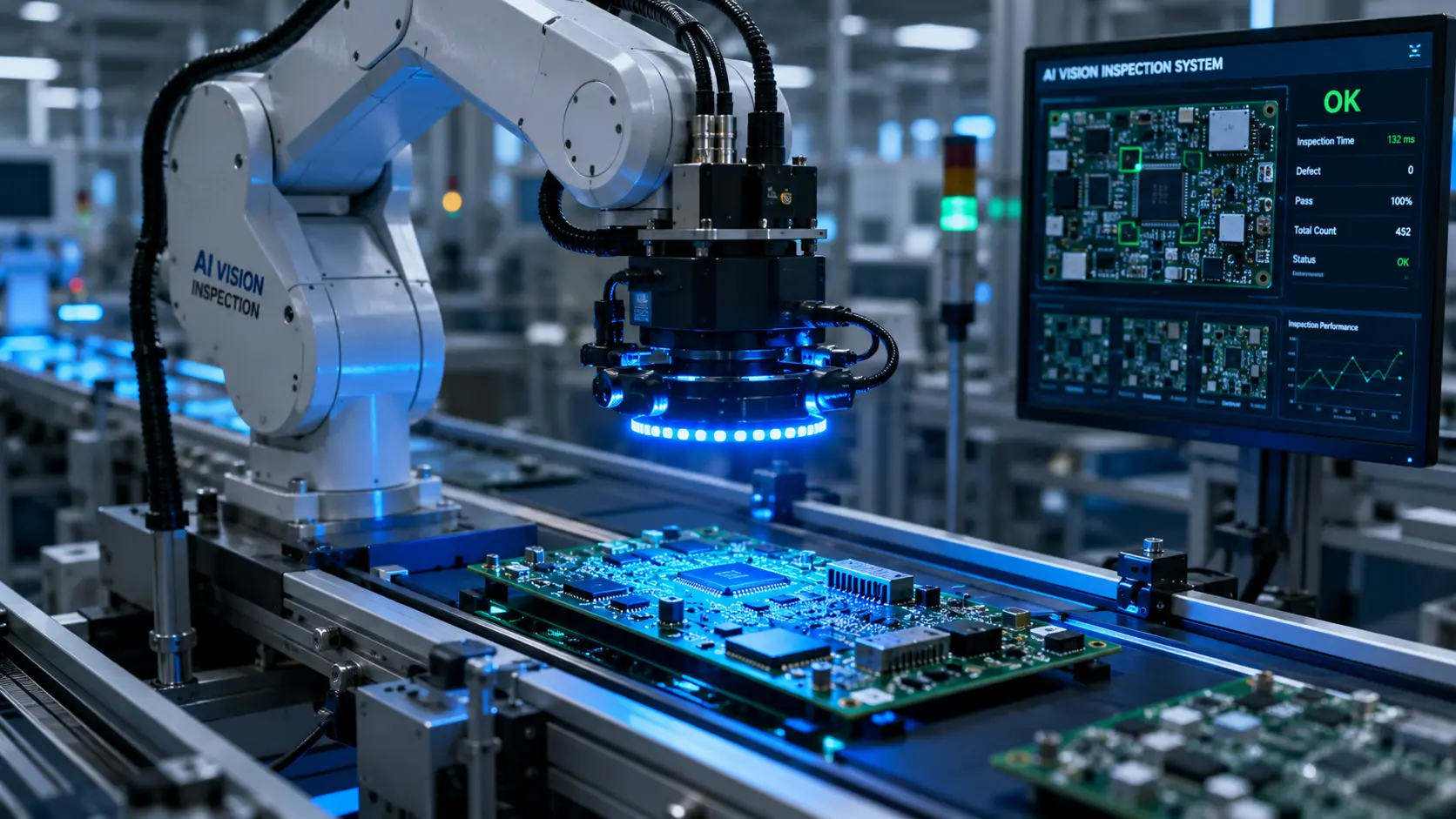
AI quality inspection utilizes advanced computer vision, deep neural networks, and machine learning algorithms to automatically evaluate physical products during active production. Rather than relying exclusively on human operators or rigid, rule-based software, AI systems process high-resolution image and video feeds from industrial cameras in milliseconds.
[Industrial Camera Capture] ➔ [Computer Vision Preprocessing] ➔ [Deep Learning Feature Extraction] ➔
[Real-Time Decision: Pass/Reject/Alert]
These automated setups catch a wide range of microscopic and structural flaws, including:
Surface scratches, micro-cracks, and structural dents
Paint finish variations and orange-peel imperfections
Missing assembly components or misaligned solder joints
Sub-millimeter dimension variations and geometric errors
Labeling mistakes, barcode misprints, and packaging leaks
Why Legacy Inspection Methods Fall Short
Traditional quality assurance relies heavily on manual spot-checking or legacy machine vision. As global production lines accelerate, these approaches face clear limitations:
Operator Fatigue: Human inspectors suffer attention drift after extended shifts, missing subtle flaws.
Lack of Scalability: Manual checking creates bottlenecks, forcing factories to inspect random samples rather than 100% of outputs.
Rigid Rule-Based Software: Early machine vision relies on strict, hard-coded pixel thresholds. Slight shifts in ambient lighting or normal material textures frequently cause false rejections.
High Operational Overhead: Unchecked defects lead to costly product recalls, material waste, and warranty claims downstream.
For high-precision sectors like electronics, automotive, defense, and pharmaceuticals, non-automated inspection carries significant financial and operational risk.
Key Pillars of an AI Inspection Architecture
An industrial AI visual inspection system relies on four integrated components:
1. High-Precision Optics & Industrial Sensors
Depending on the application, factories deploy area-scan cameras, line-scan units, 3D laser profilers, thermal imaging devices, or industrial X-ray sensors to capture images under synchronized lighting setups.
2. Computer Vision Processing
Computer vision algorithms denoise, align, and preprocess incoming raw image frames, identifying shapes, surfaces, and key spatial features.
3. Deep Learning Anomaly Models
Convolutional Neural Networks (CNNs) trained on thousands of image samples differentiate acceptable variations from actual defects. Unlike rigid code, these models continuously improve accuracy as operational data accumulates.
4. Real-Time PLC Edge Control
In under a second, the AI decides whether a part passes, requires rework, or must be ejected via mechanical pneumatic arms, directly sending instructions to Programmable Logic Controllers (PLCs).
Traditional Machine Vision vs. AI Quality Inspection
| Performance Feature | Legacy Rule-Based Vision | AI-Powered Quality Vision |
| Logic Foundation | Hard-coded pixel thresholds & if-then rules | Neural networks & pattern recognition |
| Adaptability | Low; fails on natural background variances | High; handles minor lighting or surface changes |
| Defect Horizon | Spots simple, fixed geometric errors | Detects complex, organic, and unknown anomalies |
| Continuous Learning | None; requires manual re-programming | Yes; continuously learns from new production data |
| Edge Maintenance | High; time-intensive rule updates | Streamlined; centralized model re-training |
The Rise of Predictive Quality Control & Edge AI
Modern visual inspection is moving beyond simple detection toward Predictive Quality Control. By combining vision data with IoT sensor streams (monitoring spindle vibration, mold pressure, ambient thermal levels, and tool wear), AI pinpoints degrading tool conditions before bad parts are produced.
Furthermore, executing these deep learning networks directly on Edge AI hardware on the factory floor keeps latency under 10 milliseconds, eliminates cloud bandwidth costs, and maintains continuous operation during network offline windows.
Related Industry Insights & Media Coverage
To learn more about how artificial intelligence, advanced electronics manufacturing, and national industrial policies are transforming modern production lines, explore these news analysis pieces from Matribhumi Samachar:
Smarter, Faster, Safer: How Artificial Intelligence is Transforming the Factory Floor — Explore how smart manufacturing ecosystems integrate AI with industrial automation.
Beyond Assembly: How the MPMS Framework Shifts India from ‘Made’ to ‘Designed’ in India — An analysis of policy frameworks driving high-tech manufacturing, deep-tech research, and semiconductor supply chains.
Beyond Chatbots: How Artificial Intelligence is Rewriting Operational Rules — How real-time anomaly detection and deep learning transform data-critical operations.
Frequently Asked Questions (FAQ)
What is AI quality inspection?
AI quality inspection uses artificial intelligence, computer vision, and deep learning algorithms to automatically evaluate products on assembly lines, identifying visual and structural defects in real time.
Can AI completely replace human quality inspectors?
AI automates fast, repetitive, high-speed visual checks. However, human engineers remain essential for managing complex system configurations, reviewing edge-case anomalies, leading continuous process improvements, and overseeing safety protocols.
How does Edge AI improve quality inspection performance?
Edge AI processes vision algorithms locally on dedicated hardware at the machine site rather than sending frames to cloud servers. This guarantees sub-second processing speeds, lowers network latency, protects industrial data, and ensures uninterrupted operation.
Is AI visual inspection viable for small and medium-sized manufacturers?
Yes. Thanks to accessible hardware options, cloud-trained neural networks deployed locally, and scalable edge hardware, small and medium enterprises (SMEs) can incrementally upgrade key inspection stations with modest initial outlays.
Disclaimer
Disclaimer: This article is intended solely for informational, educational, and editorial purposes. Specific technical configurations, industrial camera selections, and deployment costs vary depending on factory environments, hardware specs, throughput speeds, and product types. Consult certified industrial automation engineers and AI integration professionals before deploying automated systems on active production lines.
