

Mumbai. Saturday, 25 July 2026
Have you ever looked at the back of your smartphone or smart device and noticed the label “Made in India”? A decade ago, that label almost always meant “Assembled in India from imported parts.” Fast forward to today, and India is undergoing one of the most remarkable industrial transformations in modern history.
Driven by aggressive government policies, global supply chain shifts, and booming domestic demand, India’s Electronics Manufacturing Services (EMS) sector has evolved from a basic box-assembly setup into a sophisticated, vertically integrated manufacturing powerhouse.
Key Takeaway: Total Indian electronics production has scaled past ₹12 Lakh Crore ($130B+), while smartphone exports alone have crossed ₹3.3 Lakh Crore ($40B+), establishing the country as a critical node in global supply chains.
1. Electronics Manufacturing Services (EMS): The Core Engine
At the heart of this growth are EMS providers. Instead of relying entirely on foreign factories, major global brands now team up with domestic and international contract manufacturers operating on Indian soil.
What EMS Companies Do Today
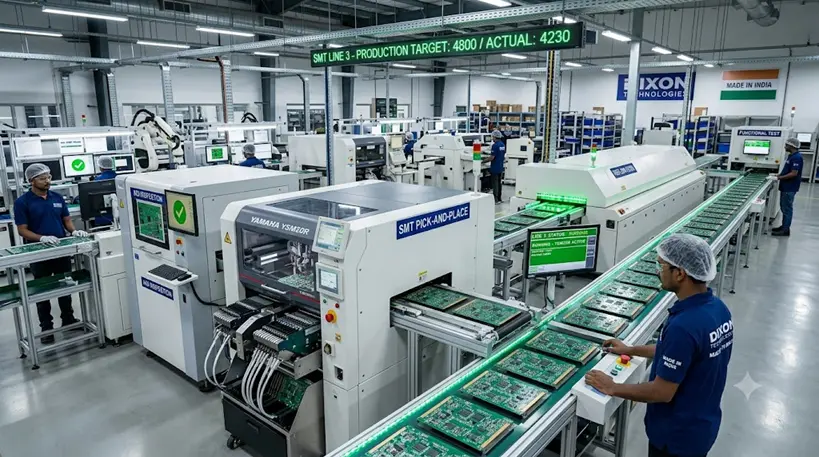
PCBA (Printed Circuit Board Assembly): Populating blank boards using high-speed SMT lines.
System Integration: Precision fitting of camera modules, battery packs, and structural metal frames.
Testing & Quality Assurance: Advanced Automated Optical Inspection (AOI) and X-ray structural testing.
Lifecycle Logistics: Packaging, regional distribution, repair services, and after-sales support.
Key Players Driving the Momentum
Domestic Leaders: Dixon Technologies, Kaynes Technology, Syrma SGS, Avalon Technologies, Zetwerk, VVDN, and Optiemus.
Global Titans in India: Foxconn, Tata Electronics, Pegatron, Jabil, Flex, and Sanmina.
For additional coverage on how domestic policy is reshaping national industries, explore the Matribhumi Samachar Business News Section.
2. The Smartphone Boom & Export Surge
Smartphones served as the primary catalyst for India’s manufacturing expansion. Major global brands—including Apple, Samsung, Xiaomi, Vivo, Oppo, Motorola, and Realme—now run deep manufacturing operations across key Indian clusters.
  2014-2015: ~5-8% Domestic Value Addition (DVA)
  └─ [Basic Assembly & Screwdriver Operations]

  2025-2026: ~18-20% Domestic Value Addition (DVA)
  └─ [PCBA Population, Display/Camera Modules, Battery Packaging]

  2030 Target: 35-40% Domestic Value Addition (DVA)
  └─ [Substrates, Passive Components, Local Semiconductor Packaging]
Why Global Brands Pick India
Production Linked Incentive (PLI) Scheme: Direct financial kickbacks tied to incremental production and export targets.
China+1 Strategy: Global brands diversifying risk by expanding production hubs outside China.
Robust Local Clusters: Integrated ecosystems in Noida (UP), Sriperumbudur and Hosur (Tamil Nadu), Bengaluru (Karnataka), Hyderabad (Telangana), and Dholera (Gujarat).
Top export destinations now include the United States, Western Europe, the Middle East, the UK, and Australia.
3. Deepening the Value Chain: PCBs, Components, and Chips
While assembly brings scale, long-term economic strength requires local component production. India is making progress across three critical layers:
A. PCB Manufacturing & Assembly
Printed Circuit Boards are the structural foundation of modern hardware. Indian EMS facilities have upgraded from single-layer boards to multi-layer, High-Density Interconnect (HDI), and flexible PCBs used in EV electronics, laptops, defense systems, and medical gear.
B. Component Localization
Local suppliers are producing chargers, power adapters, enclosures, USB connectors, battery packs, and SIM trays. High-value elements like display panels, memory chips, and high-end camera sensors are still primarily imported, but targeted incentives are helping bridge this gap.
C. Semiconductor Integration
With packaging and assembly (OSAT/ATMP) facilities like Tata’s semiconductor plants coming online, the link between semiconductor fabrication and EMS lines is shrinking lead times and protecting local factories from global chip crunches.
You can read more about national technological initiatives on the Matribhumi Samachar National Portal.
Overcoming the Value Addition Challenge
Despite rapid progress, rising above 20% domestic value addition requires solving key structural bottlenecks:
Raw Material Reliance: Building domestic capacity for copper clad laminates, specialty chemicals, and high-grade substrates.
Component Supply Chains: Scaling local production of passive electronic components (resistors, capacitors, inductors).
Talent Development: Training specialized engineers in advanced microelectronics, automation, and chip design.
Programs like the Electronics Components Manufacturing Scheme (ECMS), Semiconductor Mission (ISM), and Design Linked Incentive (DLI) are structured specifically to address these gaps.
Frequently Asked Questions (FAQ)
Q1: What is the main difference between basic assembly and EMS?
Basic assembly involves putting together pre-imported parts into a final product shell. EMS covers the end-to-end manufacturing lifecycle—including high-speed PCB surface mounting, precision component testing, quality control, packaging, and supply-chain management.
Q2: Why is the PLI Scheme so important for Indian electronics?
The Production Linked Incentive (PLI) scheme provides performance-linked financial incentives to manufacturers based on sales targets. It reduces operational cost differentials, attracts foreign direct investment, and encourages global players to set up large-scale factories in India.
Q3: How much domestic value addition does India currently achieve in electronics?
Domestic value addition currently ranges between 18% to 20%, up from under 8% a decade ago. Government policy aims to increase this to 35–40% by expanding local component and substrate manufacturing.
Disclaimer
The information provided in this article is intended for educational and informational purposes only. Economic estimates, company listings, and policy details reflect publicly available industry data and reporting as of 2026. Readers should consult official government releases or financial advisory sources before making business or investment decisions based on these insights.
For the latest news updates, in-depth reports, and national developments, visit Matribhumi Samachar English Main Portal.
