

New Delhi. Sunday, 26 July 2026
When the Open Network for Digital Commerce (ONDC) was introduced, most people viewed it simply as India’s answer to closed e-commerce giants. But over time, something much bigger has been taking shape. Micro, Small, and Medium Enterprises (MSMEs) across the country are discovering that ONDC is not just a digital storefront—it is an entire digital business infrastructure.
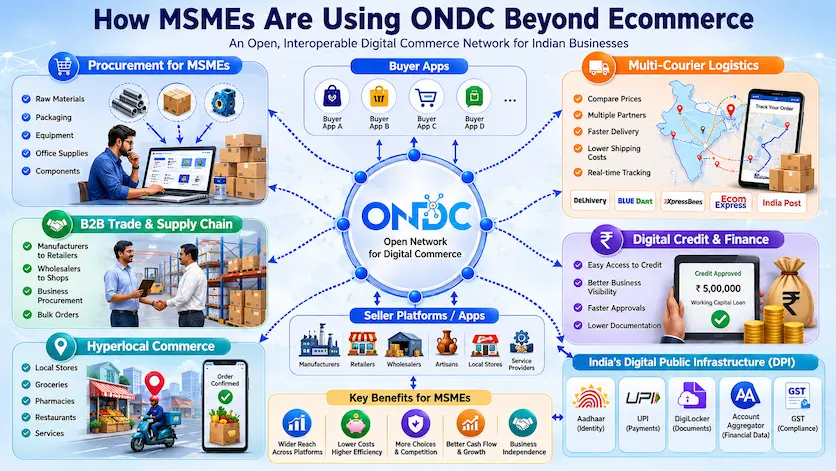
By weaving seamlessly into India’s expanding Digital Public Infrastructure (DPI) stack—alongside Aadhaar, UPI, DigiLocker, and the Account Aggregator framework—ONDC is shifting the narrative from marketplace dominance to open protocol collaboration.
Here is a comprehensive look at how ONDC is transforming daily operations, procurement, financing, and logistics for India’s small businesses.
The Paradigm Shift: Closed Marketplaces vs. Open Protocol
In traditional e-commerce, sellers operate inside “walled gardens.” A seller depends on one platform for product visibility, delivery options, payment collection, and customer interactions. If platform commissions rise or algorithm policies change, the seller has little leverage.
ONDC operates on an entirely unbundled, interoperable framework:
Platform Neutrality: A buyer on App A can seamlessly purchase from a seller listed on App B.
Unbundled Logistics: Shipping providers compete directly on price and speed, rather than being locked to a specific retail platform.
Interoperable Payments: Financial settlements flow across open payment standards like UPI.
Data Sovereignty: Businesses retain control over their inventory and transaction histories.
10 Ways MSMEs Are Leveraging ONDC for Growth
                 ┌───────────────────────────────────────┐
                 │          ONDC Open Network            │
                 └──────────────────┬────────────────────┘
                                    │
    ┌─────────────────┬─────────────┼──────────────┬──────────────────┐
    │                 │             │              │                  │
┌───▼─────────┐ ┌─────▼───────┐ ┌───▼────────┐ ┌───▼───────────┐ ┌────▼─────────┐
│ Procurement │ │  Logistics   │ │ B2B Trade  │ │ Digital Credit│ │ DPI Stack   │
│ & Inventory │ │ Multi-courier│ │ Wholesale  │ │ Flow Financing│ │ Account Agg.│
└─────────────┘ └─────────────┘ └────────────┘ └───────────────┘ └─────────────┘
1. Streamlined Digital Procurement
Small manufacturers no longer have to rely exclusively on middle-men or regional distributors. Through ONDC, MSMEs can procure raw materials, packaging goods, spare parts, and tools from verified suppliers nationwide, ensuring competitive price discovery.
2. Multi-Provider Logistics Choice
Shipping is often a major pain point for smaller sellers. ONDC allows merchants to compare real-time rates across multiple logistics players, picking partners based on delivery speed, price, or specialized regional coverage.
3. Expanded Customer Reach Without Platform Lock-In
Instead of spending heavily to maintain separate store profiles on multiple e-commerce websites, a single onboarding through an ONDC seller app makes products discoverable across the entire network of buyer applications.
4. Unlocking B2B Wholesale Opportunities
Beyond B2C retail, ONDC provides a solid backbone for B2B transactions:
Wholesalers supplying local retailers
Component sourcing between manufacturing units
Restaurants procuring fresh supplies from direct producers
5. Access to Flow-Based Digital Credit
Access to formal working capital has historically been a hurdle for small enterprises. As businesses build a verified digital transaction record across ONDC, financial institutions can leverage this data to assess risk accurately and disburse collateral-free working capital loans faster.
6. Significantly Lower Technology Costs
Building custom e-commerce websites or paying steep marketplace listing fees can strain small budgets. ONDC reduces tech overhead by letting MSMEs plug into compatible seller apps without large upfront investments.
7. Powering Hyperlocal Commerce
Neighborhood pharmacies, bakeries, florists, and Kirana stores can serve nearby customers through buyer apps while utilizing local delivery partners for instant fulfillment—helping them stay competitive against quick-commerce apps.
8. Superior Inventory Management
By broadening visibility to nationwide buyer apps, MSMEs can move slow-moving or seasonal inventory faster, improving cash flow and reducing warehouse holding costs.
9. Seamless DPI Integration
ONDC works alongside India’s digital public infrastructure:
UPI for frictionless payments
DigiLocker for instant business document verification
Account Aggregator for consensual financial data sharing
GSTN for automated invoicing and compliance
10. True Business Autonomy & Data Ownership
Unlike closed platforms where seller data remains proprietary to the platform, ONDC lets businesses retain their customer relationship footprints and adapt their operational strategies as they grow.
ONDC vs. Traditional E-Commerce At A Glance
| Operational Feature | Traditional Closed Marketplace | ONDC Open Network |
| Ecosystem | Locked single platform | Interoperable multi-app network |
| Logistics | Platform-assigned delivery partners | Choice of competing multi-courier providers |
| Data Control | Maintained by the marketplace | Retained by the individual merchant |
| Credit Assessment | Limited seller financing | Open credit framework via Account Aggregator |
| Transaction Focus | Predominantly B2C retail | B2C, B2B wholesale, Procurement, & Hyperlocal |
Key Challenges to Address
While the potential is vast, widespread adoption across tier-2 and tier-3 hubs requires overcoming several operational friction points:
Digital Literacy: Training small shopkeepers to manage digital inventories.
ERP Systems Integration: Connecting legacy billing software with ONDC network nodes.
Service Quality Consistency: Ensuring uniform packaging and delivery benchmarks across all network participants.
Order Management: Handling customer returns and dispute resolutions smoothly across decentralized buyer-seller apps.
Related Coverage & Industry Updates
To read more about ecosystem initiatives supporting small merchants and MSME digitisation, check out the following report:
Matribhumi Samachar: PayG Drives Digital Transformation of Indian MSMEs and Traders with Launch of INSPIRE in Collaboration with ONDC
Frequently Asked Questions (FAQ)
What is ONDC?
ONDC (Open Network for Digital Commerce) is an open-protocol initiative created to democratize digital commerce in India by enabling buyers, sellers, and logistics providers to transact regardless of the specific application they use.
How does ONDC help MSMEs beyond selling retail goods?
Apart from consumer retail, MSMEs use ONDC for raw material procurement, comparing multi-vendor shipping rates, conducting B2B trade, accessing flow-based working capital loans, and managing local store inventory.
Is ONDC an app or a marketplace website?
No, ONDC is neither an application nor a website. It is an open network protocol (similar to how UPI works for payments) that connects existing buyer apps, seller platforms, and logistics providers.
Disclaimer
This article is intended for informational and educational purposes only. Business decision-makers should consult official ONDC documentation and financial advisors before making operational or technology investments.
