 Matribhumi Samachar English


Mumbai. Thursday, 30 July 2026
For years, the global view of India’s tech sector was clear and simple: a fast-growing assembly powerhouse. Factories across the nation were unboxing imported kits, soldering pre-made modules together, and turning out finished smartphones, appliances, and cars. While this “screw-driver manufacturing” created millions of shop-floor jobs and turned India into the world’s second-largest smartphone maker, it left a crucial gap—most of the financial value, technical IP, and advanced engineering remained overseas.
Today, that story is changing rapidly. Driven by bold government policies, global supply chain shifts, and booming domestic demand, India is moving upstream. Manufacturers are shifting from merely putting together imported kits to fabricating the very components that power modern life.
Why Assembly Alone Isn’t Enough
Final assembly delivers quick wins—factory floors, entry-level employment, and high headline export numbers. However, when you pop open a typical smartphone or electric vehicle assembled under a purely basic setup, the reality of domestic value addition becomes obvious:
-
Display panels (Imported)
-
Camera modules (Imported)
-
High-density Printed Circuit Boards (PCBs) (Imported)
-
Semiconductor ICs & Memory chips (Imported)
-
Lithium-ion cells & Sensors (Imported)
In a typical $300 smartphone assembled locally, simple assembly might capture only 15% to 20% of the product’s total bill of materials (BOM). The remaining 80%+ streams right back out to component-producing hubs in Taiwan, South Korea, Japan, and China. To build true economic resilience and export competitiveness, mastering the internal components is non-negotiable.
The Power of the Component Ecosystem
Why does component manufacturing matter so much? Because components are where the highest margins, richest IP, and most stable engineering talent reside.
┌─────────────────────────────────────────────────────────┐
│              ASSEMBLY-ONLY MODEL                        │
│ Imports (80% Value) ──► Assembly (20% Value) ──► Market │
└─────────────────────────────────────────────────────────┘
                            │
                            ▼
┌─────────────────────────────────────────────────────────┐
│            COMPONENT-FIRST MODEL                        │
│ Raw Materials ──► Domestic Components ──► Assembly      │
│                     (70%+ Domestic Value Retention)     │
└─────────────────────────────────────────────────────────┘
Key Advantages of Deep Manufacturing:
-
Higher Domestic Value Creation: Retains the vast majority of product revenues within national borders.
-
True Technology Transfer: Shifts workforce development from basic manual assembly to precision tooling, cleanroom ops, and materials research.
-
Supply Chain Immunity: Protects domestic industries from foreign supply bottlenecks and geopolitical trade tensions.
-
Export Punch: Turns the country into a global supplier of specialized sub-assemblies rather than just an end-market consumer.
The Current Transition: Where Progress Is Accelerating
India’s manufacturing landscape is expanding across four core high-impact sectors:
1. Electronics & Sub-Assemblies
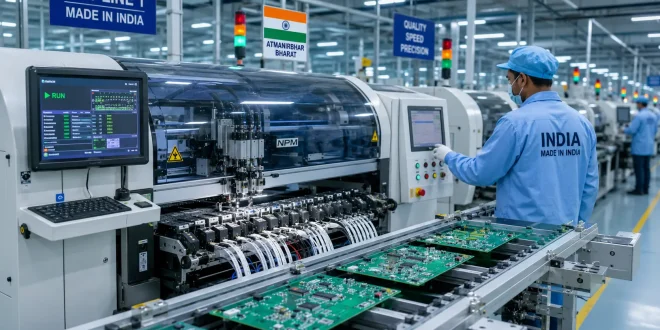
Local production is moving beyond basic plastic cases into multi-layer PCB fabrication, automated surface-mount technology (SMT) lines, camera module packaging, connectors, and complex power adapters.
2. Semiconductor Packaging & OSAT
While front-end wafer fabs (making chips at sub-7nm) require massive capital investment and years of buildout, India has fast-tracked Outsourced Semiconductor Assembly and Test (OSAT) and Advanced Packaging. Facilities in Gujarat and Assam are bringing chip packaging and testing directly into the domestic supply loop.
3. EV Batteries & Power Electronics
Driven by the green mobility wave, domestic production is expanding rapidly across Lithium-ion battery pack assembly, smart Battery Management Systems (BMS), power modules, and specialized thermal management materials.
4. Precision Automotive Components
Building on decades of strength in auto parts—forgings, castings, and transmissions—Indian suppliers are upgrading their lines to produce electric drive units, advanced sensors, and high-voltage wiring harnesses.
Government Policy Catalyst
This industrial transition is supported by targeted strategic frameworks:
-
Electronics Components Manufacturing Scheme (ECMS): Specifically designed to incentivize sub-assembly facilities, passive component units, and supply-chain localization.
-
Production-Linked Incentive (PLI) Schemes: Linking cash incentives directly to incremental sales and domestic sourcing milestones across mobile phones, telecom equipment, and auto tech.
-
Semicon India Mission (Semicon 2.0): Offering capital support for chip packaging plants, compound semiconductors, and display fab projects.
Key Industry Matrix
| Industry Sector | Primary Component Opportunities | Economic Impact |
| Smartphones & Tablets | Camera modules, OLED driver assemblies, multi-layer PCBs, batteries | Maximize local BOM value from ~20% up to 60%+ |
| Electric Vehicles (EVs) | Traction motors, BMS units, power electronics, cell packaging | Drastically lowers battery pack import reliance |
| Renewable Energy | Solar cells, high-power grid inverters, power modules | Strengthens energy independence and green infrastructure |
| Defence & Aerospace | Ruggedized sensors, radar electronics, embedded micro-controllers | Boosts national security and strategic autonomy |
Real Challenges on the Road Ahead
While momentum is strong, transitioning to high-tech component production requires overcoming several structural hurdles:
-
Capital Intensity & Precision Needs: Component manufacturing requires cleanroom environments, ultra-precise automated machinery, and advanced testing labs—costing significantly more up-front than standard assembly lines.
-
Upstream Raw Material Gaps: Silicon wafers, specialized chemicals, display glass, and rare earth materials still depend on global supply chains.
-
Skilled Engineering Talent: The industry needs process engineers, automation experts, and materials scientists skilled in advanced physical manufacturing.
Related Coverage on Matribhumi Samachar
Stay informed on India’s growing tech and manufacturing landscape through these in-depth reports from Matribhumi Samachar:
-
India’s Electronics Revolution: How ECMS Is Building a Global Powerhouse
-
Silicon Backbone: How India’s Semiconductor Mission Powers the Future
-
India Extends ₹7,280-Crore Rare Earth Permanent Magnet (REPM) Scheme
-
Explore All Business & Tech News on Matribhumi Samachar English
Frequently Asked Questions (FAQ)
Q1: What is the main difference between assembly and component manufacturing?
Assembly involves putting together pre-made parts imported from other countries into a final product. Component manufacturing means fabricating the actual core parts—such as circuit boards, camera modules, sensors, and battery packs—within the country, retaining much higher economic value.
Q2: How does the PLI scheme help domestic component production?
The Production-Linked Incentive (PLI) scheme offers direct financial incentives to eligible manufacturers based on incremental sales of products made domestically. This reduces capital risk for companies setting up complex component facilities in India.
Q3: Why is OSAT/ATMP chip packaging so important for India right now?
Building advanced semiconductor fabrication facilities (fabs) requires tens of billions of dollars and many years. OSAT (Outsourced Semiconductor Assembly and Test) allows India to enter the semiconductor value chain quickly by packaging, testing, and integrating silicon chips into usable market-ready components.
Editorial Disclaimer
Disclaimer: The information provided in this article is intended for educational and informational purposes only. Economic projections, policy details, and industry metrics are subject to change based on evolving government regulations, market conditions, and global supply chain developments. Readers and investors are advised to consult official governmental publications and industry experts before making financial decisions.