

Mumbai. Thursday, 30 July 2026
India’s artificial intelligence (AI) ecosystem has officially reached a decisive turning point. For the past two years, the nation’s AI push was almost single-mindedly focused on securing supply chains for high-performance graphics processing units (GPUs) from tech giants like NVIDIA and AMD. Hyperscalers, telecom players, and cloud providers raced to deploy thousands of enterprise chips to keep pace with the generative AI boom.
However, tech leaders and policymakers across New Delhi and domestic tech hubs now face a pivotal question: What comes after GPU imports?
Hardware alone cannot sustain a sovereign, globally competitive AI economy. As compute demands scale across healthcare, finance, defence, and smart manufacturing, India’s focus is rapidly shifting from chip acquisition to building a comprehensive, domestic AI Infrastructure Stack.
The Next Frontier: The Complete AI Technology Stack
To fully leverage high-density computing clusters, India is investing heavily across six foundational technological layers:
 ┌─────────────────────────────────────────────────────────┐
 │               AI Applications & LLMs                    │
 ├─────────────────────────────────────────────────────────┤
 │         Software & Orchestration Platform               │
 ├─────────────────────────────────────────────────────────┤
 │             Storage & Data Lifecycle                    │
 ├─────────────────────────────────────────────────────────┤
 │       Compute (GPUs) + High-Speed Networking            │
 ├─────────────────────────────────────────────────────────┤
 │       Liquid Cooling & Power Infrastructure             │
 └─────────────────────────────────────────────────────────┘
High-Speed AI Networking: High-performance accelerators require ultra-low latency interconnects like InfiniBand and RoCE v2 (RDMA over Converged Ethernet) to prevent data bottlenecks during large-scale LLM training runs.
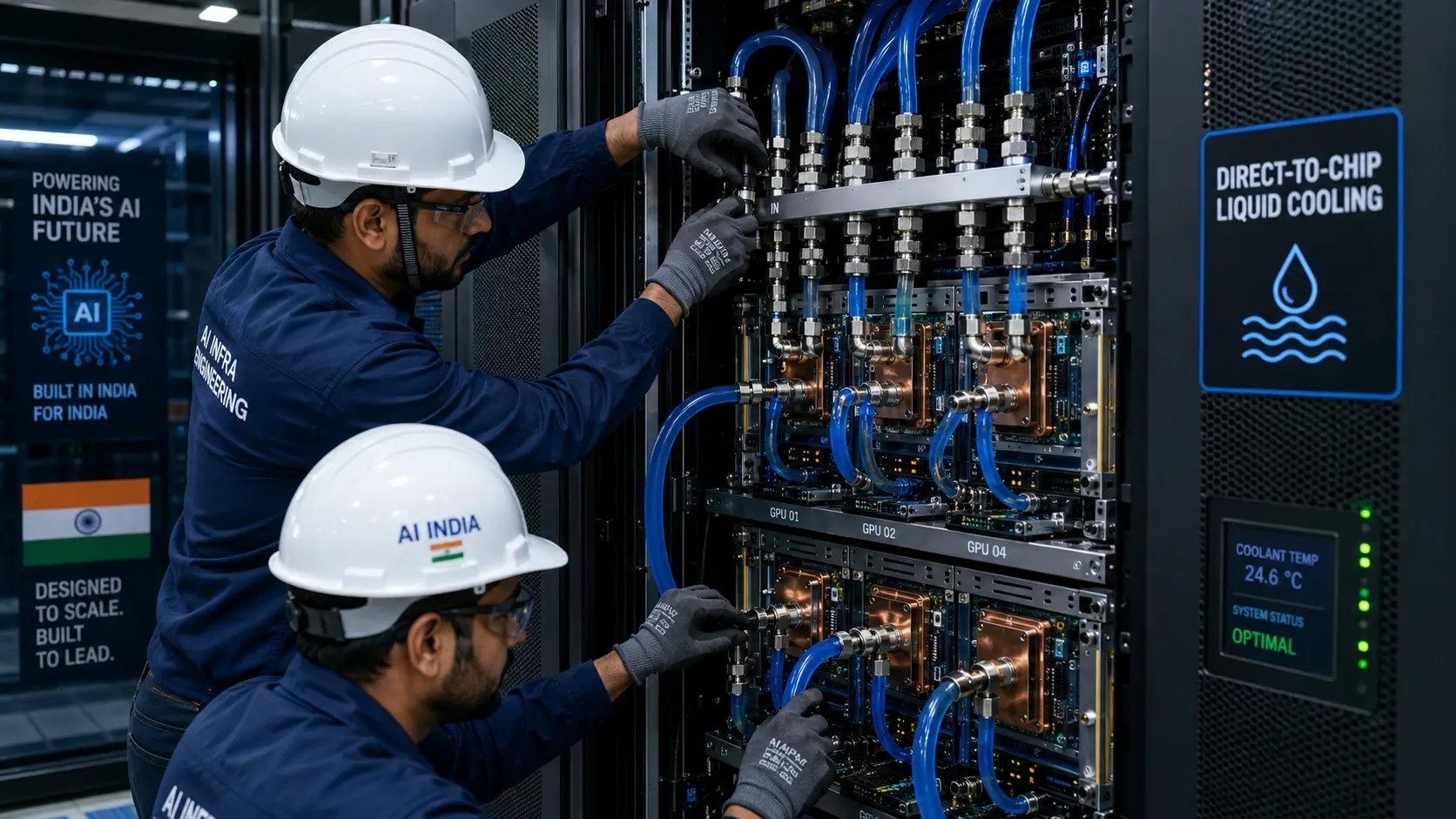
Advanced Thermal Management: With modern AI chips exceeding 700W to 1000W per unit, air cooling has hit its physical limits. Next-generation facilities are transitioning to direct-to-chip liquid cooling and immersion cooling systems.
Resilient Energy Infrastructure: Access to clean, high-capacity electricity is becoming a bigger competitive moat than silicon availability. AI megacampuses are integrating directly with solar microgrids, wind farms, and Battery Energy Storage Systems (BESS).
Parallel Storage Clusters: Ingesting petabytes of unstructured training data requires ultra-fast NVMe-over-Fabrics and scalable parallel file systems to keep GPU cores constantly saturated.
AI Software & Orchestration: Software layers running Kubernetes, GPU virtualization, and automated cluster observability are driving maximum utilization out of existing compute investments.
Advanced Packaging & Assembly: Under initiatives like the India Semiconductor Mission (ISM), domestic focus is expanding into Assembly, Testing, Marking, and Packaging (ATMP) and localized AI server manufacturing.
Sectoral Opportunities Across the Value Chain
The transition to integrated AI data centers is opening high-growth avenues across traditional and high-tech industries:
| Industry Sector | Core Growth Area | Key Drivers |
| Construction & Real Estate | AI Campus & Hyperscale Buildouts | Specialized structural design for high-density load-bearing racks |
| Electrical Equipment | High-Voltage Power Gear | Transformers, switchgear, and uninterrupted power supply (UPS) systems |
| Cooling & Thermal Solutions | Liquid Cooling Technologies | Coolant Distribution Units (CDUs), dielectric fluids, and heat exchangers |
| Renewable Energy | Direct Clean Energy Integration | Long-term Power Purchase Agreements (PPAs) for solar/wind microgrids |
| Semiconductors & Electronics | Server Assembly & Packaging | Domestic manufacturing of AI server chassis, ATMP, and motherboard design |
Strategic Significance & Regional Coverage
As AI data centers evolve into vital national utility assets, independent media outlets covering technology and industrial trends—such as Matribhumi Samachar—have highlighted how state-level policies (like those in Haryana and Uttar Pradesh) are encouraging decentralized deep-tech ecosystems. By creating unified frameworks across power, land, and domestic software talent, India is laying the foundation to transform from a tech consumer into a self-sustaining sovereign compute powerhouse.
Frequently Asked Questions (FAQ)
Q1: Why is GPU availability alone not enough for India’s AI expansion?
A: GPUs require a robust supporting infrastructure stack—including low-latency networking, extreme liquid cooling, uninterrupted high-voltage power, and fast storage—to operate efficiently. Without these components, expensive GPUs remain underutilized.
Q2: What cooling technology is replacing traditional air cooling in AI data centers?
A: Next-generation data centers are deploying Direct-to-Chip (D2C) liquid cooling and Immersion cooling, which circulate specialized fluid near high-density microprocessors to manage intense thermal output far more efficiently than fans.
Q3: How does power grid availability impact AI expansion?
A: Training massive generative AI models requires gigawatt-scale, uninterrupted power. AI campuses increasingly rely on direct connections to clean power grids, solar microgrids, and Battery Energy Storage Systems (BESS) to ensure continuous operation without overloading national energy grids.
Disclaimer
This article is for informational, educational, and analytical purposes only. Industry projections, technology benchmarks, and policy frameworks mentioned reflect structural market developments as of 2026. Readers should conduct independent verification before making commercial or investment decisions.
Related Coverage from Matribhumi Samachar
For deeper insights into India’s evolving digital landscape, read the following updates on Matribhumi Samachar:
