

New Delhi. Thursday, 30 July 2026
India’s digital landscape has evolved at a breathtaking pace over the past decade. Built upon the solid foundation of Digital Public Infrastructure (DPI)—popularly known as the India Stack alongside Aadhaar, UPI, DigiLocker, and ONDC—the Account Aggregator (AA) framework is fundamentally altering how individuals and businesses control and share their financial data.
For decades, getting a loan, securing insurance, or onboarding with a wealth management platform required navigating a labyrinth of paperwork. Borrowers spent days gathering bank physical statements, salary slips, tax filings, and profit-and-loss statements.
Today, the Account Aggregator ecosystem removes those friction points entirely, substituting slow manual verification with instantaneous, consent-driven, end-to-end encrypted digital transfers.
1. What is an Account Aggregator?
An Account Aggregator (AA) is an RBI-regulated Non-Banking Financial Company (NBFC-AA) that acts as a secure, digital data manager. It provides a standardized highway for financial data to flow directly between institutions—strictly under the user’s explicit instruction.
To understand what an AA does, it helps to understand what it does not do:
❌ Does NOT Store Data: The framework uses ephemeral, pass-through pipelines.
❌ Does NOT Read Data: All data payloads are end-to-end encrypted using the recipient’s public key.
❌ Does NOT Sell or Monetize Data: AAs cannot analyze, track, or sell customer records to third parties.
Think of an Account Aggregator as an impenetrable digital courier: it picks up a sealed, encrypted package containing your financial records from your bank and delivers it directly to your lender—only after you hand over the digital key.
2. Core Architecture: How the AA Ecosystem Functions
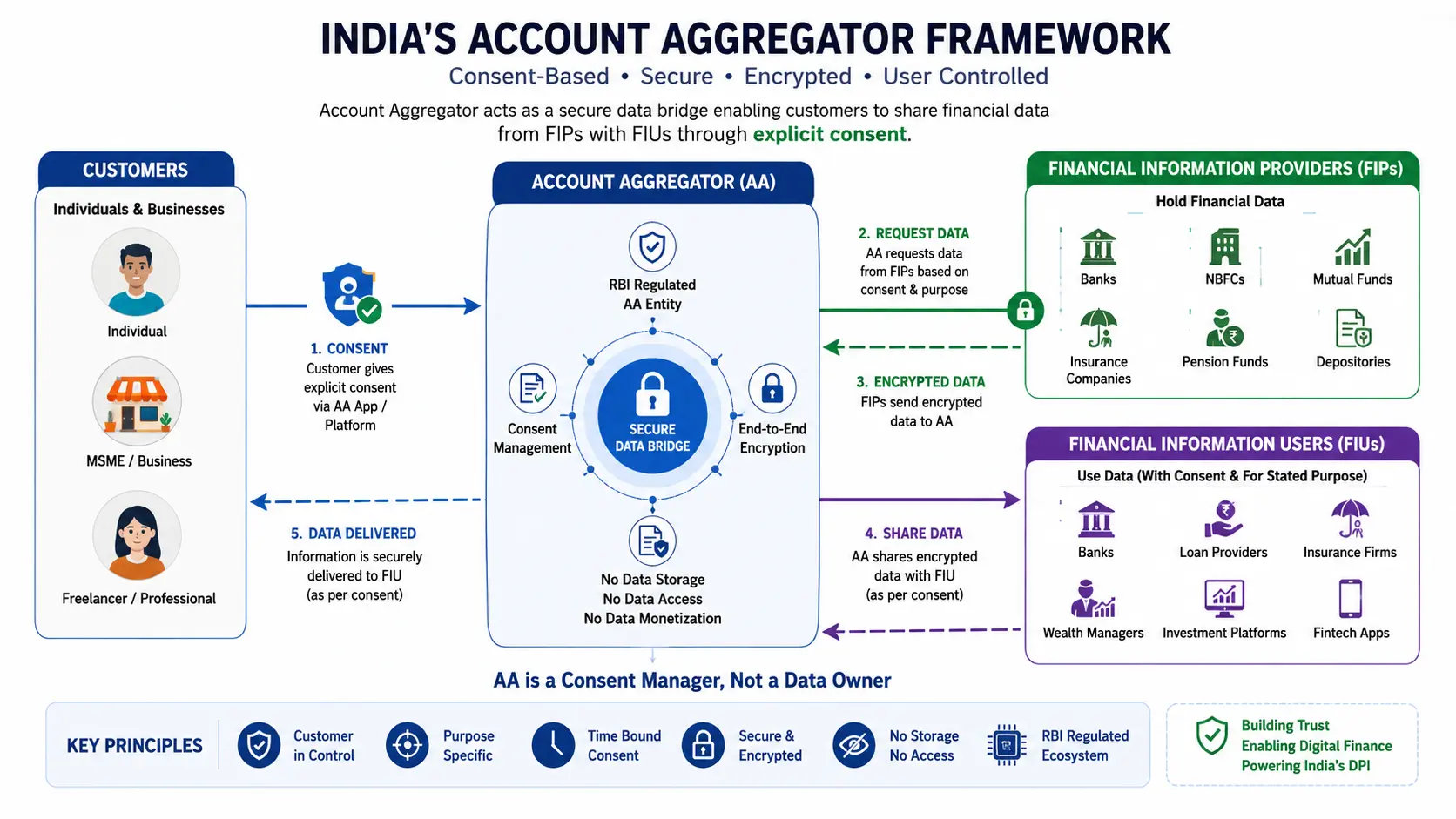
The framework relies on a synchronized balance between four key participants:
+-------------------------------------------------------------------------+
|                               CUSTOMER                                  |
|                 (Individual, MSME, Startup, Freelancer)                 |
+-------------------------------------------------------------------------+
                                     |
                          1. Grants Digital Consent
                                     v
+-------------------------------------------------------------------------+
|                        ACCOUNT AGGREGATOR (AA)                          |
|                       (RBI-Regulated Bridge)                            |
+-------------------------------------------------------------------------+
              /                                           \
    2. Requests Data                             4. Transmits Encrypted
             /                                              Data
            v                                                v
+------------------------+                        +------------------------+
|  FINANCIAL INFORMATION |                        |  FINANCIAL INFORMATION |
|     PROVIDER (FIP)     |                        |       USER (FIU)       |
| (Banks, MF Registrars, |                        | (Lenders, Insurers,    |
|   GSTN, Depositories)  |                        |   Wealth Managers)     |
+------------------------+                        +------------------------+
Customer: The data owner (an individual borrower, MSME, startup, or freelancer).
Financial Information Provider (FIP): Regulated institutions holding raw financial records, such as banks, mutual fund registries, insurance providers, pension funds, or the GST Network.
Account Aggregator (AA): The consent manager receiving request mandates, reaching out to FIPs, encrypting payload streams, and delivering them to requesting entities.
Financial Information User (FIU): Entities that require verified data to deliver services, including banks, digital lenders, wealth management platforms, and underwriters.
3. Traditional Data Sharing vs. The Account Aggregator Framework
| Feature | Traditional Financial Data Sharing | Account Aggregator Framework |
| Transmission Medium | Physical paper documents, email PDFs, manual portal uploads | Direct, encrypted FIP-to-FIU data stream |
| Turnaround Time | 3 to 10 business days | Minutes to instant evaluation |
| Fraud Risk | High (risk of manipulated PDFs or forged statements) | Virtually zero (authenticated at source by FIP) |
| User Privacy | Static documents stored indefinitely on external servers | Time-bound, purpose-specific, revocable consent |
| Lending Approach | Heavy reliance on physical collateral & historical assets | Real-time cash-flow and revenue-based evaluation |
4. Real-World Applications Across Industries
A. MSME Working Capital & Cash-Flow Lending
Small and Medium Enterprises (MSMEs) historically struggled to access formal credit because they lacked traditional fixed assets to pledge as collateral.
Through the AA framework, an auto-parts manufacturer or electronics wholesaler can grant a bank temporary access to their GST return streams and bank ledger data. Lenders assess live monthly collections and revenue health automatically, disbursing working capital loans within hours instead of weeks.
B. Inclusive Digital Credit for Gig Workers & Freelancers
Drivers, delivery partners, and independent creators often do not possess traditional monthly salary slips or formal employment contracts. Using AA, they can securely connect their bank transaction history, proving steady cash inflows and repayment capabilities to access personal loans and credit lines.
C. Automated Insurance Underwriting & Wealth Planning
Insurance: Health and life insurance providers can quickly verify banking records and income sources with applicant consent, eliminating fraudulent declarations and speeding up policy issuance.
Consolidated Wealth Views: Wealth managers can pull together a complete portfolio picture—combining savings accounts, fixed deposits, mutual fund holdings, and pension assets—without asking clients to manually download dozen-page statements from multiple portals.
5. Privacy Safeguards Built into the Architecture
The AA architecture operates under a Consent-by-Design philosophy enforced by strict technical and legal constraints:
End-to-End Encryption: Data is encrypted by the FIP using asymmetric cryptography and can only be decrypted by the designated FIU. The AA cannot decrypt the payload.
Time-Bound & Purpose-Specific: Every consent artifact clearly states why data is required, what specific data types are being accessed, how long the window remains open, and how often data can be pulled.
Complete User Control: Users retain full rights to revoke or modify access permissions directly through their Account Aggregator smartphone application at any time.
Frequently Asked Questions (FAQs)
Is an Account Aggregator owned by a bank?
No. An Account Aggregator is an independent, RBI-regulated entity licensed specifically to manage financial data consent. It does not operate as a commercial bank.
Does sharing data via an Account Aggregator impact my credit score?
No. The AA framework is simply a secure channel for transmitting information. The transmission itself does not register as a hard inquiry or lower your credit score.
Can banks access my data without my explicit approval?
No. Financial Information Users (FIUs) cannot request or view your data through the AA framework without your explicit, digital consent approval.
Can I revoke consent once it is granted?
Yes. Consent is entirely user-controlled and can generally be revoked or cancelled at any time through your AA application, subject to agreed loan or service terms.
Editorial Disclaimer
Disclaimer: This article is intended strictly for informational and educational purposes. It does not constitute formal financial, legal, or investment advice. Readers are advised to consult certified financial experts and review terms directly with RBI-regulated financial entities before granting data sharing consents.
Recommended Contextual Links
For broader updates on Indian policy, business developments, and economic news, visit Matribhumisamachar English Section.
Stay updated with regional, national, and international headlines at Matribhumisamachar Home.
