

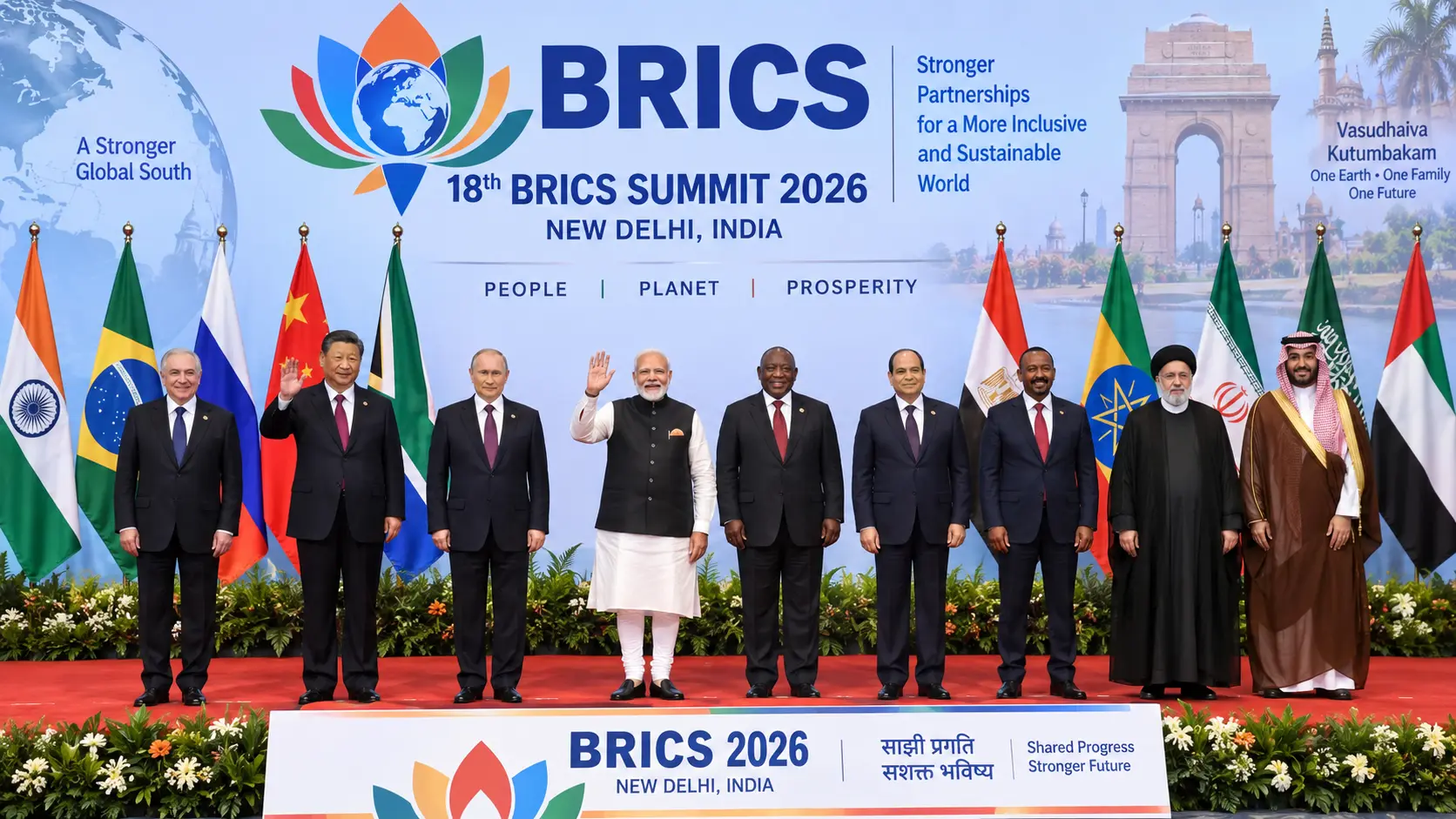
New Delhi, 13 September 2026
Under India’s presidency, the 18th BRICS Summit concluded today in New Delhi with a decisive turn toward actionable, institutional cooperation. Moving beyond political rhetoric, member states centered their discussions on global governance reform, financial infrastructure, open-source technology, health resilience, and the needs of the Global South.
A New Era of Action-Oriented Diplomacy
India’s chairship of the 2026 BRICS Summit sought to reshape the multilateral grouping into a practical execution body. Leaders adopted the New Delhi Declaration, reaffirming their commitment to multilateralism, sovereign equality, and international institution reform—including modernizing the United Nations and global financial institutions to better represent emerging market economies.
For India, securing a firm, consensus-backed stance on counter-terrorism was a primary strategic outcome. The New Delhi Declaration explicitly condemned the Pahalgam terrorist attack and mandated a strict zero-tolerance policy against terrorism, terrorist financing networks, and safe havens.
High-Stakes Diplomacy: The Modi–Xi Bilateral Engagement
On the sidelines of the summit, Indian Prime Minister Narendra Modi met with Chinese President Xi Jinping. The bilateral talks served as a major diplomatic platform for managing complex neighbor relations.
Key Areas of Modi–Xi Bilateral Discussion:
├─ Border Stability: Prioritizing peace and tranquility along the Line of Actual Control (LAC)
├─ Institutional Dialogue: Utilizing existing diplomatic and military channels for sustained negotiations
└─ Economic Ties: Rebuilding trust while resolving market access barriers and trade imbalances
Both leaders recognized that maintaining border tranquility is essential for stabilizing broader ties, though the talks represented a step in rebuilding trust rather than a final settlement of the boundary question.
Transforming Financial Cooperation & Global Tech Infrastructure
Economic integration and financial independence took center stage without resorting to radical monetary shifts:
- Local Currency Trade: Instead of introducing a shared BRICS currency, leaders agreed to expand local-currency trade settlements and interconnect national payment systems to lower transaction costs.
- New Development Bank (NDB): The NDB continues to serve as the backbone for development financing, expanding support for local-currency infrastructure investments.
- BRICS AI Open Source Zone: India spearheaded an initiative to establish an open-source AI zone. This program allows developing nations, startups, and universities to build locally tailored AI models while adhering to responsible, trustworthy AI standards.
- Digital Public Infrastructure (DPI): India showcased its digital identity and payment ecosystem as a scalable blueprint for Global South economies to enhance public service delivery.
Key Achievements of India’s 2026 BRICS Presidency
- Practical Execution: Shifted the focus from abstract declarations to institutional mechanisms in health, DPI, and trade.
- Global South Leadership: Integrated developing nations’ priorities in climate resilience, health equity, and fair access to finance.
- Institutional Health Initiatives: Established a network of Mental Health Centres of Excellence, coordinated by India’s NIMHANS.
- Counter-Terror Consensus: Secured clear language condemning terror attacks and cutting off financial networks.
- Constructive Engagement: Maintained a platform for bilateral dialogue despite strategic differences among member states.
As India hands over the BRICS presidency to China, the key test will be converting these New Delhi agreements into measurable outcomes.
Frequently Asked Questions (FAQ)
Q1: Did the 18th BRICS Summit launch a new single currency?
No. The summit focused on promoting local-currency cross-border trade settlements and improving the interoperability of existing national digital payment systems rather than creating a unified BRICS currency.
Q2: What is the BRICS AI Open Source Zone?
It is a proposed collaborative tech ecosystem enabling member states and Global South economies to access open-source AI models, training resources, and technology frameworks tailored to local needs.
Q3: Did the Modi-Xi meeting resolve the India-China border dispute?
No. The meeting provided a crucial platform to maintain peace along the border and improve communication, but resolving the boundary question requires ongoing negotiations through established military and diplomatic mechanisms.
Related Content & External Links
- Read more international policy insights on Matribhumi Samachar English.
- Learn about artificial intelligence in financial systems via Matribhumi Samachar’s RBI & BRICS coverage.
Disclaimer: This article is written for informational and educational purposes based on news summaries of the 18th BRICS Summit held in New Delhi. For official press releases and full treaty texts, refer to the official Ministry of External Affairs releases.
