

New Delhi. 14 September 2026
During India’s 2026 BRICS chairship, the expanded 11-member grouping—representing nearly half of the global population—has shifted healthcare focus from high-level declarations to actionable, permanent infrastructure. By positioning public health security, digital integration, and equity at the center of its agenda, BRICS is building a robust healthcare network tailored to the unique needs of the Global South.
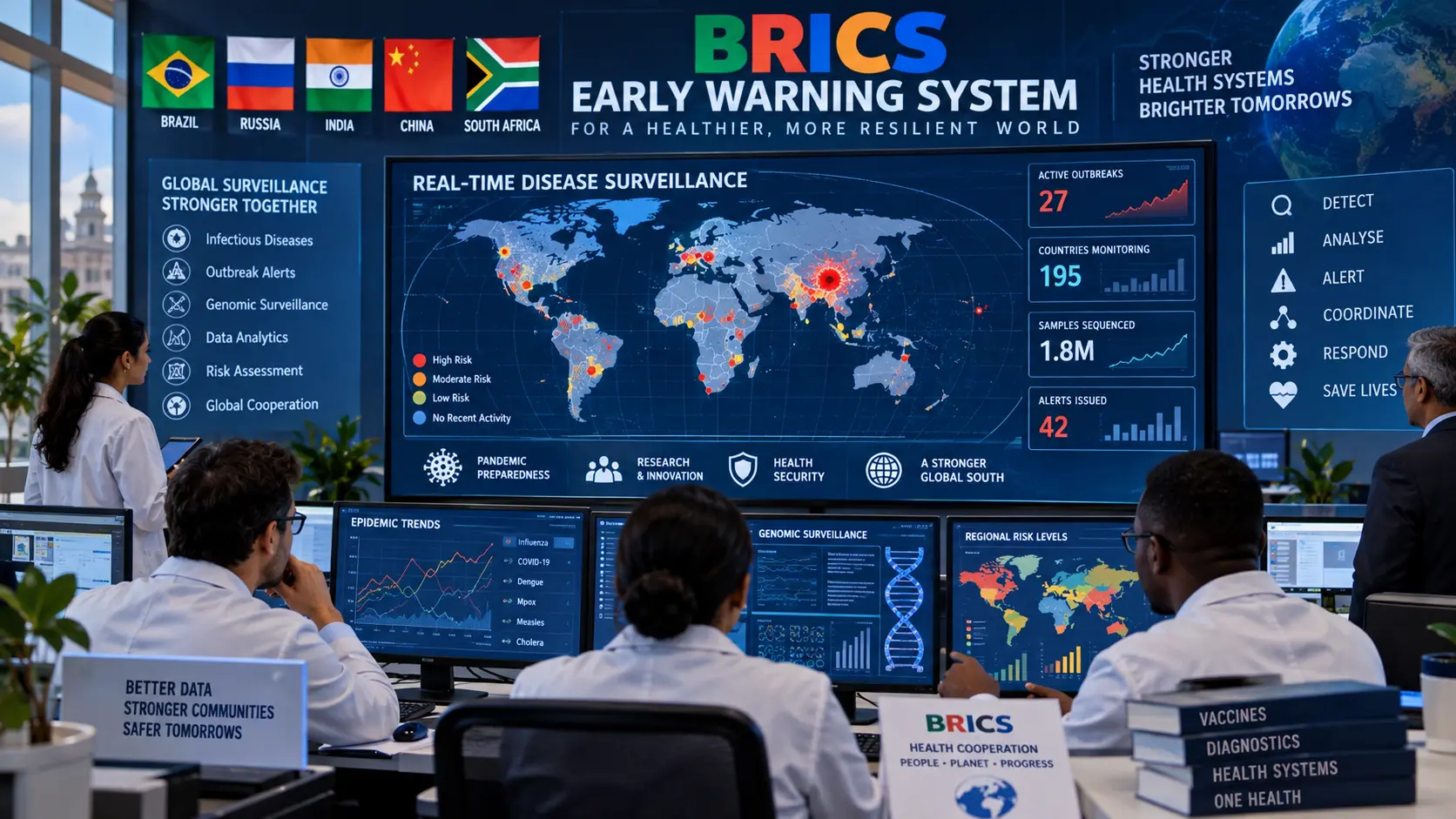
1. Integrated Early Warning System for Infectious Diseases
The cornerstone of the 2026 agenda is the establishment of the BRICS Integrated Early Warning System for Prevention and Response to Mass Infectious Diseases.
Supported by a specialized sub-working group and the BRICS Network of National Public Health Institutes, this initiative focuses on:
- Faster Surveillance: Accelerating cross-border epidemiological data sharing and threat detection.
- Early Outbreak Identification: Spotting emerging viral, bacterial, and zoonotic risks before they escalate.
- Coordinated Preparedness: Building joint public-health response protocols to strengthen pandemic resilience.
2. NIMHANS Leads the Mental Wellness Network
Mental health is now integrated directly into universal healthcare planning rather than treated as an isolated concern. The bloc has endorsed the BRICS Network of Centres of Excellence on Mental Wellness, designating Bengaluru’s National Institute of Mental Health and Neuro Sciences (NIMHANS) as the primary coordinating nodal body.
Complementing this structure, the BRICS Training Hub Network aims to upskill healthcare professionals across member nations through specialized mental healthcare training and workforce exchange programas.
3. Digital Health and Expanding Healthcare Access
Under the Digital Health Architecture for Continuum of Care framework, member countries are tackling regional equity gaps:
- Interoperable Health Infrastructure: Establishing uniform standards for digital health records to maintain continuity of care.
- Remote Healthcare: Utilizing telemedicine and AI-assisted diagnostics to extend specialized medical services beyond major urban centers to rural communities.
4. Addressing Chronic Illnesses, NCDs, and Lifestyle Diseases
Beyond emergency response, the 2026 roadmap directly addresses non-communicable diseases (NCDs) through targeted initiatives:
| Initiative / Platform | Strategic Objective | Core Mechanism |
| BRICS Mission for Healthy Lifestyle (2026–2029) | Combat rising rates of obesity and NCDs | Community-level preventive interventions |
| BRICS TB Research Network | Develop affordable drug regimens for high-burden regions | Joint clinical trials and R&D sharing |
| Regulatory Cooperation | Streamline medical product approvals | Standardized drug inspection & safety protocols |
5. Elevating Traditional, Complementary & Integrative Medicine (TCIM)
Traditional and integrative systems of medicine now have a formal platform for scientific collaboration. The new TCIM framework focuses on:
- Conducting multi-country clinical validation and scientific trials.
- Standardizing safety, quality control, and pharmacovigilance for herbal therapies.
- Facilitating evidence-based knowledge exchange between diverse traditional systems.
Strengthening Global South Health Sovereignty
By moving away from ad-hoc emergency measures, the 2026 chairship creates a model for South-South healthcare cooperation. These technical networks allow developing nations to secure equitable access to vaccines, diagnostics, and medical technologies while reducing reliance on external supply chains.
Frequently Asked Questions (FAQ)
What is the BRICS Integrated Early Warning System?
It is a coordinated surveillance and response mechanism designed to help member states detect and contain mass infectious disease outbreaks before they develop into regional or global pandemics.
Why was NIMHANS selected as a Coordinating Centre of Excellence?
Bengaluru-based NIMHANS was selected due to its advanced psychiatric research capabilities, public health infrastructure, and training capacity, allowing it to lead the newly formed BRICS Network of Centres of Excellence on Mental Wellness.
How does the 2026 agenda support traditional medicine?
The framework establishes scientific criteria for evaluating traditional, complementary, and integrative medicine (TCIM), ensuring traditional remedies undergo clinical validation, safety testing, and standard pharmacovigilance.
Disclaimer
This article is for informational and educational purposes only and does not constitute formal medical or policy advice. For official statements and full declarations, consult official press releases on Matribhumi Samachar or the official BRICS secretariat portals.
