

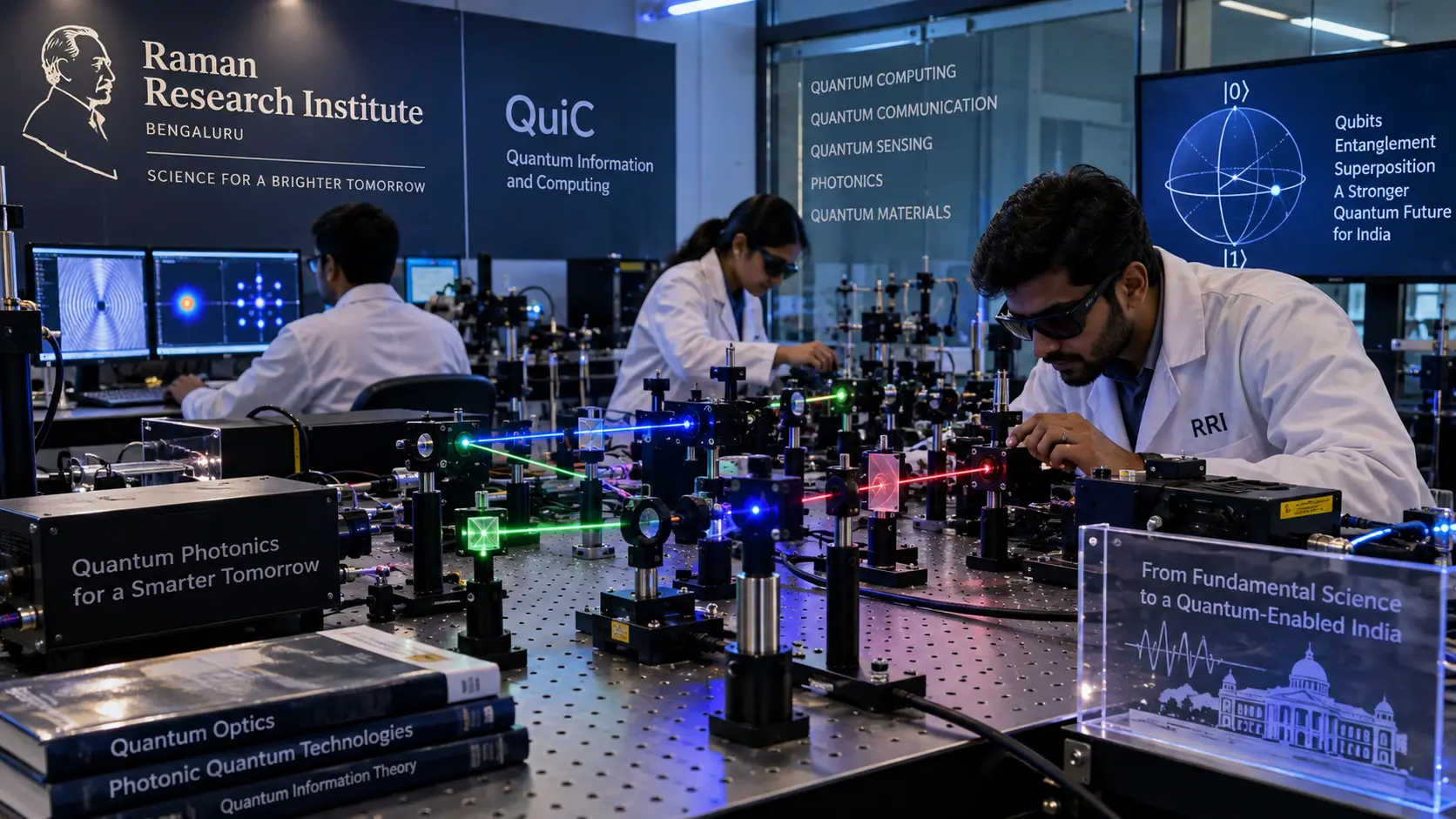
Bengluru. 15 September 2026
Researchers at the Raman Research Institute (RRI) in Bengaluru have reported a major breakthrough in addressing one of quantum computing’s most persistent technical barriers: quantum decoherence.
The research, led by Prof. Urbasi Sinha at RRI’s Quantum Information and Computing (QuIC) laboratory, introduces a precise, timing-based technique designed to control quantum systems without relying on hardware-intensive, continuous corrective operations. By targeting specific evolution windows, the single-shot approach successfully delays entanglement loss and counters the phenomenon known as “entanglement sudden death.”
Understanding Decoherence: The Achilles’ Heel of Quantum Computers
Quantum systems derive their processing power from two primary phenomena:
- Superposition: Allowing qubits to exist in multiple states simultaneously.
- Entanglement: Interlinking the quantum states of separate particles regardless of distance.
+-----------------------------------------------------------------------+
|                       ENVIRONMENTAL NOISE                             |
|             (Thermal fluctuations, electromagnetic interference)       |
+-----------------------------------------------------------------------+
                                   |
                                   v
+-----------------------------------------------------------------------+
|                         DECOHERENCE                                   |
|       (Fragile quantum states collapse before task completion)         |
+-----------------------------------------------------------------------+
                                   |
                                   v
+-----------------------------------------------------------------------+
|                    ENTANGLEMENT SUDDEN DEATH                          |
|    (Abrupt loss of useful quantum correlation across system qubits)    |
+-----------------------------------------------------------------------+
Traditional error-mitigation methods require constant interventions and complex code execution, demanding massive hardware and computational overhead.
The Single-Shot Timing Approach: Time as a Control Parameter
The QuIC laboratory’s strategy shifts the paradigm from continuous intervention to high-precision timing:
- Evolution Identification: Researchers track the dynamic evolution of the entangled state.
- Optimal Window Selection: A specific favorable point in the system’s natural progression is identified.
- Single Operation Execution: A single intervention is applied precisely at that moment to extend entanglement lifetime.
“The research does not replace quantum error correction or eliminate decoherence entirely. Instead, it provides a crucial addition to the quantum control toolkit by extending the operational window of fragile quantum states.”
How the RRI Technique Compares to Conventional Quantum Control
| Parameter | Conventional Error Correction | RRI Single-Shot Control |
| Control Mechanism | Continuous active monitoring & feedback | Single operation applied at calculated time |
| Hardware Overhead | High (requires significant auxiliary physical qubits) | Minimal (utilizes internal system timing dynamics) |
| Primary Goal | Real-time active error detection & correction | Delaying decay onset & preventing sudden death |
| System Integration | Core structural requirement | Complementary layer in the technology stack |
Bengaluru’s Role in India’s National Quantum Mission (NQM)
This breakthrough arrives as India accelerates implementation of the National Quantum Mission (NQM), which carries an approved outlay of ₹6,003.65 crore spanning 2023–24 through 2030–31.
+-----------------------------------------------------------------------+
|                 NATIONAL QUANTUM MISSION (NQM)                        |
|                     Total Outlay: ₹6,003.65 Cr                        |
+-----------------------------------------------------------------------+
                                   |
         +-------------------------+-------------------------+
         |                                                   |
         v                                                   v
+-----------------------------------+               +-----------------------------------+
|    FABRICATION INFRASTRUCTURE     |               |     THEMATIC HUB LEADERSHIP       |
|            (₹720 Crore)           |               |       (IISc Bengaluru Lead)       |
| IISc Bengaluru, IIT Bombay,       |               | Directing national development of |
| IIT Kanpur, IIT Delhi             |               | 50-1,000 physical qubit systems   |
+-----------------------------------+               +-----------------------------------+
Bengaluru continues to serve as the nation’s primary quantum hub, supported by the Foundation for Quantum Computing Innovation (FQCI) established at IISc Bengaluru to bridge research, hardware fabrication, and deep-tech startup deployment.
Related Coverage from Matribhumi Samachar
For further insights into India’s quantum ecosystem and deep-tech infrastructure, explore our coverage:
- Read our analysis on how India is advancing hardware capabilities under the National Quantum Mission: Beyond AI Sovereignty: How India is Engineering the Next Quantum Leap.
- Explore state-level deep-tech infrastructure and research funding models: UP Startup Policy 2026: Financial Grants, U-Hub Infrastructure, and CoEs.
Frequently Asked Questions (FAQ)
What is quantum decoherence?
Quantum decoherence is the process where a quantum system loses its quantum properties (such as superposition and entanglement) due to interactions with the surrounding environment, turning quantum information into classical noise.
Who led the RRI research on quantum timing control?
The research was conducted at the Quantum Information and Computing (QuIC) laboratory at the Raman Research Institute (RRI) in Bengaluru, led by Prof. Urbasi Sinha.
Does the single-shot technique eliminate quantum errors completely?
No. The technique is a proof-of-concept tool designed to delay entanglement loss and prevent entanglement sudden death. It is intended to complement, rather than replace, existing quantum error correction techniques and hardware improvements.
What is the budget for India’s National Quantum Mission?
The National Quantum Mission (NQM) has an approved total outlay of ₹6,003.65 crore for the period covering 2023–24 to 2030–31.
Disclaimer: This article is published for informational and educational purposes based on scientific research press disclosures from the Raman Research Institute (RRI) and public announcements regarding India’s National Quantum Mission. Technical metrics and timelines represent current proof-of-concept stages as reported by the institution.
