

New Delhi. Monday, 15 June 2026
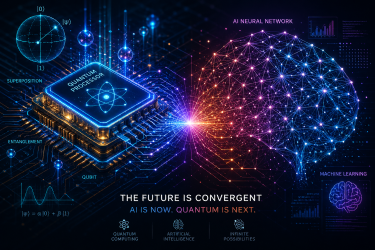
Artificial Intelligence (AI) has established itself as the defining technology of the current decade, fundamentally rewiring global industries from data analytics to autonomous supply chains. However, as the global technology ecosystem rapidly shifts, leading experts point to a new computational horizon. The phrase “AI is now, Quantum is next” represents a fundamental transition in how humanity processes complex data.
India is aggressively positioning itself at the absolute center of this paradigm shift. By coupling the IndiaAI Mission with the National Quantum Mission (NQM), the nation is building a dual-engine architecture designed to secure both immediate AI capabilities and next-generation quantum infrastructure.
Fact-Checking and Course Corrections: Moving From Blueprint to Active Production
When analyzing quantum computing and advanced hardware ecosystems, early policy drafts often overlook the logistical realities of high-tech manufacturing. Significant execution milestones require distinct updates to common industry perceptions:
Correction on Commercial Fabs vs. Design Hubs: Early narratives often conflated general tech clusters with massive hardware manufacturing. In practice, regional centers are acting as specialized layers. For example, Jaipur’s deep-tech evolution via the Malaviya National Institute of Technology (MNIT) acts as a premier powerhouse for chip design, virtual simulation, and quantum cryptography rather than high-volume commercial silicon wafer fabrication.
Active Manufacturing Timelines: While chip layout and hardware prototyping accelerate in domestic design labs, massive front-end chemical fabrication is concentrated in dedicated megastructures. The historic ₹91,000 crore Tata Electronics-PSMC facility in Dholera, Gujarat, is actively driving toward equipment installation and cleanroom commissioning, positioning India to transition from semiconductor blueprints to commercial-scale production.
The Power and Water Reality: A critical factor frequently missing from general quantum and AI discussions is resource continuity. Advanced quantum installations and hyperscale data centers require highly stable green energy grids and complex liquid-cooling infrastructures. Minor power grid oscillations lasting a fraction of a second can ruin entire physical computing batches or collapse delicate qubit states.
The Co-Dependency of Sovereign AI and Quantum Infrastructure
Quantum computing is not designed to replace traditional binary systems or displace the current AI boom. Instead, they operate symmetrically. As massive, multi-billion parameter AI models grow increasingly power-hungry and computationally demanding, the physical limits of traditional silicon architectures become a bottleneck.
This bottleneck is driving the push toward AI Sovereignty—a nation’s independent capability to train, host, and deploy computational intelligence without foreign tech dependencies.
[Advanced Lithography & Design] ➔ [Localized Semiconductor Packaging] ➔ [High-Performance Compute Hubs]
➔ [Sovereign AI & Quantum Models]
To achieve true digital self-reliance, India is integrating its hardware supply chains. Indigenous tech innovations, such as Netrasemi’s 12nm A2000 Edge AI chip, are allowing local hardware to process complex datasets natively. Simultaneously, industrial focus has systematically scaled into the deployment of automated counter-drone electronics and secure quantum communication links.
Inside the Structural Framework of India’s Quantum Ecosystem
India’s National Quantum Mission is uniquely structured around a hub-and-spoke model, moving away from purely theoretical academic research and funneling capital into four specialized Thematic Hubs (T-Hubs) set up as operational corporate entities.
The Four Strategic Pillars of the National Quantum Mission
Quantum Computing (Hosted at IISc, Bengaluru): Tasked with developing intermediate-scale quantum computers. The short-term goal targets 20 to 50 physical qubits, scaling up towards a 50 to 1,000 physical qubit range across superconducting and photonic platforms over the mission lifecycle.
Quantum Communication (Hosted at IIT Madras & C-DOT): Developing unhackable, quantum-safe networks. Teams are actively building inter-city Quantum Key Distribution (QKD) channels and satellite-based secure links spanning across extensive regional distances.
Quantum Sensing & Metrology (Hosted at IIT Bombay): Engineering high-precision atomic clocks and advanced magnetometers vital for defense communication, localized navigation networks, and aerospace systems.
Quantum Materials & Devices (Hosted at IIT Delhi): Researching the underlying physical substrates—such as advanced superconductors and single-photon detectors—required to sustain stable quantum coherence.
Real-World Use Cases: Where AI and Quantum Converge
As these technologies mature, their intersection gives rise to Quantum Machine Learning (QML). This convergence will redefine multiple sectors:
Advanced Materials and Drug Discovery: While current AI models predict molecular shapes based on existing data patterns, quantum simulators can model exact atomic and molecular interactions natively according to the laws of quantum mechanics, cutting pharmaceutical R&D timelines significantly.
Industrial Automation and Smart Factories: Modern factories are layering artificial intelligence and digital twins over heavy physical hardware to predict machine maintenance needs before failures occur. Integrating quantum optimization algorithms can seamlessly balance wafer and component manufacturing margins against slight power grid fluctuations in real-time.
Logistics and Cryptographic Security: Quantum networks can instantly optimize immense supply chain distribution paths while simultaneously shielding critical national infrastructure from evolving cyber risks via post-quantum cryptography.
The global race for computing leadership is no longer just a benchmark for hardware speed—it is the baseline for national security, economic independence, and localized digital infrastructure. By securing the semiconductor pipeline and investing heavily in quantum research today, the coming decade will see India transition from an adopter of technology into a self-reliant global manufacturing and computing anchor.
External References and Continuous Coverage
Discover how domestic packaging feeds directly into global data infrastructure: Silicon Sovereign: How India’s Semiconductor Push is Flipping the Switch to Active Production.
Read the complete analysis of India’s first commercial front-end fabrication plant: Tata Semiconductor Plant in Dholera: Turning India’s Silicon Ambitions Into Active Production.
Learn how deep-tech ecosystems are reshaping regional tech hubs: Inside Jaipur’s Bold Leap into AI, Semiconductors, and Quantum Computing.
Unpack the geopolitical landscape of exascale supercomputing: Global AI Sovereignty and the Supercomputer Race: Why Nations Are Competing for Computing Power.
