

Bengluru. 15 September 2026
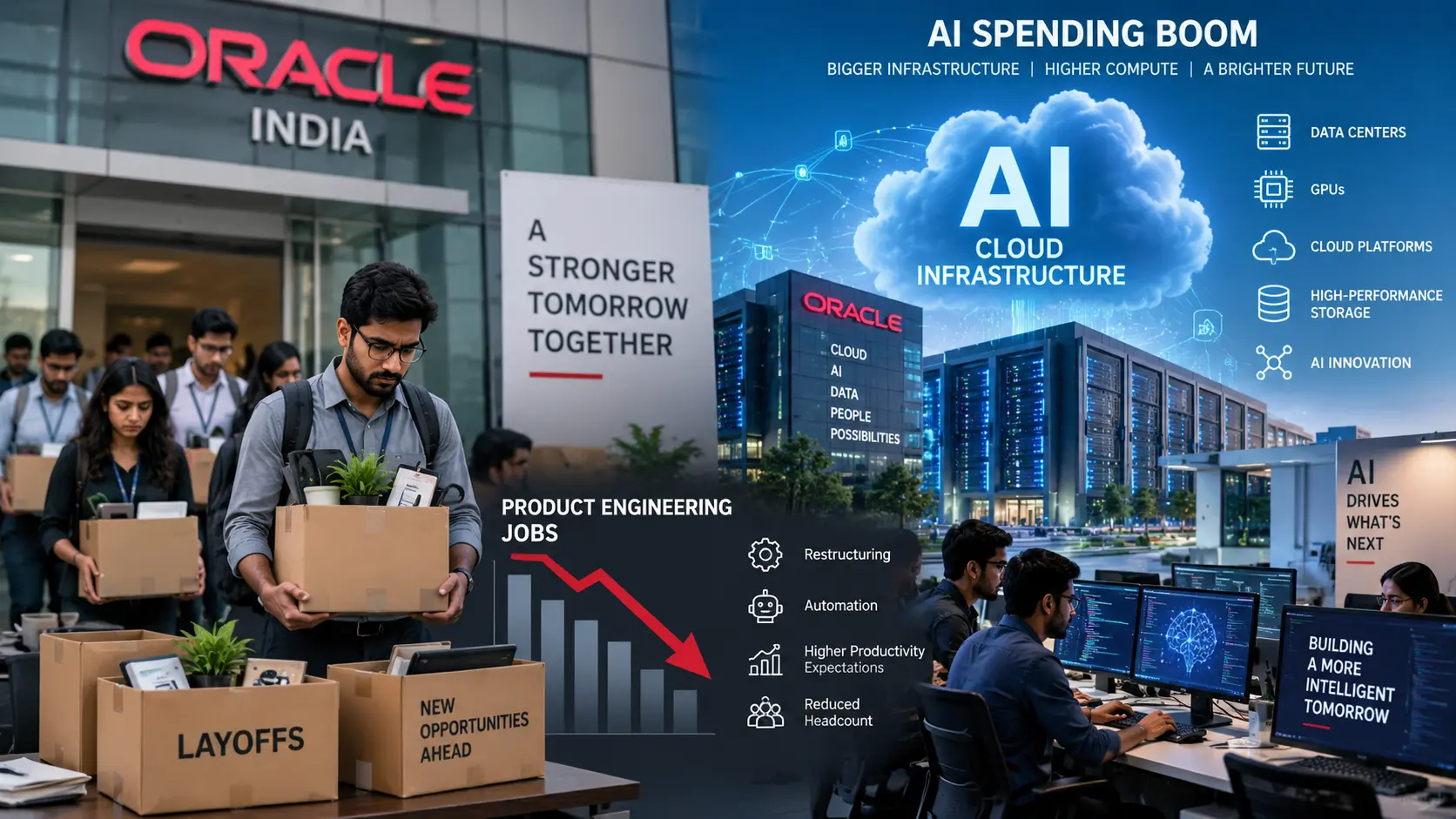
The global technology sector is witnessing one of its most striking structural paradoxes to date. Enterprise tech behemoths are funneling historic amounts of capital into artificial intelligence and cloud infrastructure, while simultaneously scaling back headcount across core engineering operations.
Oracle’s latest operational restructuring in India vividly illustrates this ongoing dynamic. Despite accelerating investments in massive data centers, high-density GPU computing clusters, and specialized cloud environments, product engineering teams across Indian hubs are navigating significant workforce reductions.
This transformation reflects a strategic reallocation of capital away from traditional software engineering workflows toward physical compute hardware, machine learning pipelines, and automated development environments.
1. Capital Reallocation: Physical Compute vs. Human Operations
The primary catalyst for this workforce disruption is where enterprise tech firms choose to direct their capital expenditures. The physical infrastructure required to sustain modern AI applications—including high-performance networking, specialized storage, and thousands of enterprise GPUs—requires billions in liquid capital.
To sustain aggressive infrastructure rollouts while safeguarding operational margins, major tech firms are curbing payroll expenses in legacy software maintenance and non-specialized engineering divisions.
- Heavy Capital Expenditures: Funding gigawatt-scale data centers leaves less margin for expanding legacy product engineering teams.
- Automated Engineering Workflows: AI-assisted developer environments raise the baseline output of individual engineers, reducing the net human capital needed for feature extensions, code testing, and bug fixing.
- Redefined Hiring Priorities: Capital is shifting toward specialized talent capable of managing complex distributed systems, AI infrastructure, and cloud network topologies.
Similar workforce realignments have swept across major hyperscalers, as reflected in Matribhumi Samachar’s coverage on Google Cloud restructuring specialized teams to fund AI expansion.
2. Changing Skills Matrix: Shift in Demand
The transition does not mean software engineering is dead; rather, the underlying skill requirements are being fundamentally reshaped.
| Retrenching & Low-Growth Domains | High-Demand AI & Infrastructure Roles |
| Legacy Product Maintenance | Cloud Architecture & Platform Engineering |
| Monolithic Code Refactoring | GPU Cluster Management & Optimization |
| Manual QA & Routine System Testing | ML Systems & Data Engineering |
| Standard Web/App Development | Agentic Framework Implementation & Cyber Resilience |
3. Implications for India’s Tech Ecosystem
Historically, India’s engineering centers expanded on high-volume hiring to support global product engineering and enterprise maintenance. As AI tools handle routine programming tasks with higher speed and accuracy, Indian operations are transitioning from headcount-driven growth to productivity-driven growth.
Firms are opting for smaller, highly specialized teams capable of building on top of automated pipelines rather than expanding traditional engineering units.
Frequently Asked Questions (FAQ)
Q1: Is AI completely replacing software engineers in India?
No. AI is changing the economics of software development rather than eliminating engineers. By automating routine tasks like code generation and testing, fewer engineers are required for conventional maintenance, while demand for engineers in AI architecture, security, and cloud infrastructure remains strong.
Q2: Why are tech companies laying off employees while hitting record revenue or investing billions?
Companies are reallocating budgets from operating expenses (like payroll for legacy projects) into capital expenses (such as AI data centers, chips, and server infrastructure) to remain competitive in the AI race.
Q3: Which skills will protect software developers from future layoffs?
Engineers who specialize in cloud platform engineering, distributed systems, machine learning pipelines, cybersecurity, and AI tool fluency are best positioned to navigate shifting technology demands.
Disclaimer
This article is for informational purposes only. Workforce dynamics, corporate restructuring figures, and market trends are based on industry reports and analytical models. Readers should conduct independent research before making career or investment decisions.
