

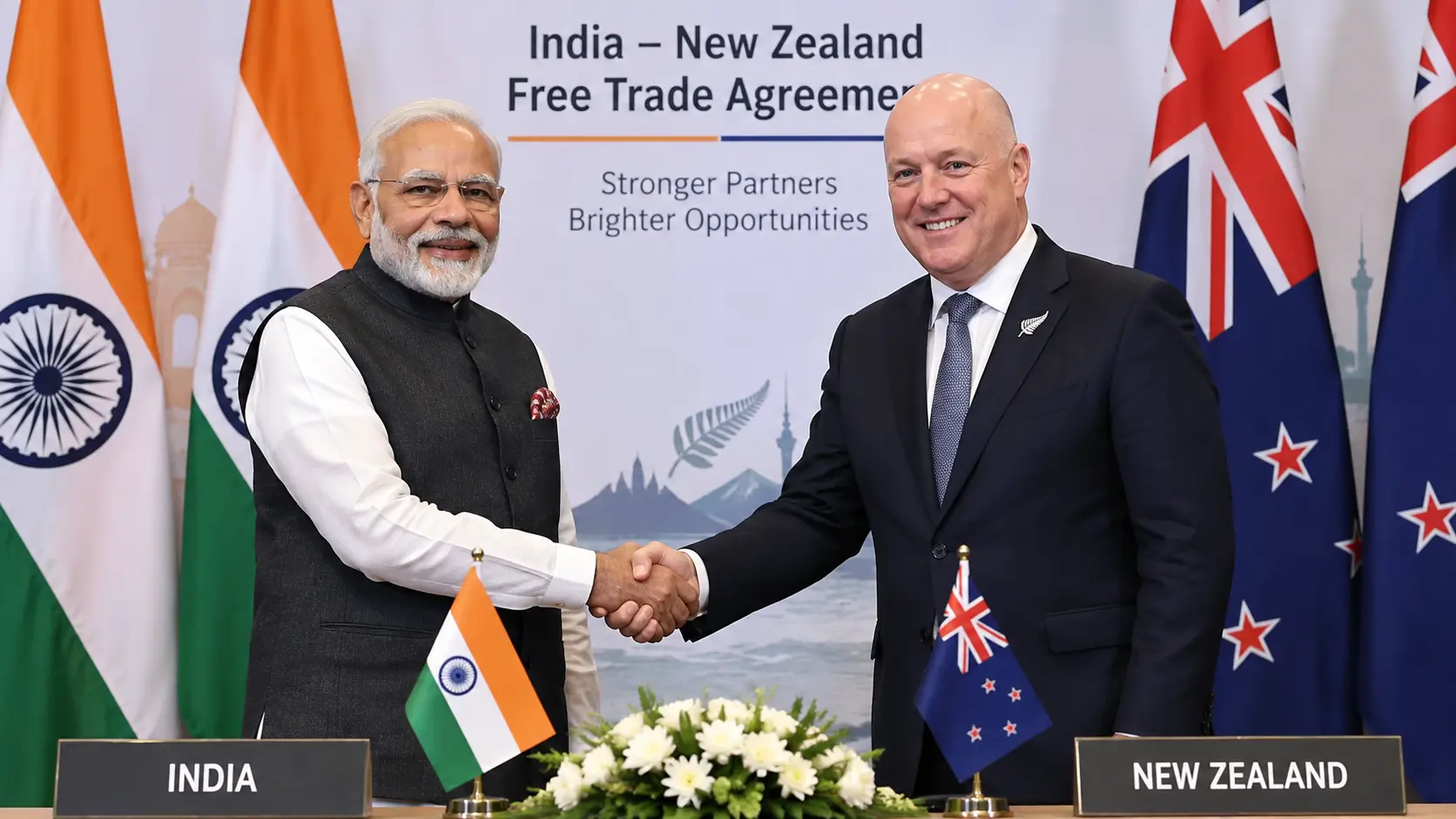
New Delhi.
India and New Zealand are set to enter a transformative phase of bilateral economic cooperation with the official entry into force of the India–New Zealand Free Trade Agreement (FTA) on 20 October 2026. Signed in New Delhi on 27 April 2026, the landmark deal delivers 100% duty-free access for Indian goods, opens 5,000 temporary work visa pathways, creates a working holiday scheme, and secures a US$20 billion investment facilitation commitment over 15 years.
The economic pact bridges major growth sectors, combining tariff elimination on merchandise trade, expanded service access, and streamlined professional mobility. For Indian exporters, manufacturers, and professionals, the agreement offers a strategic bridge to a high-value developed market.
1. Zero-Duty Access Starting 20 October 2026
The core pillar of the deal is the complete removal of import tariffs on 100% of Indian goods entering New Zealand from day one. Prior to this agreement, tariffs increased the landed cost of Indian exports, creating competitive disadvantages against regional rivals.
While zero-duty access eliminates tariff burdens, final product pricing will still depend on commercial factors such as freight, insurance, biosecurity compliance, and local distribution overheads.
2. Key Industry Winners in India
Several manufacturing and processing sectors stand to gain immediate market competitiveness:
- Textiles & Apparel: Garment manufacturers can lower landed costs, expanding reach across retail and wholesale networks.
- Leather & Footwear: Footwear and leather producers gain an edge to compete on variety, price, and manufacturing excellence.
- Pharmaceuticals & Medical Devices: Fast-tracked entry for eligible products through mutual recognition of inspection approvals from trusted overseas regulators.
- Gems, Jewellery & Engineering: Machinery parts, electrical components, and fine jewellery face zero tariff barriers upon entry.
- Processed Foods: Specialty and ethnic food suppliers gain expanded shelf access, provided they meet strict biosecurity standards.
3. Dedicated 5,000 Skilled Visa Pathway & Mobility
Beyond merchandise trade, the agreement features dedicated mobility schemes for Indian professionals and youth:
| Provision | Key Framework Details |
| Temporary Employment Entry | Cap of 5,000 active visa holders at any single time (equivalent to ~1,667 3-year visas annually). |
| Target Skilled Occupations | IT professionals, healthcare workers, engineers, and digital specialists. |
| Specialized Professions | Dedicated allocations for Yoga instructors, chefs, musicians, and Ayurvedic practitioners. |
| Working Holiday Scheme | 1,000 places annually for young Indians to travel and work. |
Note: The 5,000 visa cap is an active stock limit at any given time, not a fresh annual quota. All candidates must fulfill standard registration and qualification criteria.
4. Boost for MSMEs and Small Businesses
Micro, Small, and Medium Enterprises (MSMEs) can leverage zero-duty access to enter a developed market without tariff penalties. However, commercial success requires proactive preparation:
- Quality Certification: Aligning product specifications with New Zealand safety standards.
- Partner Networks: Securing reliable local importers, distributors, and retail partners.
- Supply Reliability: Maintaining consistent delivery schedules and competitive pricing.
5. US$20 Billion Investment Commitment & Protected Sectors
New Zealand has committed to facilitate US$20 billion in investments into India over 15 years. Key target areas include agricultural technology, food processing, renewable energy, manufacturing infrastructure, and technology start-ups.
Protecting Sensitive Domestic Interests
To safeguard local livelihoods, India has excluded sensitive agricultural sectors from duty-free access:
- Dairy Retained: Complete protection maintained for domestic dairy ecosystems (milk, butter, cheese).
- Agricultural Protections: Exclusions applied to selected grains, sugar, and animal products.
- Managed Quotas: preferential quota arrangements apply strictly to select items like apples and kiwifruit.
Exporter Readiness Checklist (Pre-October 20, 2026)
- Identify exact product HS codes and verify preferential tariff treatment under the FTA.
- Confirm Rules of Origin (RoO) documentation to ensure duty exemption eligibility.
- Review New Zealand’s MPI biosecurity, labeling, and safety regulations.
- Recalculate landed costs including freight, insurance, and distributor margins.
- Establish contact with verified New Zealand importers, trade bodies, or retail groups.
Frequently Asked Questions (FAQ)
Q1: When does the India–New Zealand FTA come into force?
The agreement enters into force on 20 October 2026 following complete ratification procedures.
Q2: Will all Indian goods enter New Zealand duty-free?
Yes, the agreement grants 100% zero-duty access for Indian goods upon commencement, subject to compliance with Rules of Origin and biosecurity regulations.
Q3: Are 5,000 new work visas issued every year?
No. The 5,000 threshold represents the maximum number of temporary employment visa holders present at any given time (roughly 1,667 three-year visas per year).
Q4: Is the dairy sector included under tariff cuts?
No. India has retained tariff protections for domestic dairy, sugar, and sensitive agricultural products to safeguard domestic farmers.
Relevant Portal Links
- Stay updated on business and national news at Matribhumi Samachar English – Latest News, Business & More.
- Learn about our editorial standards and background at About Us – Matribhumi Samachar English.
- Explore national economic policy updates on the National Archives – Matribhumi Samachar English.
Disclaimer
This article is provided for informational and analytical purposes only. Trade policies, tariff schedules, biosecurity regulations, and visa eligibility conditions are subject to official notifications issued by the Ministry of Commerce and Industry (India) and Immigration New Zealand. Businesses and individuals should consult relevant government portals or legal experts before committing to commercial contracts or travel plans.
