

Geneva.
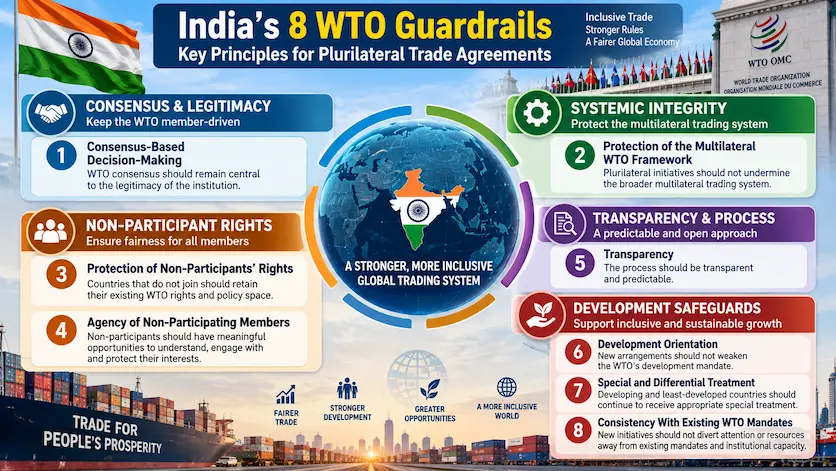
In a significant legal and diplomatic shift, India has recalibrated its long-standing approach toward plurilateral trade agreements at the World Trade Organization (WTO). Moving away from unconditional rejection, New Delhi has formally proposed eight strategic guardrails. These safeguards establish essential procedural and legal boundaries required before any subset-driven trade initiative can be formally integrated into the broader WTO framework.
                             ┌───────────────────────────────┐
                             │    Consensus Decision-Making  │
                             └───────────────┬───────────────┘
                                             │
      ┌──────────────────────────────────────┼──────────────────────────────────────┐
      ▼                                      ▼                                      ▼
Systemic Integrity & Mandates       Member Rights & Inclusion               Development & Policy Space
┌───────────────────────────┐    ┌──────────────────────────────┐        ┌──────────────────────────────┐
│ • Protection of           │    │ • Non-Participant Immunity   │        │ • Development Orientation    │
│   Multilateral Framework  │    │ • Agency of Non-Participants │        │ • Special & Differential     │
│ • Transparency            │    │   (Right to Opt-Out)         │        │   Treatment (S&DT)           │
│ • Consistency with        │    └──────────────────────────────┘        │ • Protection of Domestic     │
│   Existing WTO Mandates   │                                            │   Policy Priorities          │
└───────────────────────────┘                                            └──────────────────────────────┘
What Are Plurilateral Agreements?
Unlike traditional multilateral WTO agreements—which require the unanimous consent of all 166 member nations and apply universally—plurilateral agreements are negotiated by a smaller coalition of willing countries.
Under the WTO architecture, official plurilateral trade pacts reside in Annex 4 of the Marrakesh Agreement. Historically, India has viewed these arrangements with caution, arguing that “a la carte” negotiations by smaller groups risk fragmenting global trade rules, marginalizing non-participants, and weakening the consensus principle.
India’s 8 Proposed Guardrails
India’s proposed framework establishes comprehensive procedural and substantive safeguards covering the entire lifecycle of a plurilateral initiative:
- Consensus-Based Decision-Making: Reaffirms that formal inclusion of any new plurilateral agreement into Annex 4 of the WTO rulebook must obtain explicit consensus from the entire WTO membership.
- Protection of the Multilateral WTO Framework: Ensures plurilateral pacts complement—rather than replace or weaken—the core multilateral trading system.
- Protection of Non-Participants’ Rights: Guarantees that countries choosing not to join face no erosion of their existing Most-Favoured-Nation (MFN) rights or policy flexibility.
- Agency of Non-Participating Members: Provides observational access and structured engagement opportunities for non-signatories to evaluate proposals that impact global trade governance.
- Transparency: Mandates clear, predictable rules for how proposals are initiated, negotiated, adopted, and integrated into the WTO.
- Development Orientation: Requires all new trade rules to support poverty reduction and economic progress across developing economies.
- Special and Differential Treatment (S&DT): Preserves flexible compliance schedules and administrative support for developing and least-developed countries.
- Consistency With Existing WTO Mandates: Prevents institutional bandwidth, administrative budgets, and negotiation priorities from being diverted away from core issues like food security and public stockholding.
Why Has India Shifted Its Stance?
India’s evolution from outright opposition to conditional openness reflects a pragmatic response to shifting global trade dynamics. By establishing clear “rules of the road,” New Delhi aims to:
- Prevent Systemic Marginalization: As major powers negotiate digital trade, investment, and green standards outside full consensus, setting upfront rules prevents advanced nations from establishing global norms without developing country input.
- Shift the Reform Debate: Rather than fighting individual disputes—such as blocking the China-backed Investment Facilitation for Development (IFD) agreement—India elevates the conversation to foundational WTO governance.
- Champion the Global South: The guardrails provide a protective framework for developing nations seeking a balance between global market access and domestic policy space.
| Dimension | Traditional Multilateralism | Unchecked Plurilateralism | India’s Guardrailed Path |
| Decision Rule | 100% consensus for all negotiations. | Coalition-based rule-making. | Coalition negotiations with full consensus required for WTO integration. |
| Non-Participant Impact | Full veto power. | Risk of economic marginalization. | Guaranteed protection of existing WTO rights & MFN benefits. |
| Systemic Risk | Periodic institutional gridlock. | Fragmentation of global trade rules. | Orderly, rules-based integration. |
Frequently Asked Questions (FAQ)
Q1: What is the main difference between multilateral and plurilateral WTO agreements?
Multilateral agreements bind all WTO members equally and require universal consensus. Plurilateral agreements are negotiated among a subset of willing members and bind only the participating signatories.
Q2: Does India’s proposal mean it will accept all plurilateral trade agreements?
No. India’s position represents conditional openness. Plurilateral initiatives will only be considered for incorporation into the WTO if all eight safeguards are respected.
Q3: Can a plurilateral agreement be added to the WTO without consensus?
Under Article IX of the Marrakesh Agreement, incorporating a new plurilateral pact into Annex 4 of the WTO framework requires the explicit consensus of all WTO member states.
Disclaimer
This article is for informational and educational purposes only and does not constitute formal legal, economic, or trade policy advice. The trade policy stances described reflect ongoing negotiations and official proposals within international trade forums.
