
New Delhi.
- Key Highlights & Overview: IIWW 2026
- Core Focus Areas of IIWW 2026
- Major Announcements & Breakthrough Innovations
- Key Takeaways: From Agriculture to Groundwater Recovery
- 1. Groundwater Recharge Growth
- 2. Micro-Irrigation & Agriculture Efficiency
- 3. Role of Water Tech Startups
- Key Government Schemes Driving Water Security
The ninth edition of India International Water Week (IIWW) 2026 concluded successfully at Bharat Mandapam in New Delhi. Organised by the Ministry of Jal Shakti, Government of India, the five-day premier event brought together policymakers, global water leaders, scientists, tech startups, and grassroots warriors to address India’s dual challenge of rising water stress and climate uncertainty.
With The Netherlands and Germany serving as international partner countries, IIWW 2026 focused heavily on climate-resilient water management, precision agriculture, digital monitoring systems, and community-driven groundwater conservation.
Key Highlights & Overview: IIWW 2026
| Feature | Details |
| Event Name | India International Water Week (IIWW) 2026 |
| Edition | 9th Edition |
| Dates | September 22–26, 2026 |
| Venue | Bharat Mandapam, New Delhi, India |
| Official Theme | Climate Resilient Water Management |
| Organiser | Ministry of Jal Shakti, Government of India |
| Partner Nations | The Netherlands & Germany |
Core Focus Areas of IIWW 2026
The official theme, “Climate Resilient Water Management,” emphasizes adapting water infrastructure to handle unpredictable weather extremes—ranging from severe droughts and prolonged heatwaves to localized flash floods.
The conference laid out seven priority areas for actionable change:
- Inclusive & Equitable Water Governance: Ensuring fair distribution across rural and urban centers.
- Resource Optimization: Cross-sectoral collaboration to eliminate resource waste.
- Technology & Community Action: Blending digital tools with active local involvement.
- Climate & Water Risk Mitigation: Preparing infrastructure for extreme precipitation and dry spells.
- Innovative Infrastructure Financing: Securing investments to modernize aging distribution networks.
- Sustainable Management: Protecting surface reservoirs and underground aquifers.
- Ecosystem & Human Health: Balancing economic demand with river restoration and biodiversity needs.
Major Announcements & Breakthrough Innovations
Two major digital frameworks were inaugurated during the event to revolutionize India’s water infrastructure through predictive data analytics:
- Sustainable Urban River Management Framework: A structured model guiding municipal bodies to protect urban river basins, treat municipal wastewater, and restore natural drainage channels.
- AI/ML-Driven Integrated Reservoir Sediment Management: An advanced technological initiative leveraging machine learning to monitor, model, and mitigate siltation in reservoirs, preserving maximum storage capacity over time.
Key Takeaways: From Agriculture to Groundwater Recovery
1. Groundwater Recharge Growth
National assessment figures presented at IIWW 2026 highlighted steady progress in aquifer replenishment:
- 2017 Baseline: 432 Billion Cubic Metres (BCM)
- 2025 Assessment: 448.52 BCM
- Net Increase: +16.52 BCM (~3.8% increase)
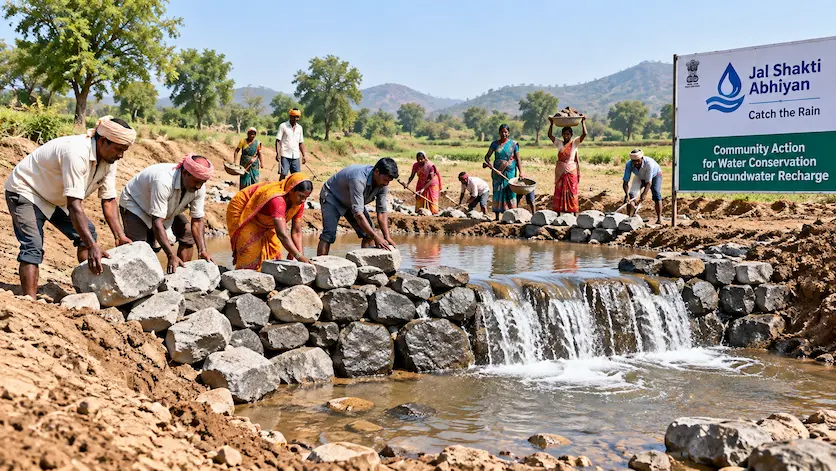
While positive, experts emphasized that groundwater sustainability requires localized recharge projects, such as check dams, farm ponds, and strict limits on over-extraction.
2. Micro-Irrigation & Agriculture Efficiency
Agriculture consumes the largest share of freshwater in India. The conclave highlighted precision farming techniques—including drip and sprinkler irrigation, soil moisture sensors, and weather-synchronized crop schedules—to preserve topsoil and drastically cut water consumption without lowering crop yields.
3. Role of Water Tech Startups
The commercial startup ecosystem displayed practical innovations across several critical verticals:
- Smart meters with automated real-time leak detection.
- Remote sensing devices for continuous water-quality monitoring.
- Data analytics for early flood forecasting and precision dam management.
- Affordable urban rainwater harvesting and decentralized graywater treatment modules.
Key Government Schemes Driving Water Security
The Jal Shakti Ministry highlighted how national programs directly align with IIWW’s climate resilience goals:
| Initiative | Primary Objective |
| Jal Shakti Abhiyan: Catch the Rain | Rainwater harvesting drives across urban and rural structures |
| Atal Bhujal Yojana | Community-led groundwater management in water-stressed districts |
| Mission Amrit Sarovar | Developing and rejuvenating 75+ local water bodies per district |
| Jal Jeevan Mission | Providing functional household tap connections (FHTC) in rural India |
| National Aquifer Mapping (NAQUIM) | Scientific 3D mapping of underground aquifers for sustainable management |
Frequently Asked Questions (FAQ)
Q1: What is the primary theme of India International Water Week 2026?
The primary theme is “Climate Resilient Water Management,” focusing on preparing infrastructure, agriculture, and urban centers to withstand extreme rainfall, droughts, and surging demand.
Q2: Who organised India International Water Week 2026?
IIWW 2026 was organised by the Ministry of Jal Shakti, Government of India, alongside international partner countries The Netherlands and Germany.
Q3: What major technological frameworks were announced at IIWW 2026?
The Jal Shakti Ministry launched two key tech initiatives: the Sustainable Urban River Management Framework and the AI/ML-Driven Integrated Reservoir Sediment Management system.
Q4: How much has India’s groundwater recharge increased since 2017?
Annual estimated groundwater recharge grew from 432 BCM in 2017 to 448.52 BCM in 2025, marking an increase of 16.52 BCM (approximately 3.8%).
Useful Coverage & Links
Stay updated with full national news coverage, policy breakdowns, and infrastructure updates on Matribhumi Samachar English:
- National News & Updates – Matribhumi Samachar
- Regional Initiatives & Environmental Policies
- Earlier Water Week Coverage on Matribhumi Samachar
Disclaimer
This article is prepared for informational and news reporting purposes based on official announcements and data released during India International Water Week 2026. Figures and policy schedules are subject to official Ministry updates.
