

Mumbai.
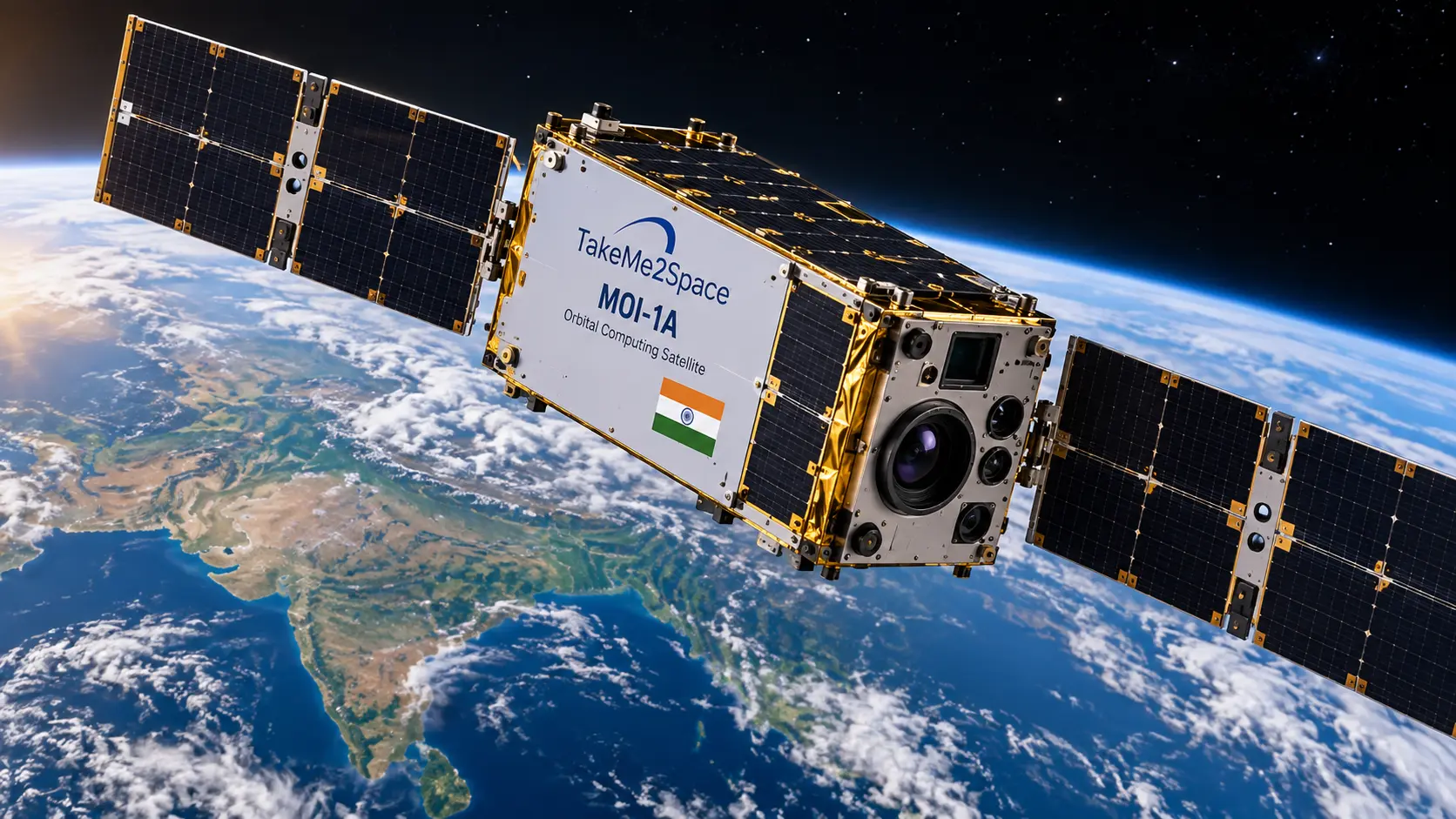
India’s private space ecosystem reached a major milestone in edge artificial intelligence with the successful launch of MOI-1A. Developed by Hyderabad-based space-tech startup TakeMe2Space, MOI-1A is engineered as India’s first orbital AI-computing platform designed to process Earth-observation imagery directly in low Earth orbit (LEO).
Lifted into orbit aboard a SpaceX Falcon 9 as part of the Transporter-18 rideshare mission from California’s Vandenberg Space Force Base at approximately 11:48 PM IST on October 1, the spacecraft represents a paradigm shift: moving heavy data analysis from terrestrial ground stations directly to space.
What Is MOI-1A? Core Technical Specifications
MOI-1A is a compact 6U CubeSat weighing roughly 14 kg with physical dimensions of 226.3 × 100 × 366 mm. Functioning as a miniaturized space laboratory, it allows third-party clients to deploy custom neural networks and run inference directly on raw satellite data.
| Spec Category | Feature & Hardware Details |
| Computing Engine | NVIDIA Jetson Orin NX-based edge AI system |
| AI Performance | Up to 117 TOPS (Trillion Operations Per Second) |
| Memory | 16 GB LPDDR5 RAM (Bandwidth up to 102.4 GB/s) |
| Onboard Storage | 2 TB solid-state capacity for data buffering |
| Payload Imager | 9-Band Multispectral Optical Imager |
| Power Envelope | Up to 120 W peak power support |
| Survivability Tech | Precision attitude-control & proprietary RadShield radiation protection |
How Orbital AI Edge Computing Works
Conventional satellite observation workflows face massive transmission bottlenecks. Satellites capture raw high-resolution images and downlink vast gigabytes of uncompressed files to ground stations, where terrestrial servers finally run analytical algorithms.
The MOI-1A Orbital Edge Architecture:
- Capture: The 9-band multispectral system captures terrain images in orbit.
- In-Space Inference: The onboard NVIDIA processor executes client AI models instantly.
- Selective Downlink: Instead of raw files, the satellite transmits only actionable findings (e.g., detected flood damage, localized crop stress, or infrastructure updates).
This streamlined workflow dramatically reduces downlink bandwidth requirements, speeds up actionable reporting, and cuts ground operation expenses.
Multispectral Imaging & Practical Industry Applications
With its nine-band optical sensor, MOI-1A collects data far beyond the visible light spectrum. Paired with real-time AI inference, 23 launch-partner organizations across diverse sectors are leveraging the spacecraft for:
- Agriculture: Early crop disease identification, automated moisture mapping, and harvest yield forecasting.
- Infrastructure & Mining: Monitoring unauthorized development, mining footprint expansions, and structural integrity.
- Supply Chain & Logistics: Port congestion tracking, maritime traffic monitoring, and supply chain updates.
- Disaster Response & Insurance: Assessing post-storm infrastructure impact for immediate insurance verification.
Lessons from Pioneer Demonstrator MOI-TD
MOI-1A builds on TakeMe2Space’s initial technology demonstrator, MOI-TD, which flew aboard the ISRO PSLV-C60 mission in December 2024. While MOI-TD validated basic bus functions, a software pipeline glitch prevented the AI processing unit from triggering in orbit. MOI-1A directly resolves those initial software-stack vulnerabilities to establish a reliable, fully operational platform.
Overcoming Engineering Hurdles in Low Earth Orbit
Operating high-throughput AI platforms in LEO requires overcoming key environmental constraints:
- Thermal Radiative Cooling: In a vacuum, convective cooling does not exist; heat generated by the 117 TOPS processor must be dissipated via passive thermal radiation structures.
- Solar Power Budgeting: Solar arrays on a 14 kg CubeSat must carefully balance power draw between imaging sensors, radios, and peak GPU operation.
- Space Radiation Defenses: High-density chips like the NVIDIA Orin NX are vulnerable to cosmic radiation; TakeMe2Space utilizes specialized RadShield technology to mitigate radiation-induced single-event errors.
Frequently Asked Questions (FAQ)
Q1: What makes MOI-1A different from traditional Earth-observation satellites?
Unlike traditional satellites that transmit large raw image files to Earth for analysis, MOI-1A uses onboard AI processors to analyze data directly in space, sending back only processed results and actionable insights.
Q2: Which company developed the MOI-1A satellite?
MOI-1A was designed and built by TakeMe2Space, a space-tech startup headquartered in Hyderabad, India.
Q3: What processor powers the AI capabilities on MOI-1A?
The satellite utilizes an NVIDIA Jetson Orin NX platform, providing up to 117 TOPS of AI processing capability backed by 16 GB LPDDR5 memory.
Disclaimer
This article is published for informational and educational purposes based on news announcements regarding India’s private space technology sector. Technical specifications, operational schedules, and mission parameters are subject to post-launch updates by TakeMe2Space and official launch services providers.
Related Resources & Links
- Read more space-tech updates on Matribhumi Samachar English
- Check out national technology breakthroughs on Matribhumi Samachar National Coverage
