 Matribhumi Samachar English


Nagpur. Monday, 13 July 2026
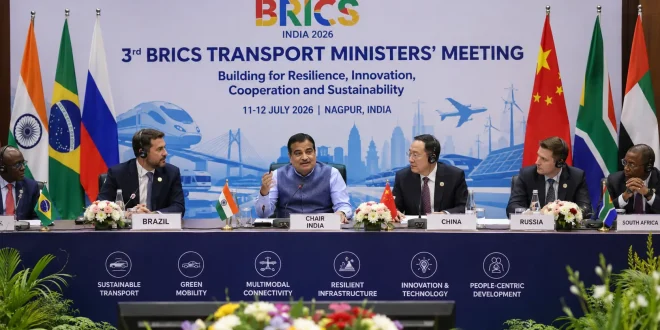
In a decisive move toward a cleaner, highly connected future, the 3rd BRICS Transport Ministers’ Meeting successfully concluded in Nagpur, Maharashtra, under India’s 2026 BRICS Chairship. Chaired by India’s Union Minister of Road Transport and Highways, Shri Nitin Gadkari, the high-level convention culminated in the unanimous adoption of a comprehensive Ministerial Declaration. The landmark accord establishes a collaborative global roadmap for low-carbon transportation, infrastructure resilience, and cross-border logistics modernization.
The four-day program, which brought together transport ministers, senior officials, and technical experts from across the expanded BRICS bloc, directly aligns with India’s forward-looking Viksit Bharat 2047 vision—emphasizing data-driven, climate-conscious, and disaster-resilient systems.
Strategic Shift Toward Sustainable Infrastructure and Low-Carbon Energy
A primary pillar of the newly adopted declaration is the accelerated transition toward cleaner, alternative transport systems. Recognizing the heavy carbon footprint traditionally associated with logistics, member nations pledged deep policy alignment to curb greenhouse gas emissions without sacrificing economic growth.
Key strategic focus areas include:
-
Alternative Fuels and Biofuels: Deepening collaborative research to commercialize and scale up non-polluting fuel alternatives across road, rail, and waterway networks.
-
Circularity in Infrastructure: Implementing resource-efficient construction methods, including recycling materials and cutting down waste in massive transit corridor developments.
-
Transport Decarbonization: Deploying advanced electric mobility solutions and smart vehicle technologies to curb urban emission levels.
Elevating Sustainable Aviation Fuel (SAF) to the Global Stage
With global aviation under intense scrutiny for its environmental impact, the Nagpur meeting identified Sustainable Aviation Fuel (SAF) as a critical area for immediate international cooperation.
Rather than working in isolation, BRICS nations will establish regular channels to exchange technical knowledge, share successful policy frameworks, and drive industrial innovation. The collective goal is clear: lower production bottlenecks and increase the commercial adoption of SAF to fundamentally decrease aviation emissions on global flight paths.
Boosting Logistics Efficiency and Slashing Supply Chain Costs
Amid shifting global trade patterns, the ministers stressed that strengthening physical and digital connectivity is non-negotiable for long-term economic stability. The declaration outlines a dedicated commitment to improving multimodal transport systems—seamlessly linking rail, road, and port networks to ensure seamless cargo transitions.
+-------------------------------------------------------------+
|               Nagpur Declaration Objectives                 |
+-------------------------------------------------------------+
|  -> Lower Regional Logistics Costs                          |
|  -> Bolster Cross-Border Supply Chain Resilience            |
|  -> Enhance Intercontinental Trade Corridor Efficiency      |
+-------------------------------------------------------------+
|  Result: Maximized economic growth for member nations.      |
+-------------------------------------------------------------+
Modernizing Rail Networks: The BRICS Railway Research Network Approved
A major breakthrough of the summit was the official endorsement and launch of the BRICS Railway Research Network. Designed to be a collaborative engine for rolling stock and track innovation, this specialized network will focus heavily on:
-
Joint Scientific Research: Co-developing high-efficiency, next-generation railway systems.
-
Technology Exchange: Sharing breakthroughs in AI-enabled signaling, automation, and predictive maintenance.
-
Enhanced Operational Safety: Standardizing safety benchmarks and modern training systems for railway personnel.
Reshaping Cities with Smart Urban Mobility Hubs
The ministerial dialogue extended deeply into localized urban planning. Delegates finalized plans to transition traditional urban transport into integrated Urban Mobility Hubs. By connecting public transit, micro-mobility, and EV charging infrastructure into centralized hubs, BRICS nations plan to drastically lower congestion and transform cities into smarter, livable spaces.
India’s Overarching Theme: A Blueprint for the Future
Operating under the official 2026 Chairship theme, “Building for Resilience, Innovation, Cooperation and Sustainability,” India effectively leveraged the summit to display its domestic transport achievements while providing a blueprint for the wider bloc. The consensus achieved in Nagpur underscores a unified political will to deepen economic ties and safeguard international supply chains against future global shocks.
Frequently Asked Questions (FAQ)
Q1: What is the main outcome of the 3rd BRICS Transport Ministers’ Meeting?
A: The primary outcome was the unanimous adoption of the Ministerial Declaration in Nagpur, which creates a joint framework for sustainable aviation fuels (SAF), infrastructure circularity, transport decarbonization, and cross-border logistics cooperation.
Q2: Which countries participated in the 2026 meeting?
A: The meeting hosted ministers and senior officials from the expanded BRICS bloc, which now represents nearly half of the world’s population and roughly 40% of global GDP, including nations like India, Brazil, Russia, China, South Africa, Egypt, Ethiopia, Iran, Saudi Arabia, the UAE, and Indonesia.
Q3: What is the purpose of the BRICS Railway Research Network?
A: The newly approved network aims to accelerate the modernization of rail systems through joint research, technology sharing, capacity building, and implementing best safety practices across member states.
Disclaimer
This article is curated for informational purposes based on official press statements and proceedings from the 2026 BRICS Chairship events. While every effort is made to maintain factual accuracy, readers are advised to cross-reference updates with official government portals.
Relevant Links
For more regional context and adjacent news coverage in English, visit: