

Mumbai. Updated on : Wednesday, 24 June 2026
The Indian real estate sector in 2026 has undergone a massive technological and regulatory transformation. Driven by an investor shift toward peripheral corridors and booming Tier-2 markets like Lucknow and Indore—where property prices have surged by up to 100%—homebuyers face a unique environment.
With the Reserve Bank of India (RBI) executing a 100 bps interest rate cut, home loans are more accessible than ever. However, choosing between a Ready-to-Move-In (RTM) property and an Under-Construction (UC) project requires a deep understanding of the 2026 market dynamics.
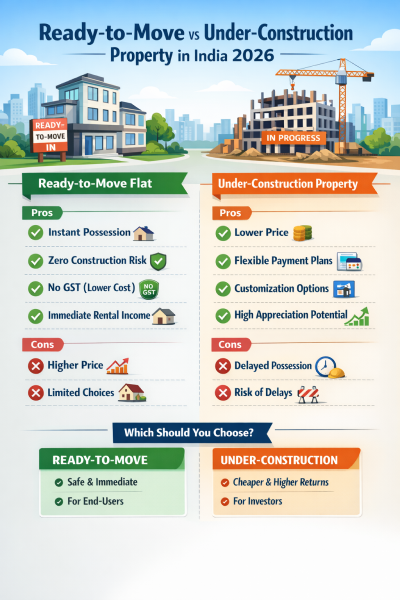
1. Ready-to-Move-In (RTM) Properties: Immediate Peace of Mind
Often called the “What You See is What You Get” route, RTM properties are favored by risk-averse buyers who want to bypass the wait times entirely.
The Zero GST Advantage: In 2026, RTM units remain exempt from Goods and Services Tax (GST) as long as they possess a valid Occupancy Certificate (OC). This instantly saves buyers roughly 5% compared to standard under-construction housing.
Instant Financial Utility: You can move in immediately—eliminating the “Rent + EMI” trap—or lease the property out. Thanks to a growing demand for premium community living, rental yields in gated townships are hovering at a five-year high.
Modernized Infrastructure: Buyers should note that premium RTM homes delivered recently come standard with 5G-ready smart setups, separating them from older sub-standard inventories.
2. Under-Construction (UC) Properties: The High-Appreciation Playbook
Under-construction projects continue to be the primary vehicle for wealth creation, especially along emerging mega-infrastructure lines.
Lower Entry and Early-Bird Discounts: UC properties are typically priced 10% to 30% lower than completed units. Buying early in development pockets along major economic transit channels offers substantial capital appreciation.
The RERA 2.0 Safety Blanket: The enforcement of strict RERA 2.0 rules has mitigated construction risks. Builders are legally obligated to deploy a Three-Bank-Account System, ensuring that money pooled for your specific project cannot be funneled elsewhere.
Mid-Phase Modular Layouts: Modern 2026 structural engineering allows buyers to request internal modular modifications during mid-construction, a benefit impossible with a finished slab.
The 2026 Property Comparison Matrix
| Feature | Ready-to-Move (RTM) Flats | Under-Construction (UC) Flats |
| GST Liability | 0% (If Occupancy Certificate is issued) | 5% (1% for Affordable Housing segment) |
| Price Point | Premium / Fixed Market Rate | 10% to 30% Base Discount |
| Risk Profile | Negligible structural or delivery risk | Drastically reduced via RERA 2.0 escrow rules |
| Capital Appreciation | Stable and predictable growth | High potential (tied to nearby infrastructure completion) |
| Smart Tech Integration | As-is condition | Built-in future tech (EV charging networks, integrated IoT) |
Essential Checklist for 2026 Property Buyers
Before signing any allotment letter, protect your investment by conducting a modern digital audit:
Audit for RERA 2.0 Compliance: Go to the official state RERA portal to confirm that the project actively utilizes the mandated project-specific tracking accounts.
Review the Financial Health Score: Utilize the national registry portals to look up the builder’s fiscal transparency rating—a safety feature designed to flag highly leveraged developers.
Verify Localized Registry Changes: Real estate buyers in regions like Uttar Pradesh must follow updated local frameworks. For instance, the New UP Property Registry Rules 2026 mandate technology-driven biometric authentication, unique QR code generation, and rigorous RERA verification to completely eliminate fraudulent land ownership claims.
Track the Infrastructure Multiplier: Prioritize buying properties positioned near major transit upgrades. As highlighted by regional infrastructure updates, developments like the Lucknow-Kanpur Rapid Rail Corridor are turning micro-markets and peripheral transit nodes into thriving urban residential hubs.
Frequently Asked Questions (FAQs)
1. Does RERA 2.0 apply to both ready-to-move and under-construction properties?
RERA 2.0 rules apply across the board to all registered developments. However, its strict financial escrow rules (like the three-bank-account fund management system) primarily protect buyers investing in under-construction properties against project delays.
2. How much GST can I save by choosing a ready flat over an under-construction unit?
You can save approximately 5% on the total cost of the property. Under-construction luxury or standard apartments attract a 5% GST rate, whereas an RTM apartment with an issued Occupancy Certificate attracts 0% GST.
3. Why are real estate prices spiking so quickly in Tier-2 cities?
Tier-2 property markets are experiencing up to 100% price growth because of major expressways, high-speed regional transit lines, and a deliberate decentralization of commercial spaces away from congested metro cities.
Disclaimer
This article is intended solely for general informational purposes. Real estate investments are subject to market risks, regulatory updates, and localized state laws. Homebuyers are strongly advised to consult legal experts and independently verify RERA registration numbers on official government portals before executing financial transactions.
