

New Delhi.
- What is the Widow Pension Scheme?
- Scheme Overview & Features
- Eligibility Criteria for 2026
- Required Documents Checklist
- State-Wise Application Portals
- Step-by-Step Online Application Guide
- Focus Guide: Uttar Pradesh Widow Pension (Nirashrit Mahila Pension Yojana)
- Aadhaar, e-KYC, and Direct Benefit Transfer (DBT)
- Troubleshooting Common Application and Payment Issues
- Tracking Payment & Beneficiary Status
The Widow Pension Scheme (Vidhwa Pension Yojana) stands as one of India’s primary social security initiatives, offering vital financial relief to widowed women across the country. Designed to promote financial independence and cover essential living costs, the pension operates through a structured collaboration between the Central Government and individual state administrations.
Whether you are applying for the first time or looking to track an existing application, this comprehensive 2026 guide breaks down everything from state-wise eligibility rules and required documents to Direct Benefit Transfer (DBT) verification and payment troubleshooting.
What is the Widow Pension Scheme?
The Widow Pension Scheme provides recurring monthly or quarterly financial assistance to eligible widowed women living in economically vulnerable circumstances.
The initiative operates on two primary levels:
- Indira Gandhi National Widow Pension Scheme (IGNWPS): A centrally sponsored component under the National Social Assistance Programme (NSAP) administered by the Ministry of Rural Development. It focuses primarily on widows from Below Poverty Line (BPL) households.
- State Widow Pension Schemes: Independent state programmes administered by respective Social Welfare Departments. Many state governments contribute additional funds to supplement central assistance or run parallel schemes with broader eligibility criteria.
Because state rules vary significantly, receiving assistance under a state scheme does not automatically mean the same rules apply as the central IGNWPS, and vice versa.
Scheme Overview & Features
| Feature | Key Details |
| Scheme Category | Social Security / Financial Assistance |
| Target Group | Widowed women meeting state/central income criteria |
| Payment Mode | Direct Benefit Transfer (DBT) to Aadhaar-linked bank accounts |
| Primary Requirement | Official Husband’s Death Certificate |
| Central Scheme | IGNWPS (NSAP) |
| Key State Example | Uttar Pradesh Nirashrit Mahila Pension Yojana |
Eligibility Criteria for 2026
Eligibility conditions are defined by the specific scheme and state administering the pension.
- Marital Status: The applicant must be a legally recognized widow.
- Age Limits:
- Central Scheme (IGNWPS): Focuses on widows aged 40 to 79 years.
- State Schemes: Many states extend benefits to young widows starting from 18 years of age.
- Income Cap: Applicants must belong to a BPL household or fall below prescribed annual income thresholds (e.g., rural vs. urban limits set by state welfare departments).
- Residence: Applicants must be permanent residents of the state where they submit the application.
- Remarriage: If the beneficiary remarries, eligibility under the pension scheme generally ceases.
- Other Pensions: Women receiving other government social security pensions are typically ineligible to draw dual pension benefits under standard rules.
Required Documents Checklist
Before initiating an online or offline application, prepare clear, legible copies of the following documents:
- Aadhaar Card (Identity Proof)
- Husband’s Official Death Certificate (Mandatory to establish widow status)
- Proof of Age (Birth Certificate, Aadhaar, Voter ID, or Matriculation Certificate)
- Proof of Residence / Domicile Certificate
- Income Certificate / BPL Ration Card
- Active Bank Passbook (Showing Account Number and IFSC Code)
- Recent Passport-size Photograph
- Mobile Number (Linked with Aadhaar for OTP verification)
Important Note on Death Certificates: Ensure that personal details (such as spelling of names) on the husband’s death certificate match the applicant’s official identification records to prevent rejection during document verification.
State-Wise Application Portals
Application routes vary across states and Union Territories. Below are verified government access routes:
| State / UT | Portal / Application Route |
| Uttar Pradesh | UP Integrated Pension Portal (sspy-up.gov.in) |
| Uttarakhand | Uttarakhand Social Security Pension Portal (ssp.uk.gov.in) |
| Kerala | Kerala IGNWPS Portal / Local Self-Government Institutions |
| Haryana | National Government Services Portal (Search: Widow & Destitute Women Pension) |
| Rajasthan | National Government Services Portal (Search: Social Security Pension) |
| Other States / UTs | National Government Services Portal or state-specific Social Welfare portals |
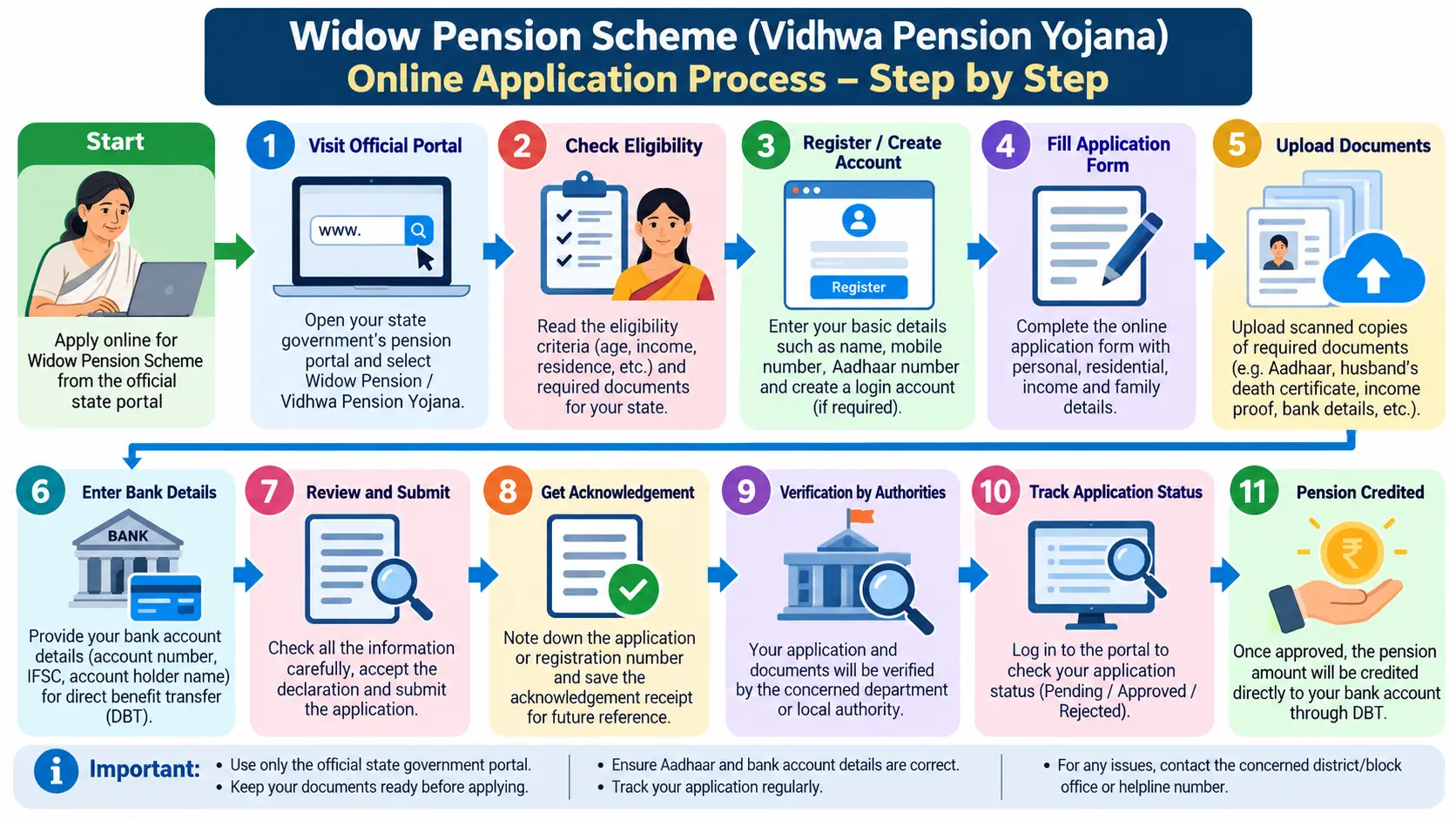
Step-by-Step Online Application Guide
Follow these generic steps to complete an online application:
- Visit the Official State Portal: Open the official social welfare or pension website for your state.
- Select Scheme: Choose Widow Pension, Vidhwa Pension, or Nirashrit Mahila Pension.
- New Registration: Click on “Apply Online” and enter personal, demographic, and residence details.
- Bank Details Entry: Input your active bank account number, bank name, and IFSC code accurately.
- Upload Documents: Upload scanned copies of your photo, death certificate, income proof, and identity documents in the specified file formats and sizes.
- Submit & Save Acknowledgement: Complete the declaration, submit the form, and note down the Application/Registration Number for tracking.
- Verification & Processing: Local authorities (Block Development Officers, Tehsildars, or District Social Welfare Officers) verify physical or digital records prior to final sanction.
Focus Guide: Uttar Pradesh Widow Pension (Nirashrit Mahila Pension Yojana)
In Uttar Pradesh, the scheme is widely known as the Nirashrit Mahila Pension Yojana and is managed via the SSPY Integrated Pension Portal.
- Age Limit: Widowed women aged 18 years and above.
- Income Ceiling: Annual household income must be below ₹46,080 for rural areas and ₹56,460 for urban areas.
- Pension Amount: Financial assistance of ₹1,000 per month (often released quarterly as ₹3,000 per installment).
- How to Apply: Applicants can apply online through sspy-up.gov.in or seek help at any nearest Common Service Centre (CSC) or Gram Panchayat office.
Aadhaar, e-KYC, and Direct Benefit Transfer (DBT)
All modern pension distributions rely heavily on Direct Benefit Transfer (DBT). To ensure unhindered monthly transfers:
- Aadhaar Seeding: Your Aadhaar card must be formally linked with your bank account.
- NPCI Mapping: The bank account must be mapped on the NPCI (National Payments Corporation of India) mapper to accept central/state government electronic transfers.
- e-KYC Verification: Beneficiaries must complete periodic life verification or e-KYC processes as requested by the state social welfare department.
Troubleshooting Common Application and Payment Issues
| Issue | Resolution Steps |
| Application Pending | Track status online using your registration number or contact the district/block welfare officer. |
| Payment Failed / Returned | Visit your bank to confirm account status, update e-KYC, and verify NPCI/DBT mapping. |
| Name / Aadhaar Mismatch | Correct demographic details at an Aadhaar Enrolment Centre and submit updated details on the portal. |
| Pension Stopped Suddenly | Check if an annual life certificate (e-KYC) update is overdue on the portal or if bank account details need re-validation. |
Tracking Payment & Beneficiary Status
Beneficiaries can monitor their payment status through three primary routes:
- State Pension Portals: Use the “Applicant Login” or “Know Your Status” feature on state-specific portals like SSPY UP.
- Public Financial Management System (PFMS): Visit the official PFMS portal (pfms.nic.in) and select “Know Your Payments” using your bank account number or application ID.
- Passbook Update: Regularly check your bank statement or passbook directly rather than relying solely on mobile SMS updates.
Frequently Asked Questions (FAQs)
Q1. Can a widow under 40 years of age apply for a pension?
Yes. While the Central IGNWPS scheme targets widows aged 40 and above, many state-run widow pension schemes accept eligible applicants starting from 18 years of age.
Q2. Is Aadhaar compulsory for applying to the Widow Pension Scheme?
Yes, in most states, Aadhaar is mandatory for identity verification, e-KYC, and processing Direct Benefit Transfer (DBT) payments directly to bank accounts.
Q3. What should I do if my pension application is rejected?
Review the rejection reason specified on your portal dashboard. If the rejection was due to missing or incorrect documents, correct the errors and re-apply or raise a grievance with your local Social Welfare Office.
Q4. Can a widow receiving another government pension get this assistance?
Generally, no. Most welfare rules prohibit beneficiaries from receiving multiple social security pensions simultaneously.
Disclaimer
This article is published for general informational and educational purposes only. Scheme guidelines, eligibility thresholds, income caps, and monthly pension rates are subject to change by respective Central and State Government departments. Applicants are strongly advised to verify all current details, forms, and official notifications on official government portals (such as nsap.nic.in, sspy-up.gov.in, or pfms.nic.in) or consult designated local welfare authorities before submitting personal details.
Related Links & Further Reading
For more updates on social welfare schemes, government initiatives, and national news, explore:
