

New Delhi. Saturday, 25 July 2026
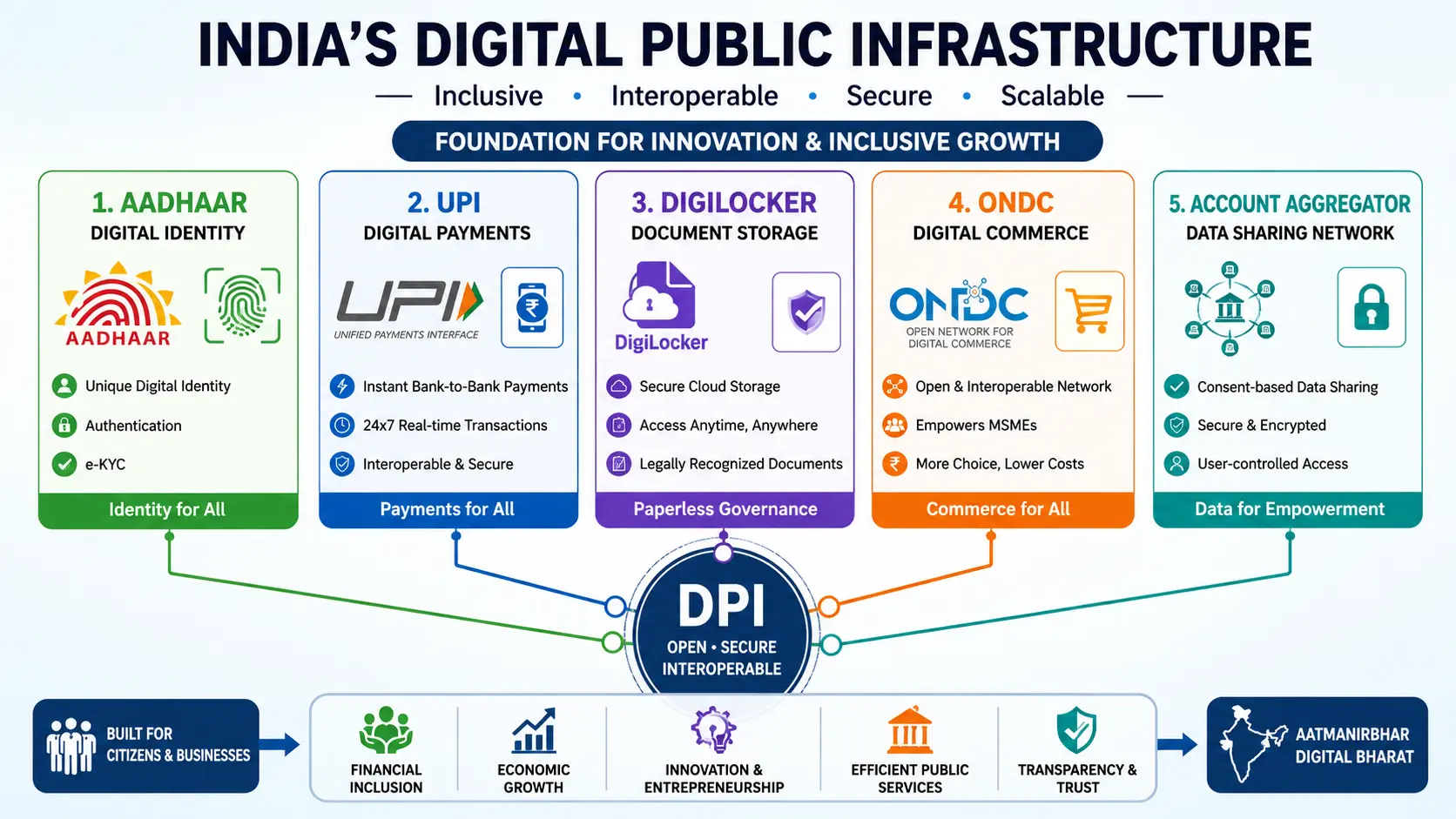
India has established itself as a global trailblazer in leveraging technology for social and economic development. At the heart of this transformation is Digital Public Infrastructure (DPI)—a collection of open, interoperable, and foundational digital systems often collectively known as India Stack.
Instead of creating fragmented, closed-loop applications for every service, India constructed reusable “digital rails” upon which governments, private enterprises, and fintech startups continuously build inclusive solutions.
What Is Digital Public Infrastructure (DPI)?
Digital Public Infrastructure refers to open-source or open-protocol digital building blocks accessible to citizens, businesses, and public agencies. Much like traditional physical infrastructure—such as highways and power grids—enables commerce and trade, DPI provides the virtual pathways needed for modern governance, banking, and digital commerce.
India’s DPI rests on three main foundational pillars:
Digital Identity: Providing universal, verifiable identity proof.
Digital Payments: Enabling real-time, low-cost financial transactions.
Data Exchange & Open Networks: Facilitating paperless document verification, consent-based financial data movement, and open market ecosystems.
The Core Pillars Powering the Ecosystem
               ┌───────────────────────────────────────────────┐
               │    INDIA'S DIGITAL PUBLIC INFRASTRUCTURE      │
               └───────────────────────┬───────────────────────┘
                                       │
         ┌─────────────────────────────┼─────────────────────────────┐
         ▼                             ▼                             ▼
┌───────────────────┐        ┌───────────────────┐        ┌───────────────────┐
│   IDENTITY LAYER  │        │   PAYMENT LAYER   │        │   DATA & COMMERCE │
│     (Aadhaar)     │        │       (UPI)       │        │     EXCHANGE      │
└────────┬──────────┘        └────────┬──────────┘        └────────┬──────────┘
         │                             │                           │
         ├─ Biometric Auth             ├─ 24/7 Real-Time           ├─ DigiLocker
         ├─ OTP Verification           ├─ QR Code Payments         ├─ Account Aggregator
         └─ e-KYC Integration          └─ Cross-Border Linkages    └─ ONDC Network
1. Aadhaar: The Universal Identity Layer
Aadhaar serves as the foundational identity layer for India’s digital architecture. Through a 12-digit unique identification number backed by biometric and demographic data, Aadhaar allows residents to authenticate their identity securely anywhere in the country.
Key Features: Biometric authentication, OTP validation, e-KYC integration, and direct API access for authorized entities.
Economic Impact: Drastically reduces identity fraud, speeds up bank account openings, and enables direct benefit transfers (DBT) for welfare schemes.
2. Unified Payments Interface (UPI): Revolutionizing Real-Time Cash Flow
Developed by the National Payments Corporation of India (NPCI), UPI transformed peer-to-peer and peer-to-merchant payments into instant, zero-friction transfers directly between bank accounts.
Key Features: 24/7 instant settlement, QR-code payment standardization, AutoPay recurring mandates, and international expansion.
Economic Impact: Processing billions of transactions every month, UPI accounts for a massive share of global real-time digital payment volume, fostering micro-commerce across both urban centers and rural villages.
3. DigiLocker: Paperless Governance in Your Pocket
DigiLocker provides citizens with a secure cloud-based document repository linked to their digital identity.
Key Uses: Storing and issuing legally valid electronic versions of driving licenses, academic certificates, PAN cards, and vehicle registrations.
Benefits: Eliminates the necessity for physical paperwork, curbs document forgery, and simplifies public service verification.
4. Open Network for Digital Commerce (ONDC): Democratizing E-Commerce
ONDC acts as an open, unbundled network rather than a single monolithic marketplace. It enables buyers, sellers, and logistics providers on different platforms to interact seamlessly.
Key Objectives: Reduces platform dominance, lowers high commission structures, and empowers small and micro-entrepreneurs (MSMEs) to reach nationwide consumer bases.
5. Account Aggregator (AA): Consent-Driven Financial Data Sharing
The Account Aggregator framework, regulated by the Reserve Bank of India (RBI), lets individuals and small businesses securely share their financial information across financial institutions.
Privacy Model: Fully encrypted, user-controlled, and strictly consent-driven.
Impact: Unlocks collateral-free cash-flow lending for gig workers and small enterprises by allowing lenders to review verified transaction histories instantly.
Overview of Key DPI Pillars
| Platform | Primary Domain | Core Function | Primary Benefit |
| Aadhaar | Digital Identity | Biometric & OTP verification | Rapid e-KYC and targeted welfare delivery |
| UPI | Real-Time Payments | Interoperable mobile transfers | Low-cost, instant financial settlement |
| DigiLocker | Digital Documents | Secure cloud document wallet | Paperless, fraud-resistant verification |
| ONDC | Open E-Commerce | Open-protocol buyer-seller matching | Level playing field for MSMEs |
| Account Aggregator | Financial Data Sharing | Encrypted, consent-based data flows | Faster formal credit access for underserved groups |
Opportunities and Remaining Challenges
Opportunities for Businesses & Startups
Frictionless Onboarding: Enterprises can verify user identity within seconds using Aadhaar-based e-KYC.
Higher Conversion Rates: Integrating UPI and ONDC reduces checkout friction and expands merchant access to hitherto untapped rural markets.
Data-Driven Underwriting: Financial institutions can create customized credit, insurance, and wealth products via the Account Aggregator pipeline.
Challenges to Overcome
Cybersecurity & Data Privacy: Safeguarding population-scale data requires continuous updates to data protection measures and strict compliance oversight.
Digital Divide & Literacy: Addressing gap areas in rural internet connectivity and promoting digital financial literacy across local languages.
Fraud Prevention: Preventing phishing, social engineering scams, and unauthorized consent requests as adoption grows.
Related Coverage from Matribhumi Samachar
Explore more detailed insights on technology, governance, and economics on our portal:
Frequently Asked Questions (FAQ)
What is the main goal of Digital Public Infrastructure in India?
DPI aims to provide accessible, open, and foundational digital systems to every citizen, business, and government agency. By building public digital rails, it enables innovation, lowers transaction costs, and promotes financial inclusion.
Is my personal financial data safe with the Account Aggregator framework?
Yes. The Account Aggregator operates on an encrypted, consent-first model. Data can only be accessed with your explicit authorization, and the AA platform itself cannot read or store the contents of your financial data.
How does ONDC differ from traditional e-commerce platforms?
Traditional e-commerce platforms operate as closed ecosystems where buyers and sellers must register on the same app. ONDC operates as an open network, allowing a buyer on one app to purchase goods seamlessly from a seller listed on a completely different network app.
Disclaimer
Disclaimer: This article is intended strictly for informational and educational purposes. The details regarding Digital Public Infrastructure, platforms (Aadhaar, UPI, DigiLocker, ONDC, Account Aggregator), and government policy frameworks are subject to updates by regulatory bodies such as the Reserve Bank of India (RBI), National Payments Corporation of India (NPCI), and Unique Identification Authority of India (UIDAI). Readers should verify specific operational or legal guidelines directly with the respective official government portals.
