

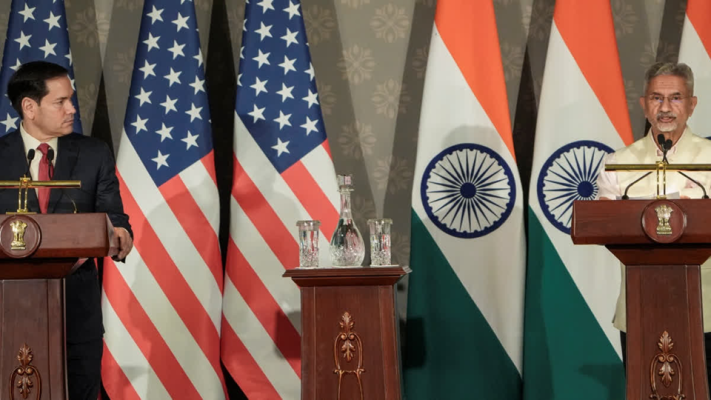
New Delhi. Sunday, 24 May 2026
In a high-stakes diplomatic summit at Hyderabad House, India and the United States reaffirmed their geopolitical alignment amid escalating global pressures. US External Affairs Minister Marco Rubio and India’s External Affairs Minister S. Jaishankar led comprehensive bilateral discussions spanning international trade corridors, deep-seated immigration shifts, and shared regional security priorities.
The joint press conference highlighted a mature diplomatic bond capable of navigating sensitive domestic policies while maintaining a unified front on international security.
1. Demystifying the US Visa Modernization Order
Recent changes to US visa regulations—specifically targeting J-1, F-1, and H-1B frameworks—have generated intense anxiety among Indian tech professionals and students. Addressing these concerns directly, Secretary Rubio clarified that the ongoing shifts are structural overhauls aimed at modernization rather than an isolationist policy targeting India.
Key Takeaways on Immigration Reforms
Global Structural Update: The changes are part of a universal migration overhaul to optimize efficiency.
Economic Interdependence: Rubio highlighted that Indian enterprises have integrated over $20 billion into the US domestic market, making economic cooperation an absolute priority.
The Transition Phase: Washington acknowledges that the operational transition might yield temporary friction but maintains it will yield long-term systemic clarity.
2. The Geopolitical Crucible: Safeguarding the Strait of Hormuz
With escalating tensions involving Iran and the broader West Asian theatre, the security of critical global shipping lanes emerged as a vital focal point. The Strait of Hormuz acts as a lifeline for maritime trade and energy security, directly impacting energy import costs across developing markets.
[Strait of Hormuz] ──► Hostile Threats ──► Spikes Global Crude & Shipping Costs
         ▲
         │ (Coordinated Safeguard Framework)
[US & Gulf Partners] ──► Ensuring Uninterrupted Commercial Passage
Rubio indicated that positive geopolitical breakthroughs are developing rapidly, hinting at incoming policy actions from US President Donald Trump. Over the last 48 hours, diplomatic breakthroughs between the US and Gulf partners have laid out a collaborative framework explicitly designed to keep the Strait open to non-belligerent commercial fleets.
3. Realist Diplomacy: India’s West Asian Equation
External Affairs Minister S. Jaishankar meticulously detailed India’s non-aligned, multi-directional foreign policy. Unlike conventional zero-sum frameworks, India continues to successfully cultivate simultaneous, constructive relationships with the US, Israel, Iran, and the Gulf nations.
“For India, peace and stability in West Asia are extremely important. The welfare and safety of the Indian diaspora remain our top priority.”
— S. Jaishankar, External Affairs Minister
India’s primary operational anchors in the region emphasize:
Energy Security: Securing stable supply lines from Middle Eastern producers to prevent domestic price shocks.
Diaspora Safety: Protecting the welfare of millions of Indian nationals residing and working in the Gulf.
Uninterrupted Maritime Transit: Advocating for open, barrier-free global shipping routes to sustain market accessibility.
4. Addressing Societal Undercurrents
The talks also confronted difficult human elements head-on. Responding to the recent rise in xenophobic and racist commentary directed at individuals of Indian origin within the United States, Rubio strongly condemned the targeted incidents. He pointed out that while “foolish people exist in every society,” the overarching US economic and cultural fabric has been immensely enriched by the contributions of the Indian diaspora.
Fact-Check and Contextual Corrections for Readers
To maintain rigorous journalistic standards, keep these structural realities in mind when assessing the output of high-profile bilateral press briefs:
Immigration Disruption Timeline: While the US administration frames visa modifications as a tool for administrative “efficiency,” immediate local updates have undeniably introduced application bottlenecks and stricter workplace compliance parameters for foreign workers.
Multilateral Security Overlaps: These discussions do not exist in a vacuum. The bilateral talks set up a critical strategic baseline right before both leaders pivot to the upcoming Quad Foreign Ministers’ Meeting, where the broader focus will turn toward secure trade lanes across the Indo-Pacific.
To read further domestic coverage on emerging trade corridors and regional diplomacy, explore updates directly via Matribhumi Samachar.
This video report highlights the cultural and bilateral events covering high-level interactions on the sub-continent: Matribhumi Samachar Media Report.
