

Mumbai. Friday, 12 June 2026
The conversation surrounding Artificial Intelligence has officially graduated from superficial text generation, art creation, and software debugging tools. A massive technological shift is unfolding: the emergence of Engineering-Focused AI Systems.
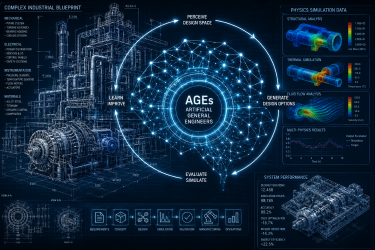
Moving far beyond traditional chatbots, these platforms are engineered to comprehend the uncompromising laws of physics, thermodynamics, chemistry, and structural mechanics. Researchers increasingly refer to this evolutionary milestone as the path toward Artificial General Engineers (AGEs)—intelligent autonomous systems capable of acting as collaborative co-workers throughout the entire product and industrial development lifecycle.
How Engineering-Focused AI Operates
Traditional generative AI models rely on probabilistic guesswork to determine the “next most logical word.” However, an engineering system cannot afford to guess; structural calculations, chip layout parameters, and fluid dynamics require absolute precision.
To bridge this gap, modern AGE platforms combine reasoning models with structural deterministic tools:
                  ┌──────────────────────────────┐
                  │ AI Reasoning Core (LLM/LMM)  │
                  └──────────────┬───────────────┘
                                 │
         ┌───────────────────────┴───────────────────────┐
         ▼                                               ▼
┌────────────────────────────────┐              ┌────────────────────────────────┐
│   Physics Simulation Engines   │              │     Real-Time Digital Twins    │
│  (CFD, Finite Element Analysis)│              │  (IoT Local Hardware Feedback) │
└────────────────────────────────┘              └────────────────────────────────┘
By connecting an AI core to traditional engineering software APIs, the platform can generate a design variant, trigger its own virtual stress test, analyze the physical failure, and auto-correct the design within seconds.
The Industrial Impact: From Blueprints to Silicon
This wave of deep-tech engineering AI is causing massive waves across heavy industries, drastically shrinking development timelines from years to months:
1. Semiconductor Design & Fabrication
Chip layout and verification are among the most complex human engineering tasks on Earth. Engineering-focused AI systems are being deployed to optimize circuit layouts and accelerate routing processes on physical silicon nodes.
This trend is incredibly relevant in regions investing heavily in localized electronics assembly. For instance, the successful validation of Netrasemi’s 12nm A2000 Chip in India highlights an industrial pivot toward designing complex, cloud-free Edge AI chips locally. By optimizing circuit geometries via automated machine loops, hardware designers can squeeze maximum efficiency out of mature nodes without blowing capital budgets.
2. Digital Twins and Industrial Infrastructure
An AGE system functions optimally when plugged into a Digital Twin—a real-time, pixel-perfect digital mirror of a physical factory or system running on continuous sensor loops. This synergy is a vital element of future high-speed communications, including the unfolding Bharat 6G Vision Transforming Global Telecommunications. In these advanced ecosystems, AI agents actively track physical telemetry, predict structural fatigue, and dynamically reconfigure hardware states on the fly.
3. Energy Systems and Hyperscale Factories
Designing power grids, smart manufacturing clusters, and massive computing facilities requires intensive, multi-variable structural optimization. As detailed in the analytical breakdown of The Backbone of the Digital Revolution and India’s AI Infrastructure Investment, modern data complexes are evolving into hyper-dense processing hubs. Because these calculate continuous matrix variations, engineering AI is needed to automatically architect fluid-dynamics loops, direct-to-chip liquid cooling systems, and green captive power configurations.
Traditional vs. AI-Driven Engineering Workflows
The operational contrast between yesterday’s manual engineering steps and an AI-orchestrated development environment shows how drastically timelines are compressing:
| Development Stage | Traditional Engineering Process | Engineering-Focused AI (AGE) Process |
| Concept & CAD Drafting | Human teams manually draw 3 to 5 variations based on specialized expertise. | AI executes Generative Design, exploring thousands of structural permutations under target weight limits. |
| Simulation & Testing | Designs are sent to standalone simulation experts; setting up and running tests takes days. | AI triggers concurrent automated simulation loops (FEA/CFD) via API integration. |
| Flaw Identification | Component flaws are often found late during physical prototyping, causing expensive redesigns. | AI intercepts structural errors and mass distribution anomalies before physical manufacturing begins. |
| Compliance Documentation | Engineers dedicate hours to writing regulatory manuals, safety protocols, and testing logs. | AI automatically compiles regulatory-compliant technical documentation alongside design iterations. |
The 2026 Regulatory Outlook: As these automated design systems take over high-stakes calculations, their integration with regional legislation is coming under intense focus. For example, Global AI Governance and India’s Strategic Path demonstrates that high-risk applications—especially those utilized in public critical infrastructure, semiconductor networks, and aviation systems—will require mandatory conformity assessments, rigorous data logs, and strict human oversight to ensure absolute mechanical safety.
A Collaborative Future: The Human Core
Despite concerns regarding complete automation, industry experts emphasize that Artificial General Engineers are intended to enhance—not replace—human ingenuity.
By offloading exhausting calculations, repetitive thermal simulations, and technical cataloging to AI systems, human engineers are liberated to focus on pure innovation, boundary-setting, creative problem-solving, and ultimate safety validation. The future of technology belongs to the engineers who learn how to orchestrate these automated systems effectively.
