 Matribhumi Samachar English


Mumbai. Saturday, 13 June 2026
The Reserve Bank of India (RBI) is steering the nation’s financial landscape toward a major milestone by expanding the practical use cases of its Central Bank Digital Currency (CBDC), widely known as the Digital Rupee (e₹). As India anchors its position as a global leader in financial technology, the RBI is shifting gears from basic retail availability to deeper functional areas like targeted government welfare transfers, international cross-border settlements, and advanced programmable functionalities.
While the infrastructure of the Unified Payments Interface (UPI) has made everyday digital payments seamless for hundreds of millions, the Digital Rupee offers unique, sovereign advantages designed to complement—rather than replace—the existing payment ecosystem.
Understanding the Digital Rupee (e₹)
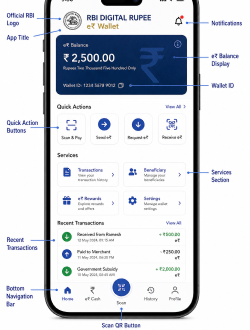
The Digital Rupee is India’s official CBDC, issued and legally guaranteed directly by the RBI. It represents a digital form of sovereign paper currency and holds the exact same monetary value as physical banknotes and coins.
Unlike decentralized cryptocurrencies (such as Bitcoin), which are highly volatile and lack regulatory backing, the Digital Rupee is official legal tender. It sits inside secure digital wallets provided by participating commercial banks and non-bank fintech entities. It does not require a traditional bank account structure to settle peer-to-peer (P2P) transfers, effectively acting as digital cash.
2026 Developments & Critical Analytical Corrections
While pilot programs have expanded since late 2022, recent official data highlights a crucial twist in user adoption dynamics that requires a direct, analytical correction to overly optimistic projections:
Data Correction & Context: According to the RBI’s annual data, retail e-rupee circulation fell to 7.71 billion rupees, down from 10.16 billion rupees a year earlier. This decline underlines a significant hurdle: because Indian consumers already enjoy an incredibly frictionless experience via UPI, getting the general public to switch to a standalone CBDC wallet requires distinct, visible advantages.
To overcome this hurdle, the RBI and central policymakers are pivoting away from generic peer-to-peer retail transactions and focusing heavily on specialized, structural use cases:
1. Targeted Welfare and Programmatic Subsidies
The true superpower of the Digital Rupee lies in its programmability. The RBI has actively piloted targeted direct benefit transfers (DBT) across regions like Gujarat, Puducherry, and Chandigarh. By embedding conditional parameters into the currency tokens, government agencies ensure that welfare funds can only be spent on designated goods—such as agricultural inputs, healthcare services, or specific food items. This programmatic locking mechanism drastically reduces systemic leakages, eliminates intermediate fraud, and guarantees fiscal funds serve their exact intended purpose.
2. Next-Gen Cross-Border Capabilities
International money transfers have historically suffered from steep intermediary fees and multi-day settlement delays. The RBI has actively entered into digital asset agreements and bilateral discussions with international regulators—including the Monetary Authority of Singapore and financial authorities in the United Arab Emirates (UAE). By testing cross-border CBDC interoperability and participating in multilateral initiatives led by the Bank for International Settlements (BIS), India aims to significantly compress international transaction costs and insulate cross-border trade from foreign exchange settlement risks.
3. Fintech Innovation and Sandbox Testing
To foster an active ecosystem, the RBI opened infrastructure access to innovative fintech players (including non-bank entities like CRED and MobiKwik). Developers are designing smart contract-enabled financial services, supply-chain automation tools, and conditional business escrow systems built entirely on top of the native e₹ layer. Furthermore, heavy emphasis is being placed on offline digital payments, allowing consumers in remote rural locations with poor internet connectivity to conduct secure transactions.
Digital Rupee vs. UPI: Key Architectural Differences
| Attribute | Unified Payments Interface (UPI) | Digital Rupee (e₹) |
| Core Nature | A payment protocol/channel | Legal tender (Digital Cash) |
| Settlement Layer | Interbank transfer (Commercial bank to commercial bank) | Direct liability of the Reserve Bank of India |
| Intermediaries | Requires active bank account and clearinghouses | Settlement occurs directly between wallets |
| Programmability | Standard transactional limits | Can be restricted to specific purposes/merchants |
| Offline Usage | Highly dependent on internet connectivity | Designed with native offline cryptographic capabilities |
The Road Ahead for India’s Digital Cash
The evolution of the Digital Rupee highlights that its destiny is not to replace cash or overshadow UPI, but to act as a specialized financial instrument. Over the coming years, its success will depend on bridging the digital divide through localized education, robust defensive measures against emerging cybersecurity threats, and the widespread rollout of merchant payment systems that smoothly bridge UPI and CBDC networks under unified QR codes.
Related External Resources
For more details on national regional reporting, news updates, and regional policy coverage in English, visit Matribhumi Samachar English.