

New Delhi. Saturday, 13 June 2026
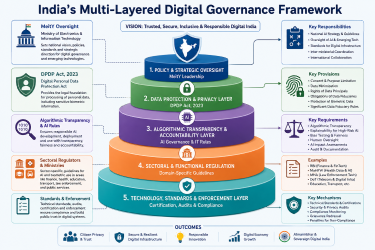
The Government of India is shifting its regulatory stance from passive observation to active oversight regarding artificial intelligence (AI) and biometric technologies. Driven by the Ministry of Electronics and Information Technology (MeitY), the upcoming governance framework seeks to strike a delicate balance: safeguarding national technological sovereignty and citizens’ privacy without suffocating the country’s booming tech innovation ecosystem.
As AI applications saturate critical sectors—from healthcare and finance to public administration—and biometrics (like facial recognition and iris scanning) power national identity infrastructure, policymakers are establishing clear, enforceable guardrails.
The Driving Force: Privacy, Deepfakes, and National Security
The push for tighter regulation is fueled by a mix of data security concerns and emerging societal threats. Under existing frameworks like the Digital Personal Data Protection (DPDP) Act, biometric data is already classified as sensitive personal data. However, the rapid evolution of generative AI has created new regulatory blind spots.
       ┌────────────────────────────────────────────────────────┐
       │      MeitY AI & Biometric Governance Pillars          │
       └───────────────────────────┬────────────────────────────┘
                                   │
         ┌─────────────────────────┼─────────────────────────┐
         ▼                         ▼                         ▼
┌─────────────────┐       ┌─────────────────┐       ┌─────────────────┐
│  Data Privacy   │       │ Trust & Safety  │       │  Sovereignty    │
│  (DPDP Act &    │       │ (Deepfake laws, │       │ (Hardware, chips│
│   Biometrics)   │       │  Watermarking)  │       │  Supply Chains) │
└─────────────────┘       └─────────────────┘       └─────────────────┘
1. Safeguarding Biometric Infrastructure
With fingerprint and facial recognition heavily integrated into both public services (like Aadhaar-enabled systems) and private fintech applications, unauthorized data collection and device vulnerabilities pose massive national security risks. MeitY’s upcoming rules will enforce stricter security standards for hardware manufacturers and data processors.
2. Combating Generative AI Risks
Misinformation campaigns, synthetic media, and deepfake-driven financial fraud have forced the government’s hand. Future regulations are expected to mandate that companies explicitly label and watermark AI-generated content, especially in sectors where public trust is paramount.
3. Securing the Hardware Supply Chain
India’s regulatory vision extends beyond software. In tandem with the nation’s multi-billion dollar push into domestic semiconductor manufacturing, authorities want complete visibility over the hardware anchoring critical digital infrastructure, reducing reliance on volatile external supply chains.
What This Means for Businesses: The Compliance Checklist
Organizations developing or deploying AI and biometric systems within India must transition from voluntary ethical guidelines to mandatory compliance. The core pillars of the upcoming compliance framework include:
Consent & Data Management: Explicit, verifiable user consent mechanisms for gathering and processing any biometric data.
Algorithmic Transparency: The ability to explain AI decision-making processes, particularly in high-impact sectors like banking, hiring, and healthcare.
Mandatory Risk Assessments: Pre-deployment risk audits for “high-risk” AI applications to check for systemic bias or security flaws.
Content Traceability: Deploying robust watermarking and origin-tracking for platforms utilizing generative synthetic media.
The First-Mover Advantage: Industry experts suggest that enterprises investing early in robust data architecture, rigorous cybersecurity protocols, and ethical AI auditing will face significantly fewer operational bottlenecks when these regulations transition into hard law.
A Mirror to Global Tech Policy
India’s strategy aligns with an accelerating global trend toward tech containment. While the European Union has opted for a strict, risk-categorized approach via the EU AI Act, and the United States relies heavily on sector-specific executive orders and voluntary commitments, India is charting a middle path.
The Indian approach leverages comprehensive data privacy legislation (the DPDP framework) alongside targeted MeitY directives to remain agile—allowing the country to protect its citizens while simultaneously pitching itself as a global hub for responsible, trusted AI development.
Relevant Links & Continuous Coverage
For ongoing updates on India’s technological policies, regional legislative updates, and national security briefings, explore the following dedicated sections:
For national policy shifts and legislative updates: Matribhumi Samachar English National News
For corporate impacts and domestic tech industry insights: Matribhumi Samachar English Business and Technology
