

New Delhi. Tuesday, 16 June 2026
For decades, India’s journey into the cosmos was a single-player game. The Indian Space Research Organisation (ISRO) achieved magnificent milestones—from walking on the Moon’s south pole to reaching Mars orbit—almost entirely on its own state-backed steam.
Today, a massive paradigm shift is underway. India’s space economy has officially entered its “New Space” era, transitioning from a government monopoly into a highly competitive, multi-billion-dollar commercial ecosystem. Driven by liberalized policies, advanced 3D-printing technologies, and cutting-edge artificial intelligence, three pivotal players—IN-SPACe, Skyroot Aerospace, and SatSure—are reengineering the regulatory, infrastructure, and downstream data landscapes.
1. IN-SPACe: The Catalyst and Regulatory Bridge
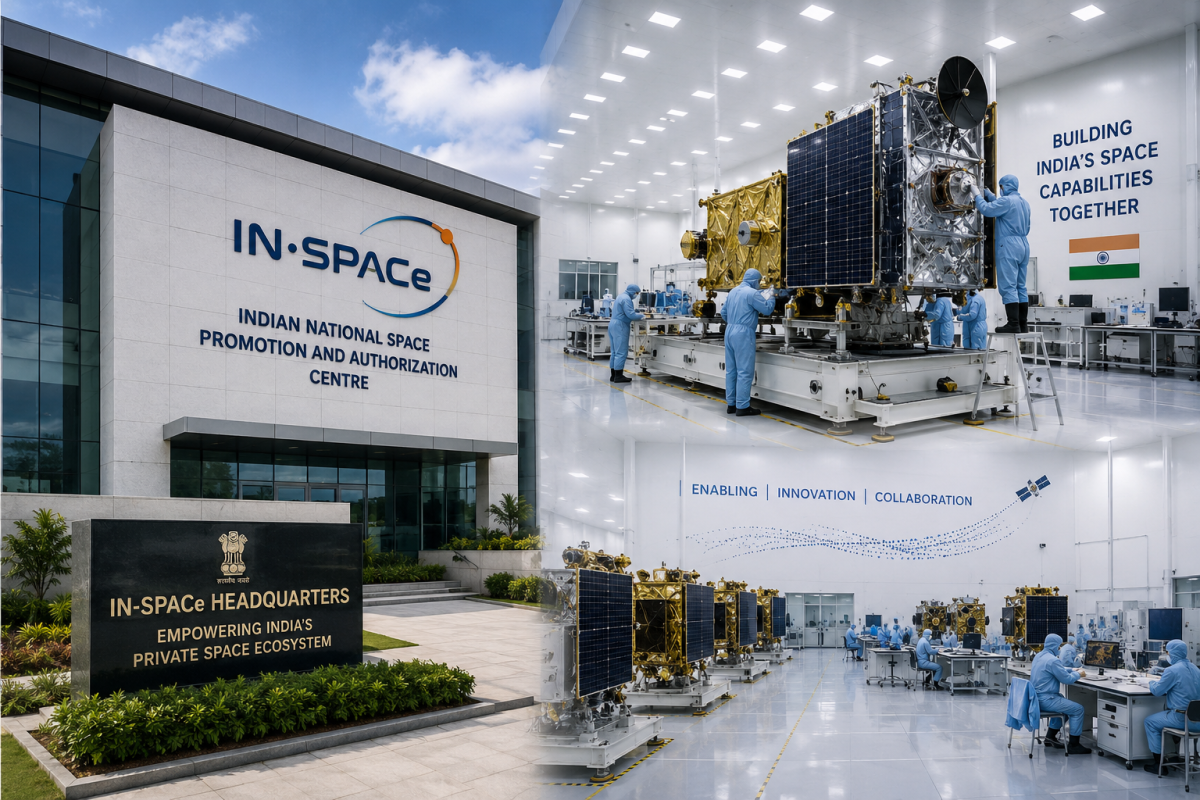
For a private space ecosystem to thrive, companies need more than just money and engineering talent; they need a clear legal path to orbit. This is where the Indian National Space Promotion and Authorization Center (IN-SPACe) steps in.
Acting as an autonomous, single-window nodal agency under the Department of Space, IN-SPACe has successfully dismantled the bureaucratic walls that previously kept private players locked out of state-of-the-art facilities.
Technology Transfer Milestones: Moving aggressively past the milestone of over 100 Technology Transfer Agreements, IN-SPACe has systematically handed over precious ISRO-developed intellectual property—such as space-grade electronics and Small Satellite Launch Vehicle (SSLV) designs—directly to private consortia.
The FDI Fuel Injection: Following the landmark liberalization of India’s Space Foreign Direct Investment (FDI) policy, IN-SPACe has streamlined international capital entry, allowing up to 100% automatic FDI for satellite manufacturing, making Indian space tech startups an incredibly attractive destination for global venture capital.
2. Skyroot Aerospace: Democratizing On-Demand Rocket Launches
If IN-SPACe writes the rules of the game, Skyroot Aerospace builds the heavy infrastructure to play it. Founded by former ISRO scientists, Skyroot captured global attention when its Vikram-S rocket became India’s first privately developed vehicle to breach sub-orbital space.
The company is currently preparing for the highly anticipated commercial launch of its flagship orbital vehicle: Vikram-1.
Advanced Manufacturing at Scale
Skyroot’s competitive edge in the global small-satellite launch market relies heavily on reducing turnaround times and lowering production costs through two major innovations:
Fully 3D-Printed Liquid Engines: By using specialized additive manufacturing, Skyroot prints highly complex engine architectures in days rather than months, slashing the overall parts count and lowering point-of-failure risks.
Carbon Composite Airframes: Replacing traditional heavy metals with lightweight, high-strength carbon fiber composites significantly improves the mass-to-payload ratio, ensuring that small satellites can be shot into precise orbits on demand with maximum efficiency.
3. SatSure: Turning Satellite Imagery into Terrestrial Economic Value
Rockets and launch pads are undeniably captivating, but the bulk of a sustainable space economy lives in the data generated once satellites are securely in orbit. SatSure is a global pioneer in downstream data refinement, proving that space tech has direct, practical solutions for challenges on Earth.
SatSure utilizes advanced artificial intelligence, machine learning, and remote sensing to process immense streams of Earth observation (EO) data.
[Raw Satellite Imagery] ➔ [SatSure AI Refinery] ➔ [Actionable Business Intelligence]
                                                   ├── Precision Agriculture
                                                   ├── Banking Risk Assessment
                                                   └── Climate Infrastructure
Predictive Risk Analytics for Banking and Insurance: SatSure translates satellite imagery into high-fidelity agricultural intelligence. By analyzing soil moisture indices, historic crop performance, and regional weather patterns via AI, banks can evaluate loan risks for remote farmers, and insurance agencies can automatically settle climate-related crop damage claims within days instead of months.
Sovereign Planet-Scale Intelligence: In a massive step forward for domestic capabilities, private consortia including SatSure have partnered with IN-SPACe to develop India’s first dedicated private commercial Earth observation satellite constellation, creating localized foundational AI models specialized in tracking tropical agriculture and monsoon variations.
The Cyclical Architecture of the New Space Economy
The synergy between these three entities creates a self-sustaining commercial loop that functions as a complete value chain:
IN-SPACe establishes the open regulatory sandbox and clears the bureaucratic hurdles.
Skyroot Aerospace builds the modular rockets that reliably blast payloads into space.
SatSure processes the data streams harvested by those payloads, injecting immediate tangible economic value back into banking, climate science, and agriculture.
Frequently Asked Questions (FAQs)
What is the role of IN-SPACe in India’s space sector?
IN-SPACe acts as a single-window, independent regulatory body that facilitates, promotes, and authorizes private sector companies to carry out space activities in India. It bridges the gap between state-owned ISRO infrastructure and commercial startups.
How does Skyroot Aerospace minimize rocket manufacturing costs?
Skyroot uses advanced additive manufacturing to 3D-print its liquid-fueled rocket engines, which reduces assembly time and part complexity. Additionally, they use ultra-lightweight carbon composite structures instead of heavy conventional metals to increase fuel efficiency and payload capacity.
What industries benefit most from SatSure’s space data analytics?
SatSure’s AI-driven geospatial data solutions primarily empower the banking, financial services, insurance (BFSI), agriculture, infrastructure, and climate risk management sectors by providing real-time, actionable insights from satellite imagery.
Can foreign companies invest directly in Indian private space startups?
Yes. India’s liberalized Space FDI policy allows up to 100% foreign direct investment through the automatic route for satellite manufacturing and components, and up to 49% through the automatic route for launch vehicles and spaceports.
Relevant Links
- Infrastructure Financial Milestones: Gain insights into how private launch infrastructure is scaling globally and tracking corporate financial movements in The Physical Layer of Innovation: Analyzing the Surge in Deep-Tech Startup Funding in 2026.
Downstream Orbit and AI Mergers: Explore how geospatial telemetry, Synthetic Aperture Radar (SAR), and space-based compute infrastructure are being deployed to bypass ground-link bottlenecks in The Next Frontier: Scaling Space-Based AI Computing and Orbital Data Infrastructure.
Bilateral Deep-Tech Strategy: Trace the international reach, earth observation analytics discussions, and public-private tech delegations between India and global partners via Global Tech Powerhouse: How Bharat Innovates 2026 is Uniting India and France in the Deep-Tech Frontier.
Disclaimer: This article is prepared for informational and educational purposes only. The space technology sector involves rapid changes, high-stakes engineering risks, and evolving regulatory environments. Readers planning investments or business ventures in space technology should conduct independent due diligence and consult specialized financial and legal experts.
