

Mumbai. Tuesday, 16 June 2026
Imagine a world where cutting-edge Artificial Intelligence (AI) isn’t just locked away in the high-tech vaults of Silicon Valley monopolies, but is as accessible, affordable, and everyday as scanning a QR code to buy a cup of tea.
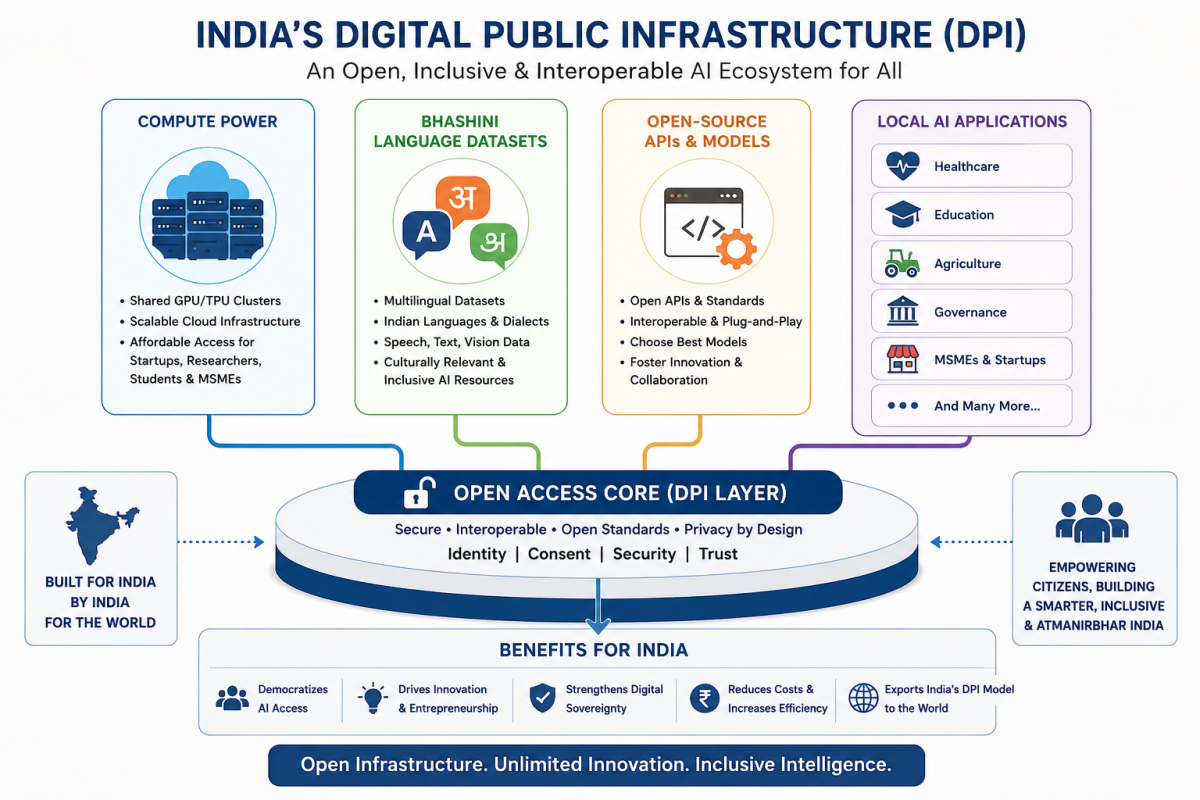
That is exactly the future India is building. By taking the open-source philosophy that turned the Unified Payments Interface (UPI) into a global fintech phenomenon, India is pioneering a UPI-style model for AI. This groundbreaking blueprint reimagines AI not as a centralized corporate luxury, but as a shared, open-source Digital Public Infrastructure (DPI) designed to lift up startups, researchers, and everyday citizens alike.
The Master Blueprint: How Do You Apply UPI Principles to AI?
When UPI rolled out, it didn’t build a single mega-app to rule them all. Instead, it built a shared highway—an interoperable framework that allowed banks, fintech startups, and street vendors to instantly talk to each other.
Applying this exact logic to artificial intelligence means shifting the focus from proprietary, closed ecosystems to a foundational, democratic layer. A UPI-style AI framework focuses on making four core pillars publicly accessible:
1. Democratizing Massive Compute Capacity
Building modern Large Language Models (LLMs) requires immense computational horsepower, usually in the form of thousands of specialized Graphics Processing Units (GPUs). This hardware is staggeringly expensive, cutting bootstrapping startups out of the race. Through the national IndiaAI Mission, the government aims to establish a public-private cloud computing infrastructure, lowering the barrier to entry for local developers.
2. The Power of Open Datasets
AI is only as smart as the data it consumes. To ensure local relevance, India is curating massive, diverse, and ethically sourced public data repositories. This includes non-personal governance data, agricultural patterns, health trends, and localized scientific datasets made safely available for public innovation.
3. Overcoming the Language Barrier with Bhashini
Most global foundational AI models are overwhelmingly trained on English and Western-centric data. India’s crown jewel in language localization is Bhashini, an AI-led language translation platform. By creating open-source datasets across India’s hundreds of regional languages and dialects, Bhashini allows a developer in a small town to build an AI app that a regional farmer can seamlessly speak to in their native tongue.
4. Interoperable APIs and Open Standards
Rather than letting a single tech giant dictate the rules of AI integration, a UPI-style model uses standardized Application Programming Interfaces (APIs). This allows different specialized AI systems—say, a healthcare diagnostic AI and an administrative hospital AI—to seamlessly plug into one another without friction.
Why This Open Framework is a Game-Changer for India
Igniting Grassroots Innovation: Instead of spending millions of dollars building fundamental compute infrastructure from scratch, entrepreneurs can dive straight into solving real-world problems in agriculture, education, and rural healthcare.
Securing Digital Sovereignty: Relying entirely on foreign, closed-source foundational models poses massive long-term risks to national data privacy and technological independence. Building native sovereign AI ensures India keeps its keys to its own digital future.
True Digital Inclusion: By prioritizing regional data and local linguistic nuances, this framework ensures that AI tools bridge the digital divide rather than widening it, empowering populations that standard technology often leaves behind.
Navigating the Roadblocks Ahead
The vision is undeniably bold, but building an open AI infrastructure comes with steep hurdles. Managing global hardware shortages to secure advanced GPUs is a constant logistical climb. Furthermore, open ecosystems must be guarded with ironclad data privacy frameworks, ethical guidelines, and robust content moderation to prevent the weaponization of deepfakes, algorithmic biases, and misinformation. Striking the balance between rapid innovation and strict consumer safety will be the ultimate test for policymakers.
Frequently Asked Questions (FAQ)
What exactly is a “UPI-style model for AI”?
It refers to building artificial intelligence as a Digital Public Infrastructure (DPI). Instead of AI being controlled exclusively by private technology monopolies, the government and public partnerships provide the foundational tools—like compute power, open-source models, localized language datasets, and APIs—so anyone can build affordable AI solutions on top of it.
How does the Bhashini initiative fit into India’s AI vision?
Bhashini is India’s national AI-driven language translation platform. It solves a crucial challenge by collecting and open-sourcing data for diverse Indian languages, allowing developers to create inclusive AI applications that break down severe linguistic barriers.
What is the IndiaAI Mission?
The IndiaAI Mission is a comprehensive national initiative designed to bolster India’s AI ecosystem. Its core goals include establishing massive public compute capacity (GPU clusters), funding local AI startups, creating open data platforms, and fostering ethical AI research across the country.
Disclaimer
The information provided in this article is for educational and informational purposes only. While every effort has been made to ensure accuracy based on the latest developments in technological policy and Digital Public Infrastructure (DPI) initiatives, readers are encouraged to consult official government whitepapers and formal releases from the Ministry of Electronics and Information Technology (MeitY) for real-time policy updates.
Visit official website directly at Matribhumi Samachar (English Edition) and utilizing their internal search bar with the terms “UPI-style AI”, “Bhashini”, or “IndiaAI Mission” to discover latest localized news stories, regional interviews, and editorial features on this topic.
