

New Delhi. Monday, 15 June 2026
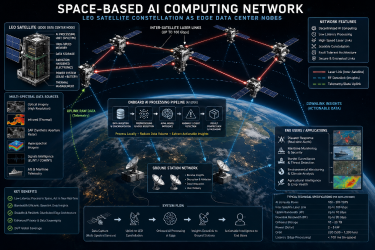
The boundaries of modern digital transformation are rapidly shifting away from Earth’s surface. As terrestrial facilities collide with an “energy wall”—where high-density processing strains regional power grids and freshwater cooling resources—the technology sector is engineering an alternative framework: Space-Based AI Computing.
By establishing high-performance data processing clusters, storage arrays, and autonomous intelligence directly in Earth’s orbit, this architectural paradigm eliminates the classic bottlenecks of extreme downlinking latency and terrestrial resource depletion.
Transitioning Beyond “Chatbots” to Off-Planet Hardware
A common misconception is that AI infrastructure remains a software-bound asset confined to terrestrial hyper-scalers. In reality, the industry has graduated from simple generative models to deep, physical execution layers. Traditional server farms are actively being reimagined as hyper-dense “AI Factories” operating in extreme orbital environments.
Rather than relying on distant terrestrial cloud networks, next-generation orbital platforms leverage custom-engineered hardware to process unstructured multi-spectral telemetry on-site. For instance, edge advancements—including the successful validation of localized, high-efficiency processors like the Netrasemi 12nm A2000 Edge AI Chip—demonstrate how modern silicon layouts allow compact architectures to execute complex matrix variations locally without a continuous, power-heavy cloud link.
Core Pillars of the Space AI Architecture
The realization of decentralized supercomputing above the atmosphere depends on an integrated framework of high-tech developments:
The functional routing of data through an orbital cluster bypasses traditional constraints via a streamlined, four-stage workflow:
Overcoming Space-Grade Engineering Constraints
Running continuous deep learning loops in the vacuum of space introduces physics constraints that traditional data center architectures never encounter.
| Engineering Bottleneck | Operational Risk to Space AI | Next-Generation Solutions |
| Thermal Dissipation | Convective air cooling is impossible in a vacuum. Continuous matrix calculations generate extreme heat that can destroy silicon nodes. | Direct-to-chip microfluidic liquid cooling loops combined with expansive infrared radiator panels designed to reject heat via thermal radiation. |
| Radiation Alterations | Cosmic rays and solar particles cause single-event upsets, resulting in devastating bit flips within active AI weights. | Hybrid hardware redundancy paired with software-level fault tolerance, ensuring automated recovery loops catch data errors in real time. |
| Power Scaling | Traditional solar panels lack the surface power density required to fuel high-density tensor processing arrays continuously. | Rollable, high-efficiency flexible solar blanket matrices deployed alongside custom power management modules designed for heavy parallel workloads. |
India’s Strategic Position in the Global Orbital Tech Race
India is uniquely positioned to bridge its massive software capability with physical hardware sovereignty. As highlighted in recent deep-tech expansions like The Hardware Boom and AI Data Center Growth, the country is rapidly setting up the underlying foundational infrastructure required to scale high-density processing networks.
Through the unified momentum of the IndiaAI Mission and the industrial pipelines of the India Semiconductor Mission (ISM 2.0), the subcontinent is moving past consumption toward true architectural self-determination. This strategic pivot was explicitly showcased internationally, with India taking center stage as a deep-tech pioneer during the Bharat Innovates tech diplomacy initiative. By developing localized, space-hardened edge architectures, domestic space-tech enterprises are paving the way for real-time applications—spanning highly accurate monsoon prediction models, precise border domain awareness, and autonomous agricultural assessment frameworks integrated directly into the nation’s foundational Digital Public Infrastructure (DPI).
The Regulatory and Governance Horizon
As intelligence moves beyond sovereign borders into low Earth orbit, it intersects with a highly fragmented regulatory landscape. As evaluated in the strategic map of Global AI Governance and Techno-Legal Frameworks, international policy bodies are struggling with data sovereignty conundrums.
When data centers operate above the atmosphere, defining which local jurisdiction governs an automated decision or an analytical logging sequence presents an evolving legal frontier. Ensuring data integrity, absolute system transparency, and strict human oversight over high-stakes space assets remains a critical focus for global policymakers heading into the next decade.
