

Mumbai. Friday, 19 June 2026
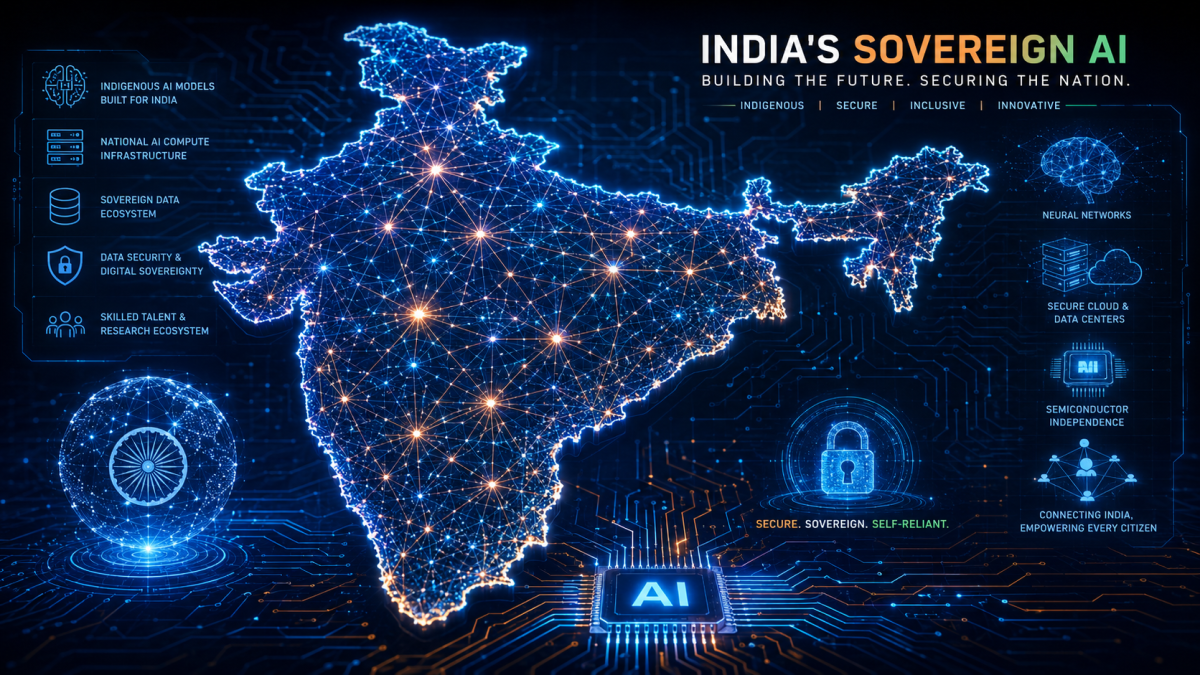
Artificial Intelligence has officially evolved past software, code, and chat interfaces. Building out local systems is no longer an optional upgrade; it is an urgent economic and strategic priority for the Indian subcontinent. To establish true digital independence, India is heavily investing in Sovereign AI—a comprehensive framework aimed at developing, deploying, and controlling critical technology infrastructure without relying excessively on foreign entities.
By treating AI as a foundational utility—similar to electricity and telecommunications—the country is ensuring its economic growth, cultural nuances, and data security remain entirely under domestic oversight.
What is Sovereign AI and Why Does It Matter?
Sovereign AI refers to a nation’s independent capability to build, train, and operate state-of-the-art AI systems using its own domestic resources. Rather than adopting technological isolation, the goal is to maintain absolute strategic control over critical data and computational pathways.
The strategy rests firmly on five distinct pillars:
Proprietary Data: Leveraging local datasets safely within national boundaries.
Computing Infrastructure: Powering development via local high-performance data centers.
Indigenous AI Models: Developing intellectual property tailored to regional problems.
Governance Frameworks: Designing regulatory controls that foster “innovation over restraint.”
Skilled Workforce: Growing a specialized talent pool directly within domestic academic hubs.
The Pillars of India’s Independent AI Strategy
India’s rapid transformation from a global software outsourcing hub to a primary developer of physical deep-tech architecture relies heavily on specific public-private partnerships.
1. The IndiaAI Mission and Massive Compute Scales
Backed by a state allocation of over ₹10,000 crore, the government’s flagship IndiaAI Mission targets the severe structural bottlenecks historically faced by local developers. The primary focus is establishing massive public supercomputing infrastructure. Currently, India manages over 38,000 operational GPUs across public and private enterprises, with active state procurement pipelines designed to add another 25,000 chips. This democratizes high-performance computing (HPC) environments for resource-constrained startups and university research labs.
To explore this hardware scale further, read Sovereign Scale: Inside India’s Trillion-Rupee AI Infrastructure Revolution.
2. Breaking the Language Barrier with BHASHINI
Standard international Large Language Models (LLMs) suffer from high token fragmentation when processing non-Latin scripts, making API deployment expensive and slow for Indic languages. India’s strategy treats linguistic diversity as an architectural priority rather than a translation afterthought.
Through BHASHINI, an open-access public language platform, the Ministry of Electronics and Information Technology (MeitY) provides centralized APIs for speech recognition and machine translation across regional dialects.
To see how these localized language models are deployed at scale, read Breaking the Language Barrier: Inside India’s Revolutionary Multilingual AI Framework.
3. Merging AI with Digital Public Infrastructure (DPI)
India is executing a unique “UPI-style” model for artificial intelligence. Instead of locking advanced machine learning tools behind the proprietary walls of private corporate monopolies, foundational elements like compute subsidies, open datasets via repositories like AIKosh, and interoperable APIs are offered as public utilities. This setup allows developers in small towns to build highly affordable local solutions for healthcare triage, personalized education, and digital banking access.
For an inside look at this open-access blueprint, check out Shaping the Future: Inside India’s Revolutionary UPI-Style Model for AI.
Overcoming Structural and Hardware Challenges
The shift toward complete self-reliance comes with distinct engineering and logistical hurdles:
Semiconductor Node Dependencies: While domestic chip packaging and edge-AI designs are accelerating quickly, India still relies heavily on importing advanced semiconductor nodes.
Grid Capacity: High-density, AI-focused data centers demand continuous, massive loads of electricity, driving a push toward sustainable hubs like the renewable energy-powered facilities in Jamnagar.
Data Scarcity for Niche Sectors: AI models inherit systematic biases if trained exclusively on foreign profiles. Gathering highly localized data for agricultural, geological, and clinical fields remains a critical priority.
Despite these challenges, India’s focused efforts have positioned it prominently on the international tech stage, highlighted by its role as the Official AI Partner Country at VivaTech in Paris, showcasing its ethical, population-scale software systems.
Frequently Asked Questions (FAQs)
What is the main objective of the IndiaAI Mission?
The IndiaAI Mission is a comprehensive national initiative designed to bolster India’s AI ecosystem. Its primary goals include establishing massive public compute capacity (GPU clusters), funding local deep-tech startups, creating open data platforms like AIKosh, and fostering ethical, responsible AI research across the country.
How does the BHASHINI initiative support sovereign AI in India?
BHASHINI serves as the open-access linguistic infrastructure layer for India. By collecting and open-sourcing data across India’s numerous regional languages and dialects, it allows local developers to build inclusive, voice-first applications that dismantle traditional literacy and cognitive barriers for rural citizens.
Why is localized data infrastructure crucial for national security?
Sovereign compute capabilities ensure that sensitive strategic data—such as public healthcare registries, agricultural yields, and defensive networks—remains entirely under domestic regulatory oversight. This decouples vital infrastructure from foreign cloud dependencies and protects the domestic economy from unexpected overseas supply chain blockades.
Disclaimer
The information provided in this article is for educational and informational purposes only. Technological roadmaps, government budgetary allocations, and infrastructure statistics are subject to change based on updated policy frameworks, market conditions, and official state releases.
